In 1934 Marc Chagall spent a summer on this bay and called it his blue paradise. More than ninety years on, the water is still exactly that colour.
Tossa de Mar is a small seaside town on the southern Costa Brava, about 100 km north of Barcelona and a short hop along the coast from Lloret de Mar. What sets it apart is the Vila Vella, a walled old town set on a headland above the main beach. Around it lie sandy beaches, turquoise coves, pine-covered hills and one of the prettiest stretches of coastal path in Catalonia. In this article we cover the best things to do in Tossa de Mar, from the castle walls and the lighthouse to boat trips, coves, local food and easy day trips, plus practical tips on getting there and where to stay.
💰 Tarull - A small family-run hotel five minutes from the beach, with a panoramic sun terrace over the old town.
🏨 Hotel Diana - A four-star boutique hotel in a Modernista building on the seafront at the foot of the old town.
💎 Elisabeth by the Sea Hotel - A five-star beachfront hotel in a 1930s building, with a rooftop pool and spa.
Explore Vila Vella, the walled old town
Start where the town itself started. The Vila Vella (Old Town) is a cluster of medieval streets wrapped in stone walls built between the 12th and 14th centuries to keep out pirates. Today it’s the only surviving fortified medieval town on the Catalan coast, and it was declared a National Historic-Artistic Monument in 1931. That status saved it from the hotel boom of the 1960s, which swallowed similar villages further along the coast.
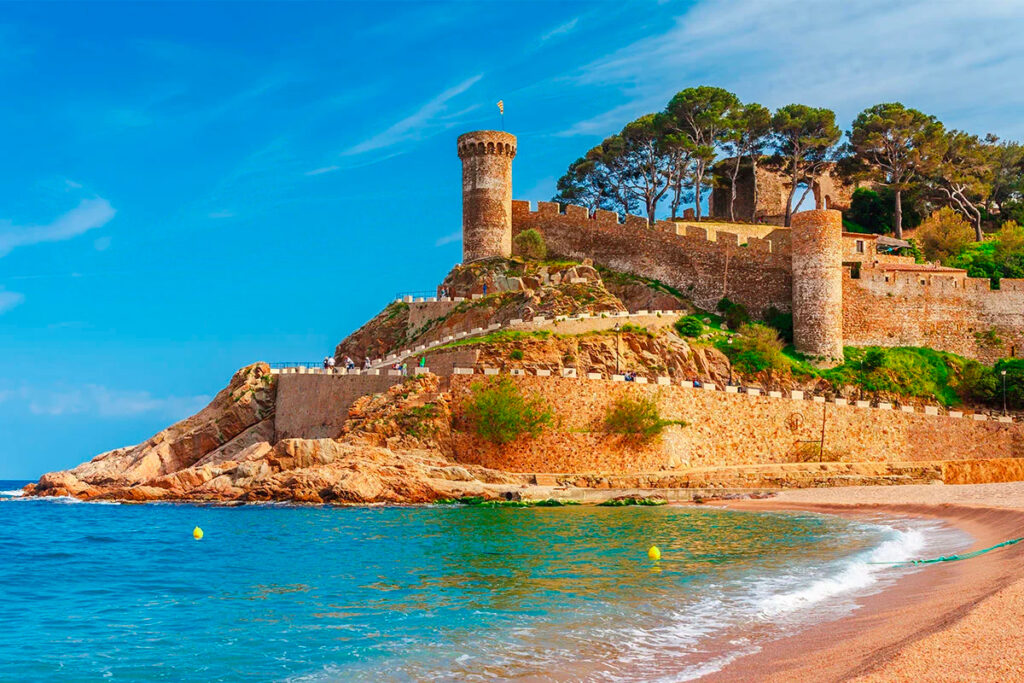
You enter through the Torre de les Hores, a tower named after the clock that once hung on it. Inside, cobbled streets climb past old stone houses, bougainvillea and tiny squares. The walls are punctuated by round and square towers, and you can walk sections of the ramparts for sea views in both directions. Access is free and the old town is open at any hour, so it’s worth coming back after dark, when the walls are lit up and the day-trippers have gone.
Give yourself time to wander rather than rush to the top. Look out for the Gothic ruins of the old church of Sant Vicenç, which stands roofless inside the walls, and the narrow passage that leads down to the little beach of El Codolar on the other side.
Walk up to the lighthouse and the Ava Gardner statue
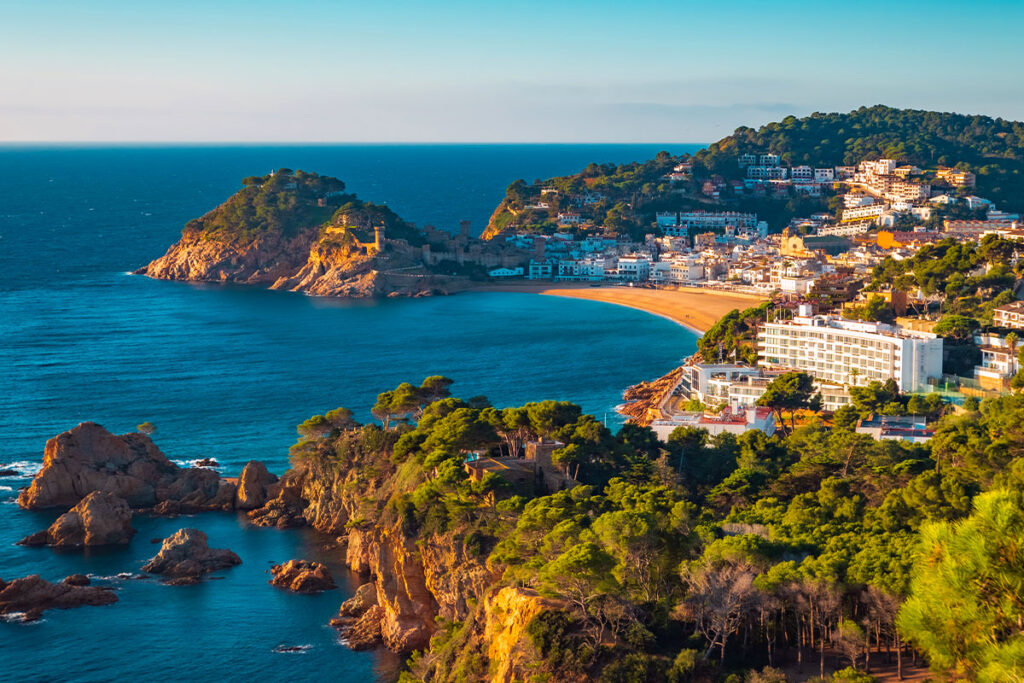
The highest point of the headland was once crowned by the medieval castle of the abbots of Ripoll, the lords of medieval Tossa. In 1917 a lighthouse was built on its site, and it still guides ships today. The path up is short but steep, and the reward is a sweeping view of Platja Gran, the town and the wooded hills behind it. Come in the late afternoon, when the light turns the walls golden.
On the way up you’ll pass a bronze statue of Ava Gardner. The Hollywood star spent the summer of 1950 here filming Pandora and the Flying Dutchman, released in 1951, and the town has never forgotten it. The statue looks out over the bay, and it’s one of the most photographed spots in Tossa. Many locals will tell you that the film put Tossa de Mar on the map.
Visit the municipal museum and Chagall’s Celestial Violinist
Inside the walls, the Museu Municipal (Municipal Museum) occupies a Gothic house that once belonged to the governor who ruled the town on behalf of the abbots. It opened in 1935, at a time when Tossa was a magnet for artists. Painters such as Marc Chagall, André Masson and Olga Sacharoff spent their summers here in the 1930s.
The star exhibit is Chagall’s Celestial Violinist, painted in 1934, which shows a violinist floating above the town walls. It’s a rare chance to see an original Chagall on the Costa Brava. Downstairs, the archaeology rooms display finds and mosaics from the Roman villa just outside the old town, so the museum is a good warm-up for the next stop.
See the Roman villa of Els Ametllers
Long before the walls went up, the Romans were farming this valley. The remains of the Vil·la Romana dels Ametllers (Roman Villa of the Almond Trees) lie a few minutes’ walk from the beach. The villa was lived in from the 1st century BC to around the 6th century AD, and it was the heart of an estate that covered much of today’s municipality.
You can still make out the baths, the living quarters and the outline of the pool. A mosaic found here names the place Turissa, the Roman ancestor of the name Tossa. It’s a quick visit, but it adds real depth to the story of the town.
Relax on Platja Gran, the main beach, and the town coves
Platja Gran is the main beach, a curve of golden sand roughly 400 metres long that runs right up to the foot of the walls. Fishing boats are still pulled up on the sand at the castle end, and the promenade behind is lined with cafés. The sand is coarse rather than powdery, which keeps the water beautifully clear. In July and August, arrive before 10am if you want a good spot near the walls.
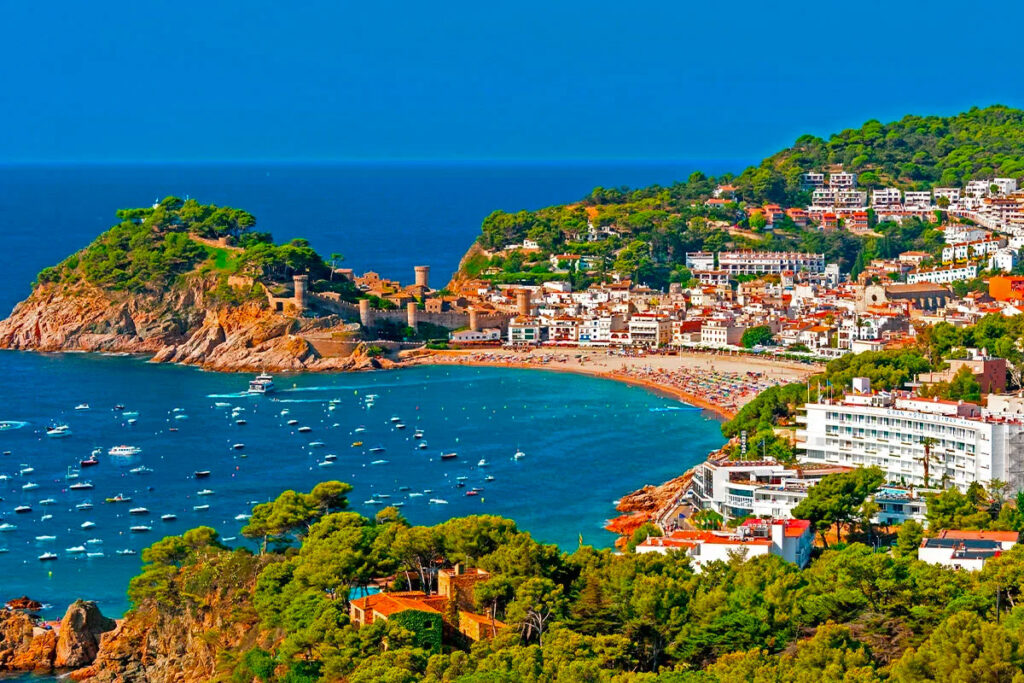
On the other side of the bay, La Mar Menuda is a smaller, calmer beach with rock pools at one end. It’s a favourite with families and with divers, who set off from here to explore the reefs offshore. For something quieter, El Codolar is a small rocky cove behind the walls of the old town. It feels a world away from the main beach, even though it’s only a few minutes’ walk.
Hike the Camí de Ronda to Cala Bona, Cala Pola and Cala Giverola
The Camí de Ronda is the old coastal path once used by fishermen and coastguards, and it’s one of the best things to do in Tossa de Mar if you enjoy walking. It’s waymarked as part of the GR 92, the long-distance trail that follows the Catalan coast. The path follows a rugged coastline, climbing over rocky headlands, dipping through pine forests and dropping down to secluded beaches you can’t reach by car.
Heading north, the path leads to Cala Bona, a sheltered cove that’s ideal for snorkelling, then on to Cala Pola and Cala Giverola. Cala Pola is a sandy cove popular with families and has a campsite nearby. Cala Giverola, about 5 km from the town, is the largest of the coves and is surrounded by dramatic cliffs and pine trees. Heading south, the trail runs towards Lloret de Mar, past quiet coves and viewpoints high above the sea.
Wear proper shoes, as some stretches are steep and rocky, and carry plenty of water in summer. Nature lovers should come in spring or autumn, when the paths are quieter and the temperatures kinder.
Go kayaking, snorkelling or diving in the coves
The rocky reefs around Tossa are full of life, and the turquoise waters are some of the clearest on the Costa Brava. A guided kayaking tour is the easiest way to reach sea caves and coves that the walking path skips. Most tours include a stop for snorkelling, so you can see the marine life up close.
If you’ve always wanted to try scuba diving, Tossa is a great place to start. Several local dive centres run beginner sessions from La Mar Menuda, where you learn the basics with an instructor before heading out to the reef. Experienced divers can join boat dives to deeper sites along the coast.
Take a boat trip along the Costa Brava
Seeing the coast from the water gives you a completely different perspective on the walls and the cliffs. In summer, glass-bottomed boats leave from Platja Gran for short trips to the northern coves. A popular option is the coastal ferry between Tossa de Mar and Lloret de Mar, which lets you combine both towns in a single day.
The boat trip is also a good choice if you’re travelling with children or don’t fancy the steep parts of the coastal path. You’ll pass sea caves, rock arches and tiny beaches, and the view of the old town as you sail back into the bay is hard to beat.
Head inland into the hills
Behind the town, the Ardenya-Cadiretes massif rises in a tangle of cork oaks and pine forests. It’s a good area for outdoor activities such as mountain biking, with hiking trails leading to old chapels, prehistoric sites and viewpoints over the whole coastline. If you’d rather not do the climbing yourself, a vintage 4×4 tour takes you along the forest tracks to lookouts above Tossa de Mar and the neighbouring coves.
The hinterland is also where you’ll find the real countryside of the Costa Brava. Small farms, quiet roads and old stone houses make a welcome contrast to the busy seafront in high season.
Taste the local food
Tossa’s cooking is rooted in the sea and in classic Catalan cuisine. The signature dish is cim i tomba, a hearty stew of fish and potatoes topped with allioli (garlic mayonnaise), which you’ll find in traditional restaurants across town. Fideuà, a seafood dish similar to paella but made with short noodles, is also widely served here.
Many restaurants line the streets around the old town and the promenade, and the best ones serve fresh fish caught that morning. Round off your meal with crema catalana, a custard dessert with a crisp caramelised top. In the evening, grab a few tapas and a glass of Empordà wine on a terrace with sea views. That’s about as good as a Costa Brava evening gets.
Day trips to Lloret de Mar, Girona and Figueres
Tossa de Mar makes a relaxed base for exploring the province of Girona. The city of Girona is under an hour away by car, with its colourful houses on the River Onyar, an imposing cathedral and a beautifully preserved Jewish quarter. Further north, Figueres is home to the surreal Dalí Theatre-Museum, one of the most visited museums in Spain.
The medieval village of Besalú, famous for its fortified Romanesque bridge, pairs well with Figueres in a single day. Closer to home, Lloret de Mar offers a livelier scene, with big beaches, gardens and nightlife. If you’re staying in Barcelona, you can also do it the other way round and visit Tossa on a day trip from the city.
How to get to Tossa de Mar
There’s no train station in Tossa de Mar, so most visitors arrive by bus or car. Direct buses run from Barcelona’s Estació del Nord, and the journey takes 75-90 minutes. You can also take a train from Barcelona to Blanes and continue by local bus. Compare times and book tickets in advance on Omio.
The nearest airport is Girona-Costa Brava, about 40 km away, which is served by low-cost flights from the UK. Barcelona-El Prat is around 100 km away and has far more connections. If you plan to explore the coves and inland villages, car hire gives you the most freedom. The coastal road from Lloret de Mar is full of bends, so take it slowly and enjoy the views. Spaces in the centre fill up quickly in summer, so use the car parks on the edge of town.
When to visit Tossa de Mar
The beach season runs from June to September, and in July temperatures regularly reach 30°C. August is the busiest month, when families from Spain and the rest of Europe fill the town. For the best balance of warm weather and space on the sand, visit in May, June or September. The sea is still warm in September, and hotel rates drop after the summer peak.
From October to April the town is much quieter, with temperatures between roughly 10°C and 20°C. Some restaurants and hotels close for the winter, but the old town, the museum and the coastal paths are at their most peaceful. Book your accommodation well ahead for July and August, as the best hotels sell out early.
See available places to stay in Tossa de Mar
Is Tossa de Mar worth visiting?
Absolutely. Tossa de Mar combines a genuine medieval old town, a rich history and beautiful beaches, which is rare on this stretch of coast. Compared with Lloret de Mar, it’s smaller, calmer and more picturesque. Lloret is the better choice for nightlife, while Tossa suits couples, families and anyone who prefers a relaxed vibe to clubbing.
The town is compact and easily walkable, so you won’t need a car to get around. One full day is enough to see the old town, the lighthouse and the main beach. With two or three days, you can add the Camí de Ronda, a boat trip and a day trip inland. If you’re wondering what the top things to do in Tossa de Mar are, start with the walls, the coves and a long lunch by the sea.
Hotels in Tossa de Mar
Tossa de Mar has a good mix of family-run hotels and stylish seafront addresses. Staying close to the old town and the main beach means everything is within easy walking distance, including restaurants, the bus station and the start of the coastal path.
💰 Tarull
A small family-run hotel in a quiet street about five minutes’ walk from the beach and the walls of the old town. Its sun terrace has panoramic views over the rooftops, the castle and the sea, and guests often praise the warm welcome from the owners. Rooms are simple but comfortable, with private bathrooms, and there’s a bar-café and private parking. Good value with a homely atmosphere.
🏨 Hotel Diana
A four-star boutique hotel in a Modernista building with more than a century of history, right on the seafront at the foot of the old town. Its period architecture gives it a character you won’t find in the big resort hotels. There’s a sea-view terrace and the beach is just across the promenade. Ideal for couples who want somewhere with personality and an unbeatable location.
💎 Elisabeth by the Sea Hotel
A five-star hotel in an elegant 1930s building on the beach, a five-minute walk from the walls of the medieval town. The rooftop pool looks out over the Mediterranean Sea, and the spa has a hammam, sauna and solarium. There’s also a restaurant and a cocktail bar, ideal for a sundowner. The top pick for a special occasion or a luxury break on the Costa Brava.

