After 144 years of construction, its most famous church has just become the tallest in the world. You’ll need far less time to fall for the city around it.
Barcelona is one of the most visited cities in Europe, and it isn’t hard to see why. The Catalan capital packs Gaudí’s fairy-tale buildings, a medieval old town, sandy city beaches and some of the best food in Spain into a compact, walkable centre. In this article you’ll find the best things to do in Barcelona, from the famous sights to quieter corners locals love. At the end there’s a simple 3-day plan and a few hotel tips, so you can turn the list into a real trip.
Barcelona attractions are grouped in a few distinct areas. The Eixample district holds most of the modernist buildings, the old town (Ciutat Vella) takes in the Gothic Quarter, El Born and La Rambla, and Montjuïc hill rises above the port with museums and gardens. Plan your days by area, and you’ll spend more time sightseeing and less time on the metro.
💰 Hostal Levante Barcelona - A simple, friendly guesthouse in the Gothic Quarter, 100 metres from Plaça Reial.
🏨 H10 Madison - A stylish four-star hotel near the cathedral with a rooftop pool and old town views.
💎 Hotel Ohla Barcelona - A five-star boutique hotel on Via Laietana with a glass-sided rooftop pool.
How many days do you need in Barcelona?
Three days is the sweet spot for a first visit. That’s enough to see the main attractions, wander the old town, spend an afternoon on the beach and catch the sunset from a viewpoint. With two days you can still cover the highlights, but you’ll have to choose between Gaudí’s houses and the museums. Five days or more lets you add a day trip to Montserrat, Girona or the Costa Brava.
Barcelona is a year-round destination. Spring (April to June) and autumn (September and October) bring warm days of around 20-25°C and fewer crowds than July and August. In July and August temperatures often reach 30°C, the beaches are packed, and the most popular attractions sell out days ahead. Whenever you come, book tickets online for the big sights well in advance.
Gaudí’s Barcelona - the best things to do in Barcelona
No other city bears the stamp of one architect the way Barcelona bears Antoni Gaudí’s. Seven of his works, including Park Güell, Casa Batlló, Casa Milà, Casa Vicens and the Nativity facade of the Sagrada Familia, together form a UNESCO World Heritage Site. You could easily spend two full days following his trail, but the four buildings below are the ones most visitors put at the top of their list.
La Sagrada Familia
The basilica of La Sagrada Familia is the number one thing to see in Barcelona and the city’s most visited monument. Construction began in 1882, and Gaudí devoted more than 40 years of his life to it. He knew he would never see it finished. In February 2026 the cross was placed on top of the central Tower of Jesus Christ, which made the Sagrada Familia the tallest church in the world at 172.5 metres.
Inside, the forest of tree-like columns and the stained-glass windows turn sunlight into pools of green, blue, orange and red. Try to visit in the late afternoon, when the western windows set the nave on fire. Work is still going on, so you’ll probably spot cranes, but they don’t spoil the experience. Tickets come in timed slots and often sell out, so book your entry, with or without tower access, as early as you can.
Park Güell
Up on the slopes of Carmel hill, Park Güell was planned in the early 1900s as a luxury housing estate. Only two houses were ever built, and in 1926 the city opened the grounds as a public park. Today the Monumental Zone, with the famous mosaic dragon on the main staircase, the Hypostyle Room and the long serpentine bench, is one of the most popular attractions in Barcelona.
To get in, you’ll need a timed ticket, and morning slots go first. Arrive 10 minutes early and give yourself at least an hour. From the terrace you can see across the city to the sea, with the Sagrada Familia rising above the rooftops. Gaudí lived in one of the two houses for almost 20 years, and it now holds a small museum about his life.
Casa Batlló
On elegant Passeig de Gràcia you’ll find Casa Batlló, a townhouse Gaudí remodelled between 1904 and 1906. Locals call it the House of Bones because of its skeletal balconies and pillars. The rippling roof is often read as the back of the dragon slain by Saint George, the patron saint of Catalonia.
Few visits in the city are as immersive. Rooms flow into each other with barely a straight line in sight, the light well is tiled in shades of blue, and the audio guide uses augmented reality to show how the house looked when the Batlló family lived there. The tour ends on the roof terrace with its colourful chimneys.
Casa Milà (La Pedrera)
A few minutes up the same avenue stands Casa Milà, better known as La Pedrera, which means “the stone quarry”. Gaudí built it between 1906 and 1912 for the Milà family. Its wavy stone facade and wrought iron balconies shocked Barcelona at the time. Today it’s one of the most photographed buildings in the city.
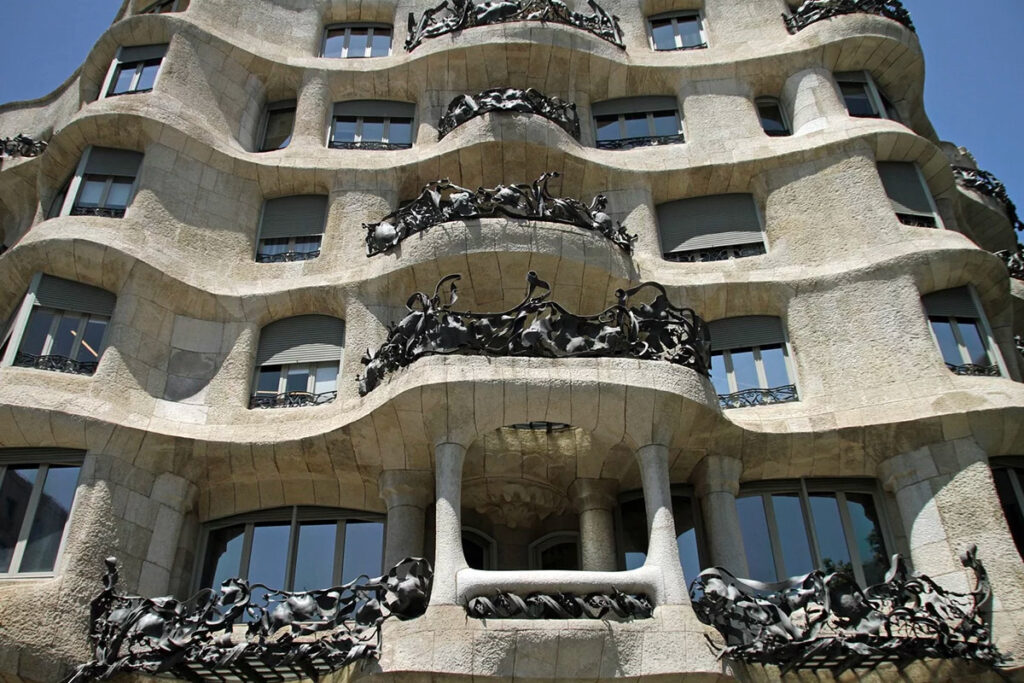
Don’t miss the rooftop, where chimneys shaped like helmeted warriors stand guard over the city. The attic, with its 270 brick arches, hosts an exhibition about Gaudí’s methods, and one of the flats is furnished as it was in the 1920s. In the evenings La Pedrera runs a night experience with light projections on the roof.
Casa Vicens and Palau Güell
If you still have energy, two smaller works complete the picture. Casa Vicens in the Gràcia neighbourhood was Gaudí’s first house, built in the 1880s and covered in green and white tiles inspired by Moorish architecture. Palau Güell, just off La Rambla, is a dark and dramatic mansion he designed for his patron Eusebi Güell. It’s far less crowded than the big four and worth visiting for its rooftop alone.

The old town - Gothic Quarter, El Born and La Rambla
Barcelona’s old town is where the city was born, and it’s the best place to wander without a plan. In a single morning you can walk past Roman walls, Gothic churches, tiny squares and some of the best tapas bars in the city.
The Gothic Quarter and Barcelona Cathedral
The Gothic Quarter (Barri Gòtic) is a maze of narrow lanes between La Rambla and Via Laietana. At its heart stands Barcelona Cathedral, a masterpiece of Catalan Gothic architecture. Step into the cloister to meet the 13 white geese that live there, one for each year of Saint Eulalia’s life. A lift takes you up to the roof for close-up views of the spires.
Right next to the cathedral, Casa de l’Ardiaca hides a peaceful courtyard with a palm tree and a small fountain. A short walk away, Plaça Sant Jaume is the political centre of Catalonia, with the Palau de la Generalitat and the City Hall facing each other across the square. Finish at Plaça del Rei, a medieval square where, according to tradition, the Catholic Monarchs received Christopher Columbus after his first voyage to the Americas.
El Born, Santa Maria del Mar and the Picasso Museum
Across Via Laietana, El Born is the old town’s trendiest corner, full of small boutiques, cocktail bars and art galleries. Its highlight is Santa Maria del Mar, a soaring 14th-century basilica built in just 54 years by the city’s sailors and dockers. It’s often called the finest Gothic church in Barcelona.

A few steps away, the Picasso Museum fills five medieval palaces on Carrer de Montcada. It’s the best place in the world to understand Picasso’s early years. You’ll see his student drawings, the paintings from his Blue Period and the famous series inspired by Velázquez’s Las Meninas. Like several museums in the city, it has free entry on the first Sunday of the month, but you still need to book a slot.
La Rambla and La Boqueria market
Las Ramblas, or simply La Rambla, is a 1.2-kilometre boulevard running from Plaça de Catalunya down to the port. It’s lined with flower stalls, cafés, portrait artists and street performers, and it’s busy from morning until late at night. Walk it once for the atmosphere, but keep a close eye on your phone and wallet, as pickpockets love the crowds here.

Halfway down, the Mercat de la Boqueria is the city’s most famous food market. Under its iron roof you’ll find towers of fruit, glistening seafood, jamón and a string of first-rate counter bars. Go before noon, when it’s less crowded, and remember that La Boqueria is closed on Sundays. On the other side of La Rambla, the Rambla del Raval runs through the heart of the multicultural El Raval district, home to the Museum of Contemporary Art (MACBA).
Palau de la Música Catalana and Gran Teatre del Liceu
Music lovers shouldn’t leave without seeing the Palau de la Música Catalana, a modernist concert hall designed by Lluís Domènech i Montaner and finished in 1908. Its stained-glass skylight, shaped like an upside-down sun, is the star of the show. The best way to see it is during a concert, but daytime guided tours are also available.

On La Rambla itself, the Gran Teatre del Liceu has been the city’s opera house since 1847. It survived two great fires and reopened in 1999 after a faithful reconstruction. Even if opera isn’t your thing, a short tour of the red and gold auditorium and the Hall of Mirrors is a great way to spend an hour.
Montjuïc hill - views, museums and the Magic Fountain
Montjuïc is one of the greenest parts of the city. Most of its buildings date from the 1929 International Exhibition and the 1992 Olympic Games. The easiest way up is the funicular from Paral·lel metro station, followed by the Montjuïc cable car to the castle at the top. On the way down you can stroll past gardens and viewpoints.
The showpiece of the hill is the Palau Nacional, home to the MNAC. The National Art Museum of Catalonia holds one of the world’s finest collections of Romanesque church frescoes and a great overview of Catalan art. Art lovers should also add to their list the Fundació Joan Miró, a light-filled gallery devoted to Barcelona’s other great modern artist.
Nearby you’ll find the Olympic Stadium, where the 1992 Games opened, and Poble Espanyol, an open-air museum with copies of buildings from all over Spain. It’s a hit with children, so it’s a good family stop.
When the sun goes down, head to the foot of the hill for the Magic Fountain show. Built in 1929, the fountain reopened in 2025 after a long drought-related closure and a major renovation. The light and music show is free and takes place on selected evenings, with a timetable that changes with the seasons. Check it before you go and arrive early to grab a spot on the steps.
Beaches, the port and Parc de la Ciutadella
Few European cities let you finish a morning of sightseeing with a swim in the sea. Barcelona’s city beaches stretch for around 4.5 kilometres, from Barceloneta to the Fòrum.
Barceloneta beach and the seafront
Barceloneta beach is the closest to the centre and the liveliest. Behind it, the old fishermen’s quarter of Barceloneta is a grid of narrow streets with excellent seafood restaurants. Order paella or arròs negre (rice cooked in squid ink) at lunchtime, never in the evening, if you want to eat like a local.
If you prefer a quieter spot, walk or cycle north along the promenade to Nova Icària or Bogatell. A bike tour along the seafront is one of the easiest ways to see this side of the city. At sunset, a short sailing trip from Port Vell gives you a completely different view of the skyline.
Port Vell, the Columbus Monument and the Aquarium
At the bottom of La Rambla, the Christopher Columbus Monument points out to sea from the top of a 60-metre column. A small lift inside takes you up to a viewing platform. From here, the wooden Rambla de Mar walkway crosses the water to Maremagnum shopping centre and the Aquarium Barcelona, famous for its 80-metre underwater tunnel full of sharks and rays.
Parc de la Ciutadella
Parc de la Ciutadella is the city’s green living room. Laid out on the site of a hated military fortress, it later hosted the 1888 Universal Exhibition. Today it has a boating lake, the Catalan Parliament and the monumental Cascada fountain, which a young Gaudí helped to design. The Barcelona Zoo sits in one corner of the park. Enter through the red brick Arc de Triomf on Passeig de Lluís Companys for the best first view.
Bunkers del Carmel and other viewpoints with sweeping city views
For the best free view in town, climb to the Bunkers del Carmel on Turó de la Rovira hill. These concrete platforms once held anti-aircraft guns that defended the city during the Spanish Civil War. Today the spot offers a 360-degree panorama over the whole of Barcelona, from the Sagrada Familia to the sea. It’s especially popular at sunset, so come early, bring a drink, and please keep the noise down, as people live just below.
Other great viewpoints include Montjuïc Castle, the terrace of Park Güell and Tibidabo, the city’s highest hill at 512 metres. At the top of Tibidabo you’ll find a neo-Gothic church and a vintage amusement park that opened in 1901. Many hotels in the centre also have a rooftop terrace, which is a lovely place for a glass of cava as the city lights come on.
More modernist gems - Sant Pau and the Block of Discord
Gaudí wasn’t the only genius of Catalan modernism. Domènech i Montaner’s Hospital de Sant Pau, now called the Sant Pau Recinte Modernista, is the largest Art Nouveau complex in the world. Its pavilions are covered in mosaics, domes and sculptures, and the complex is a UNESCO World Heritage Site. It’s also one of the least crowded attractions in Barcelona, just a 15-minute walk from the Sagrada Familia.

Back on Passeig de Gràcia, look at the block where Casa Batlló stands. Next to it rises Casa Amatller by Josep Puig i Cadafalch, and a few doors down is Casa Lleó Morera by Domènech i Montaner. Locals call this stretch the Block of Discord, because three architects seem to compete for attention on one street.
Camp Nou and FC Barcelona
For football fans, a visit to Camp Nou is a pilgrimage. FC Barcelona’s stadium has been under a major renovation since 2023. It reopened to fans in November 2025, although the works are still going on. You can visit the Barça Museum, with its trophy room and interactive displays, and take in the stadium from the stands. On match days, museum and tour hours change, so check the fixtures before you book.

Things to do in Barcelona with kids
Barcelona is a great city for families. Beyond the beach, children usually love the Aquarium, the zoo, the playful shapes of Park Güell and the dragon on the roof of Casa Batlló. CosmoCaixa, the science museum at the foot of Tibidabo, has a small flooded rainforest you can walk through. For a full day of thrills, PortAventura and Ferrari Land are around an hour and a quarter south of the city.

Day trips from Barcelona
Once you’ve ticked off the main attractions, the rest of Catalonia is waiting. The most popular day trip is to Montserrat, a monastery perched among jagged mountains about an hour from the city. You reach it by rack railway or cable car, and inside the basilica you can see the Black Madonna (La Moreneta), Catalonia’s patron saint.
Medieval Girona is under 40 minutes away by high-speed train, and you can easily book your train or bus tickets online. Further north, Figueres is home to the surreal Dalí Theatre-Museum. To the south, Roman Tarragona and the beach town of Sitges make relaxed trips by train.
If you’d rather explore the Costa Brava at your own pace, car hire gives you the most freedom. The walled town of Tossa de Mar and lively Lloret de Mar are both about 75 minutes’ drive from the city.
Barcelona in 3 days - a suggested itinerary
Not sure where to start? This plan covers the main attractions without rushing, and it groups the sights by area to save you time on the metro.

Day 1 - the old town and the seafront
Start early in the Gothic Quarter, visit the cathedral and its cloister, then cross Via Laietana to El Born and Santa Maria del Mar. After lunch, choose between the Picasso Museum and the Palau de la Música Catalana. Walk down La Rambla, stop at La Boqueria and finish the day at Barceloneta beach with a seafood dinner.
Day 2 - Gaudí’s Barcelona
Begin with a morning slot at Park Güell, then take the metro to the Sagrada Familia. In the afternoon, stroll down Passeig de Gràcia and visit Casa Batlló or La Pedrera, or both if you love modernism. End the day with sunset at the Bunkers del Carmel.
Day 3 - Montjuïc and your own favourites
Ride the cable car up Montjuïc, explore the castle and the MNAC, and have lunch in Poble Sec, a neighbourhood famous for its tapas bars. Spend the afternoon on whatever caught your eye on the first two days, from Hospital de Sant Pau to Camp Nou. Then head back down to watch the Magic Fountain show if it’s running.
Practical tips for visiting Barcelona
Getting around is easy. The metro lines cover most of the city, and a multi-day travel card or a 10-journey ticket usually works out cheaper than single fares. A hop-on hop-off sightseeing bus is handy if you have little time or you’re travelling with children. Most of the old town is best explored on foot.
Barcelona is safe, but pickpockets are a real problem on La Rambla, the metro and the beaches. Keep your bag closed and in front of you. Remember that people eat late here. Lunch is usually served from 1.30pm and dinner rarely before 8.30pm. On Sundays many shops are closed, but the beaches, parks and most of the main attractions stay open.
Barcelona gets very busy, especially from June to August and during big events such as the La Mercè festival in late September. Hotels in the centre fill up quickly, so book your accommodation as early as you can.
See available places to stay in Barcelona
Hotels in Barcelona
The best base for a first visit is the old town or the lower Eixample, close to Plaça de Catalunya. From there you can reach the Gothic Quarter, La Rambla and Passeig de Gràcia on foot, and the metro takes you everywhere else in minutes. Here are three hotels for different budgets.
💰 Hostal Levante Barcelona
A simple, friendly guesthouse on Baixada de Sant Miquel, in the very heart of the Gothic Quarter. Lively Plaça Reial is just 100 metres away, and La Rambla is a 3-minute walk. Rooms are basic but clean, with air conditioning, free Wi-Fi and a 24-hour reception. Pick it if you’d rather spend your money on sightseeing than on your room.
🏨 H10 Madison
A stylish four-star hotel in an early 20th-century building a few minutes’ walk from Barcelona Cathedral. The modern rooms are comfortable and quiet, and the rooftop terrace with a small pool offers lovely views over the old town. You can walk to El Born, the Palau de la Música and the seafront. It’s ideal for couples and anyone who wants comfort right in the centre.
💎 Hotel Ohla Barcelona
A five-star boutique hotel on Via Laietana, between the Gothic Quarter and El Born. You’ll know it by the hundreds of ceramic eyes by artist Frederic Amat on its neoclassical facade. The glass-sided rooftop pool and bar have some of the best views in the city, and the hotel’s restaurants are popular with locals too. Book it for a special city break.

