Most holidaymakers only see this city through a coach window on the way to the volcano. They miss the island’s best tapas bars, its boldest buildings and a beach made with sand shipped in from the Sahara.
Santa Cruz de Tenerife is the capital of Tenerife and, together with Las Palmas, one of the two capitals of the Canary Islands. It sits on the sunny north-east coast, far from the big resorts of the south, and feels like a real Spanish city rather than a holiday complex. Locals do their shopping on Calle del Castillo, families stroll in shady parks and the seafront is lined with modern architecture. If you’re looking for things to do in Santa Cruz de Tenerife, you’ll find a compact centre with plazas, museums and a lively food market. One of the island’s most photographed beaches is just up the coast.
In this article you’ll find the best sights in the city, ideas for day trips, a simple plan for one day, practical tips on getting there and three hotels worth booking.
💰 NH Tenerife - A modern three-star NH hotel in central Santa Cruz, a short walk from the Auditorio de Tenerife.
🏨 Hotel Taburiente S.C.Tenerife - A four-star hotel opposite García Sanabria Park, on the Rambla de Santa Cruz.
💎 Iberostar Heritage Grand Mencey - The only five-star hotel in Santa Cruz de Tenerife, in a historic colonial-style building.
Is Santa Cruz de Tenerife worth visiting?
Yes, especially if you want to see the island beyond sun loungers and all-inclusive buffets. Santa Cruz was founded on 3 May 1494 by the conquistador Alonso Fernández de Lugo. Its history as a port shows in the harbour forts, colonial churches and grand 19th-century streets. But the city also has some of the most striking contemporary architecture in Spain, from the Auditorio de Tenerife to the TEA arts centre.
Santa Cruz is in the north-east of Tenerife, so it’s greener and a little cloudier than the south, but still warm all year. As the island’s capital, it’s also a city of around 200,000 people, so restaurants and shops stay open through the seasons and prices are aimed at locals. Many travellers combine a stay here with trips to Teide National Park, the Anaga mountains and the historic town of La Laguna.
Does Santa Cruz have an old town? Not in the same sense as La Laguna, but the historic centre around the Iglesia de la Concepción, Calle de la Noria and Plaza de la Candelaria has plenty of old Canarian houses with wooden balconies. You can see the highlights in a day, but two or three days let you add the beach and the mountains at a relaxed pace.
Things to do in Santa Cruz de Tenerife at a glance
Short on time? Don’t miss these highlights: the lagoon on Plaza de España, a stroll along Calle del Castillo, the old church and tapas bars of La Noria, and the morning buzz of La Recova market. Add Calatrava’s Auditorio at sunset, the saltwater pools of the César Manrique Maritime Park, the palms of the Palmetum and a swim at Las Teresitas. If you have an extra day, head into the laurel forests of Anaga or take the tram to La Laguna.
Plaza de España and the seafront
Your first stop should be Plaza de España, the main square right by the port. It was redesigned in 2008 by the Swiss architects Herzog & de Meuron, who added a large shallow lagoon locals call La Charca. When the water is still, it reflects the palm trees and the white tower of the Cabildo, the island’s government building. Children love splashing at the edges, and the square is a natural meeting point at any time of day.

Under the plaza you’ll find the remains of the Castillo de San Cristóbal, the fort that once guarded the bay. Its walls were uncovered during construction work and you can see them in a small underground visitor centre. This fort played a key role in July 1797, when the British fleet under Horatio Nelson attacked Santa Cruz. The attack failed and Nelson lost his right arm.
From Plaza de España, walk up to Plaza de la Candelaria with its marble monument, the Triumph of Candelaria, carved in 1778. This square opens onto Calle del Castillo, the city’s main pedestrian shopping street. It’s packed with clothes shops, cafés and ice cream parlours, and in the evening it fills with locals out for a stroll.
Iglesia de Nuestra Señora de la Concepción and La Noria
The Iglesia de Nuestra Señora de la Concepción is the city’s most important church and one of its best-known landmarks. The first chapel stood here soon after the city was founded, while the present church mostly dates from the 17th and 18th centuries. Look out for the slender bell tower, the carved wooden ceilings and the Cross of the Conquest, which gave Santa Cruz its name. Like many Spanish churches, it may close in the early afternoon, so plan your visit for the morning or later in the day.

Just behind the church starts Calle Antonio Domínguez Alfonso, better known as La Noria. This short street of colourful houses is full of restaurants, wine bars and terraces. It has a lively atmosphere on weekend evenings, when people come here for tapas, grilled fish and a glass of Canarian wine. It’s one of the best places in Santa Cruz to try traditional Canarian dishes such as papas arrugadas, wrinkled potatoes with spicy mojo sauce.
Mercado de Nuestra Señora de África
Locals simply call it La Recova. The Mercado de Nuestra Señora de África opened in 1944 and looks like a small colonial town, with arches, courtyards and a clock tower. Inside, stalls sell tropical fruit, Canarian cheeses, fresh fish, flowers and island produce such as honey and wine. Come in the morning, when the market is at its busiest, and finish with a coffee or a plate of fried fish at one of the bars.

On Sundays a flea market sets up in the streets around the building. It’s a fun place to browse for second-hand bits and souvenirs, but keep an eye on your bag in the crowds.
Museums and cultural spaces in Santa Cruz
Santa Cruz has plenty of museums and cultural spaces, which makes it a good bet on a cloudy day. Most of them are within walking distance of each other.
TEA - Tenerife Espacio de las Artes
This contemporary art centre is also by Herzog & de Meuron and opened in 2008 beside the Barranco de Santos ravine. The building itself is worth a look, with its perforated concrete walls and long ramp that works like a public street. Inside you’ll find temporary exhibitions, a cinema and a permanent collection dedicated to the surrealist painter Óscar Domínguez, who was born on the island. Its public library is a favourite with local students.

MUNA - Museum of Nature and Archaeology
Set in a former civil hospital, MUNA tells the natural history of the Canary Islands and the story of the Guanches, the island’s pre-Hispanic people. The highlight for most visitors is the collection of Guanche mummies, along with pottery, tools and skulls. Older guidebooks call it the Museo de la Naturaleza y el Hombre. It’s an excellent introduction before you explore Tenerife on your own.
Museo de Bellas Artes and Iglesia de San Francisco
The municipal fine arts museum fills a former convent next to the Iglesia de San Francisco. Its permanent collection covers Flemish, Spanish and Canarian painting, as well as sculpture and coins. The baroque church next door is one of the most beautiful in the city, and Plaza San Francisco in front of it has several cafés for a shady lunch or dinner.
Military museum and the El Tigre cannon
The Museo Histórico Militar de Canarias occupies the Almeyda barracks near the port. Its star exhibit is El Tigre, the cannon that, according to tradition, fired the shot that cost Nelson his arm in 1797. History fans will also enjoy the weapons, uniforms and models of the island’s defences.

Casa del Carnaval
If you can’t visit during carnival, this small museum on the seafront shows the elaborate costumes and headdresses worn by the carnival queens, along with photos and stories from past celebrations. It gives you a good idea of how seriously the city takes its biggest party.
Auditorio de Tenerife and the Castillo Negro
The Auditorio de Tenerife is the city’s modern icon and a must for fans of contemporary architecture. It was designed by the Spanish architect Santiago Calatrava and opened in 2003. Its white concrete wing curves over the building like a giant wave, and the shape changes as you walk around it. The auditorium is home to the Tenerife Symphony Orchestra and hosts a busy programme of classical music, opera and dance. Even if you don’t catch a concert, come at sunset, when the white shell glows against the sky and the Atlantic Ocean.

Right next to it stands the Castillo de San Juan Bautista, known as the Castillo Negro because of its dark volcanic stone. This small round fort was built in the 1640s to protect the harbour. The contrast between the old fort and Calatrava’s sweeping roof makes a great photo.
César Manrique Maritime Park
A few minutes’ walk from the auditorium you’ll find the César Manrique Maritime Park, a seaside lido that opened in 1995. It was designed by the Lanzarote artist César Manrique, who loved mixing volcanic rock, water and plants. There are several saltwater swimming pools, sun terraces, palm trees and lawns where you can unwind between sights. It’s especially good for families, as the pools are calmer than the open sea.
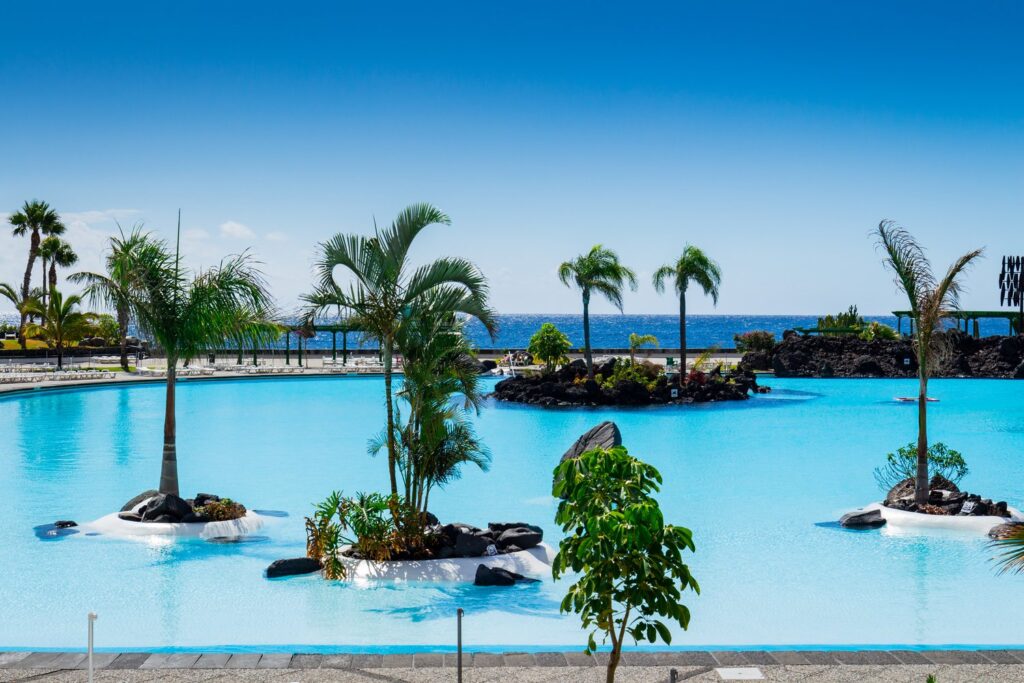
Palmetum botanical garden
The Palmetum is one of the most unusual botanical gardens in Europe. It covers 12 hectares on a hill that was once the city’s rubbish tip, and opened to visitors in 2014. Today it holds one of the largest collections of palm trees in the world, arranged by region, from the Caribbean and Madagascar to the Pacific islands. Paths lead past ponds and artificial waterfalls to a viewpoint over the port and the Auditorio. Bring a hat and water, as there isn’t much shade at midday.
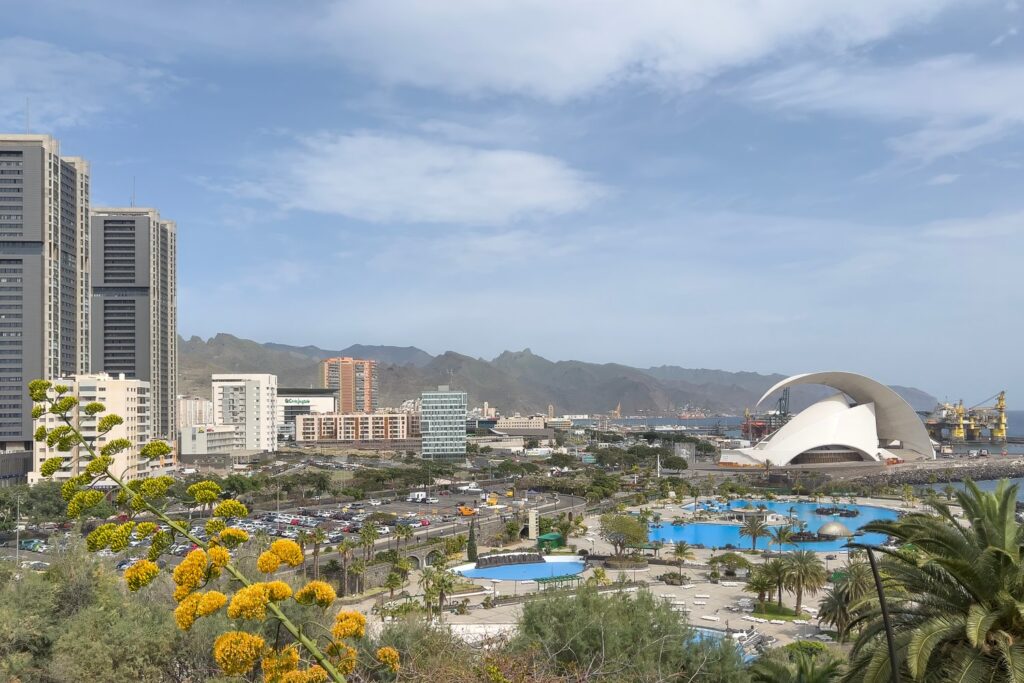
García Sanabria Park and the Rambla
García Sanabria Park is the largest park in the city centre, at around six hectares. It opened in 1926 and is full of tropical trees, fountains, ponds and sculptures. Its best-known feature is a large floral clock near the entrance. It’s a lovely place to escape the heat, and you’ll often see locals reading on the benches or playing chess.
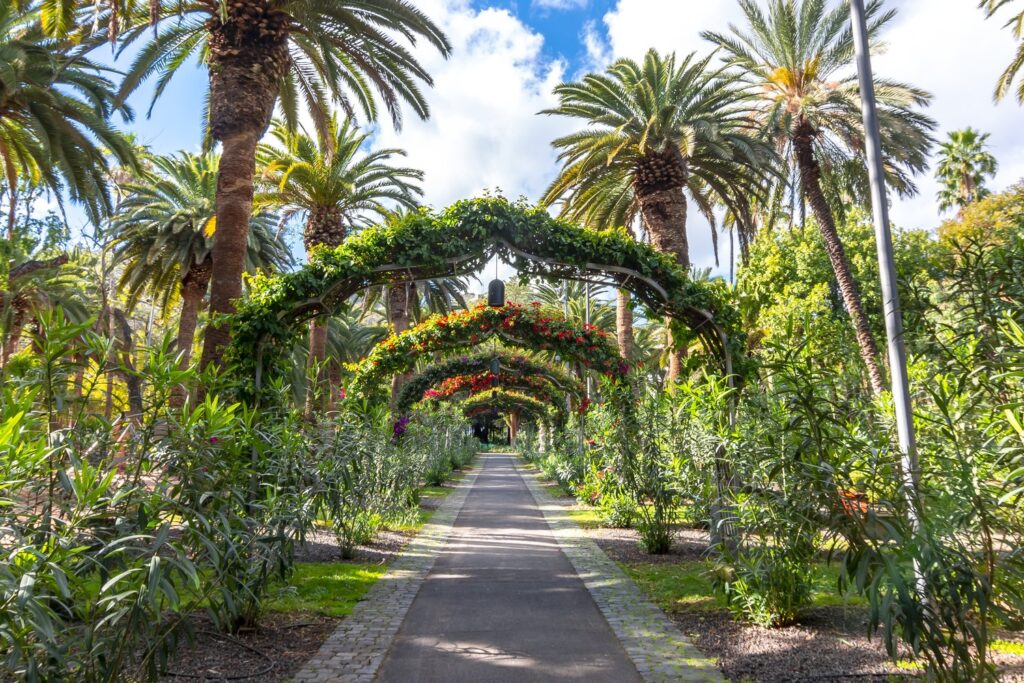
The park borders the Rambla de Santa Cruz, a wide tree-lined avenue that is also an open-air museum. In 1973 the city hosted an international exhibition of street sculpture, and many of the works stayed. Look out for pieces by Henry Moore and Joan Miró among the palm trees. Nearby, Plaza Weyler with its marble fountain and the 19th-century Teatro Guimerá are worth a short detour on your way back to the centre.
Las Teresitas beach and San Andrés
Santa Cruz is a working port, so the city centre doesn’t have a proper beach. For beach time, head about 8 km north-east to Las Teresitas, one of the most famous beaches in the Canary Islands. In the 1970s tonnes of golden sand were shipped here from the Sahara, and a breakwater keeps the water calm. With palm trees, mountains behind and clear sea in front, it looks nothing like the black volcanic beaches elsewhere in the north.

Las Teresitas beach is about 15-20 minutes from the centre by car or by bus. Go early at weekends, when locals flock here. Afterwards, walk to the fishing village of San Andrés, where small restaurants serve fresh fish and seafood. If you prefer something wilder, nearby Las Gaviotas beach has black sand and a more secluded feel.
Carnival in Santa Cruz de Tenerife
The Santa Cruz carnival is one of the largest in the world and has been declared a Festivity of International Tourist Interest. It takes place every year in February or early March, depending on the date of Lent. For more than two weeks, the city fills with parades, music, costume contests and street parties. The crowning of the Carnival Queen, with costumes so huge they are built on wheels, is the highlight for many locals.

In 1987 a street concert with the Cuban singer Celia Cruz drew around 200,000 people and made it into Guinness World Records. Carnival is also the busiest time of the year in the city, so book your accommodation well in advance.
See available accommodation in Santa Cruz de Tenerife
Day trips from Santa Cruz de Tenerife
Santa Cruz is a great base for exploring the north of Tenerife. Many places are less than an hour away, and you can reach some of them by bus or tram.
Anaga Rural Park
The Anaga Rural Park starts right on the edge of the city. These steep, green mountains are covered in ancient laurel forest, a type of subtropical forest that has almost disappeared from Europe. In 2015 the area became a UNESCO Biosphere Reserve. Hiking trails set off from the Cruz del Carmen viewpoint, and narrow roads lead down to the village of Taganana and the wild black-sand beaches of Benijo and Almáciga. Mist often rolls over the ridges, so take a light jacket even in summer.
San Cristóbal de La Laguna
The old town of La Laguna, the island’s former capital, is a UNESCO World Heritage Site. Its grid of streets, laid out in the late 15th century, served as a model for many colonial cities in Latin America. You can wander past pastel-coloured mansions, convents and the cathedral, then stop for coffee in one of the student bars. The tram from Santa Cruz takes about 40 minutes, so it’s an easy half-day trip.
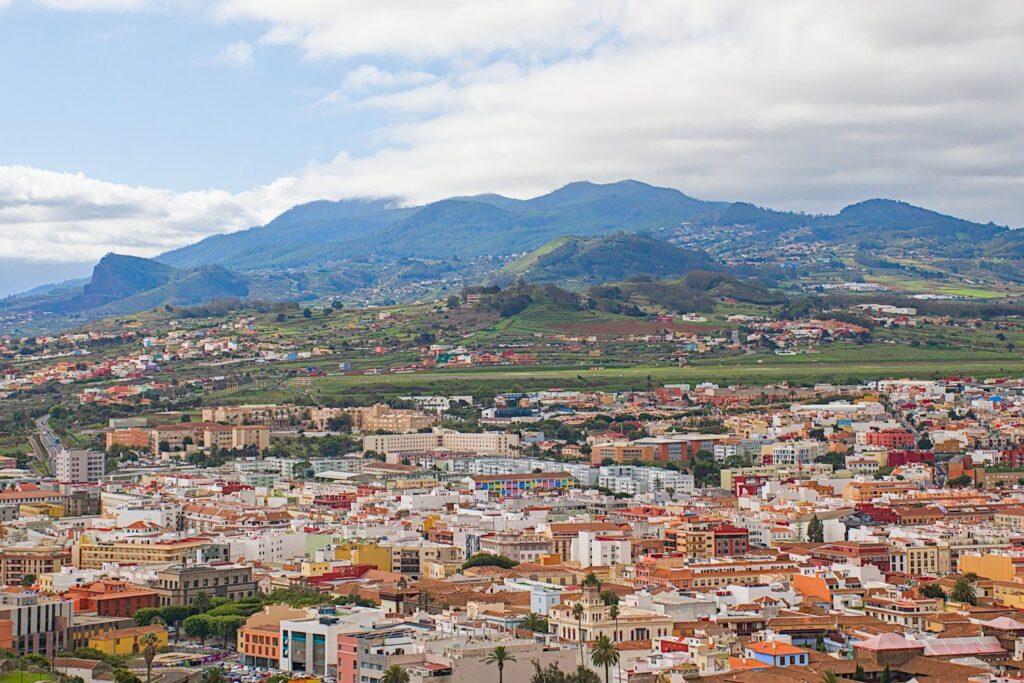
Mount Teide and the north coast
From Santa Cruz, it takes around an hour by car to reach Teide National Park. The cable car runs up Mount Teide, Spain’s highest point at 3,715 m, and the views over the lunar landscape are unforgettable. On another day, drive to Puerto de la Cruz on the north coast for Loro Parque, and stop in the colonial town of La Orotava to see the Casa de los Balcones.
How to spend one day in Santa Cruz
Start the morning at the Mercado de Nuestra Señora de África, when the stalls are full and the market is buzzing. Then walk down to Plaza de España and the underground remains of the Castillo de San Cristóbal. Continue up Calle del Castillo to Plaza de la Candelaria and the Iglesia de la Concepción, and have lunch at a terrace in La Noria.
In the afternoon, choose between museums and the seafront. Culture lovers should head to MUNA or TEA, while sunseekers can take the bus to Las Teresitas for a swim. Finish the day at the Auditorio de Tenerife, watching the sunset over the Atlantic, and return to the centre for dinner. If you only have a few hours, for example on a cruise stop, focus on Plaza de España, Calle del Castillo, La Noria and the Auditorio.
Getting to Santa Cruz and getting around
Most visitors fly into Tenerife South Airport, about 60 km from the city. The drive takes 45-60 minutes, and express buses connect the airport with the bus station in Santa Cruz. Tenerife North Airport is much closer, about 12 km away, but it mainly handles flights from mainland Spain and the other Canary Islands. Cruise ships dock right in the city centre, a short walk from Plaza de España.
How far is Santa Cruz from Las Américas? About 75 km, or roughly an hour by car along the motorway. Within the city, you can walk almost everywhere, while the tram links Santa Cruz with La Laguna. To explore Anaga, Teide National Park and the north coast at your own pace, hire a car. Ferries from the port sail to Gran Canaria, while boats to La Gomera leave from Los Cristianos in the south.
When to visit Santa Cruz de Tenerife
Santa Cruz enjoys a mild climate all year. In winter, daytime temperatures usually stay around 20-22°C, while summer days reach around 28-30°C. Rain is rare and falls mainly between November and February. Which part of the island is nicer, north or south? The south has more guaranteed sunshine and bigger resorts, while the north is greener, more traditional and better for culture. Santa Cruz offers a good balance between the two.
The best time for sightseeing is spring and autumn, when it’s warm but not too hot. Come in February if you want to see the carnival, but expect crowds and higher hotel prices.
Hotels in Santa Cruz de Tenerife
Staying in the city puts you close to restaurants, museums and public transport, and it’s a good base for the north of the island. These three hotels suit different budgets and travel styles.
💰 NH Tenerife
A modern hotel in the heart of Santa Cruz, a few minutes’ walk from Plaza de España and the seafront. Rooms are simple but comfortable, with air conditioning and wooden floors, and there’s a restaurant serving breakfast and meals throughout the day. The rooftop terrace has wide views over the city and the port. It’s a smart choice if you want a central base at a reasonable price.
🏨 Hotel Taburiente S.C.Tenerife
A four-star hotel on the Rambla, opposite García Sanabria Park. The rooms are spacious and quiet, and there’s a rooftop swimming pool where you can cool off after a day of sightseeing. Calle del Castillo and the main museums are within walking distance. It suits couples and travellers who value comfort and a calm, leafy neighbourhood.
💎 Iberostar Heritage Grand Mencey
The city’s most elegant hotel, set in a grand colonial-style building surrounded by tropical gardens. Guests can relax in the large spa, swim in the outdoor pool and choose between several restaurants. The hotel is just a short walk from García Sanabria Park and the Rambla. It’s perfect for a special occasion or a luxurious city break with a touch of history.

