For centuries, people here didn’t build their homes. They dug them out of the hillside, whitewashed the doorways and lit the lamps for a night of singing.
Sacromonte is the hillside neighbourhood on the eastern edge of Granada, where white cave houses are carved into the slopes of the Valparaíso hill above the Darro river valley. It’s the home of zambra flamenco, the place where Granada’s Roma (gitano) community lived for centuries, and one of the best spots in the city to look across at the Alhambra. In this article you’ll discover everything you need for a visit to Sacromonte, Granada. We cover the history of the caves, the Sacromonte Caves Museum and the abbey on top of the hill. You’ll also learn where to see live flamenco shows, which viewpoints to head for, how to get there and how to stay safe.
💰 Cuevas El Abanico - Whitewashed cave apartments on the Vereda de Enmedio, in the heart of Sacromonte.
🏨 Hotel Casa 1800 Granada - A boutique hotel in a 17th-century house in the lower Albaicín, with afternoon tea included.
💎 Parador de Granada - A historic parador in a former convent inside the Alhambra grounds.
Is Sacromonte, Granada worth visiting?
Yes, and for most travellers it’s one of the highlights of a trip to Granada. The Alhambra shows you the city of the Nasrid sultans. Sacromonte shows you how ordinary people lived just across the valley, often in great poverty, and how their music became one of the most recognisable sounds of Spain. You get cave houses you can step inside, a small but well-made museum and an abbey with underground chapels. There’s also a string of viewpoints, far quieter than the famous Mirador de San Nicolás.
Plan at least half a day if you want to see the museum, walk the lanes and catch the sunset. If you’d like to add a flamenco show, stay into the evening. Many visitors combine Sacromonte with the neighbouring Albaicín, and the two make a perfect day after a morning at the Alhambra. Wear comfortable shoes - the lanes are steep, cobbled and uneven.
Where is Sacromonte in Granada, Spain?
The Sacromonte neighbourhood is located on the hill north of the Darro river, east of the Albaicín and directly opposite the Alhambra. Officially, it’s part of the wider Albaicín district, and its lower streets begin where the Cuesta del Chapiz meets the Camino del Sacromonte. The Albaicín is a UNESCO World Heritage Site, together with the Alhambra and the Generalife. The Darro valley, where Sacromonte lies, has been a protected Site of Cultural Interest since 2016.
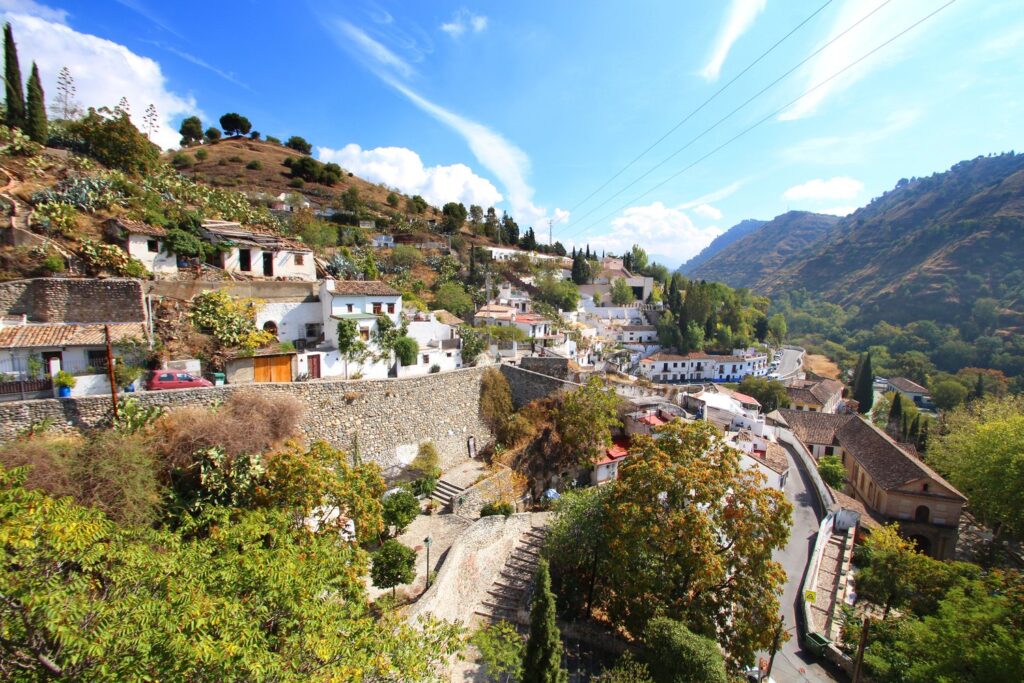
The name means “Holy Mountain”. It comes from the early 17th century, when relics believed to belong to Christian martyrs were found in caves at the top of the hill. That discovery led to the building of the Sacromonte Abbey, which still crowns the slope today.
A short history of the Sacromonte caves
The Sacromonte caves were most likely dug from the 16th century onwards, after the Christian conquest of Granada in 1492. People who found themselves on the margins of the new order settled on the hillside outside the city walls. They included Roma families, Muslims who had been forced to convert, and poor families with nowhere else to go. The soft rock of the hill was easy to dig, so a home cost little more than hard work. Providing shelter that stayed cool in summer and mild in winter, the caves suited people with very little money.
One local legend explains the origin of the name Barranco de los Negros (Ravine of the Blacks). It tells of freed slaves of Muslim families who stayed behind to dig for treasure their masters had buried before leaving the city. They never found it, but they made the caves their home. Whether or not it’s true, the story is part of the rich history of the hill, and you’ll hear it from guides and at the museum.
Over time, the Roma (gitanos, as Spain’s Gypsies are known) became the largest group on the hill. Their dialect, caló, their crafts, their traditions and above all their music shaped the identity of the Sacromonte district. Federico García Lorca, Granada‘s most famous poet, wrote about Andalusian gitano life in his collection Romancero gitano. In 1889, the priest Andrés Manjón founded the Ave María schools on the edge of the neighbourhood to teach Roma children.
Life in the caves was never easy. In the early 1960s, heavy rains caused landslides and badly damaged many cave houses. Most families were rehoused in new districts of Granada, and much of the hill was left empty for years. Since then, Sacromonte has slowly come back to life, with restored caves, artists’ studios, flamenco venues and holiday rentals.
Sacromonte caves today - Do people still live in the caves?
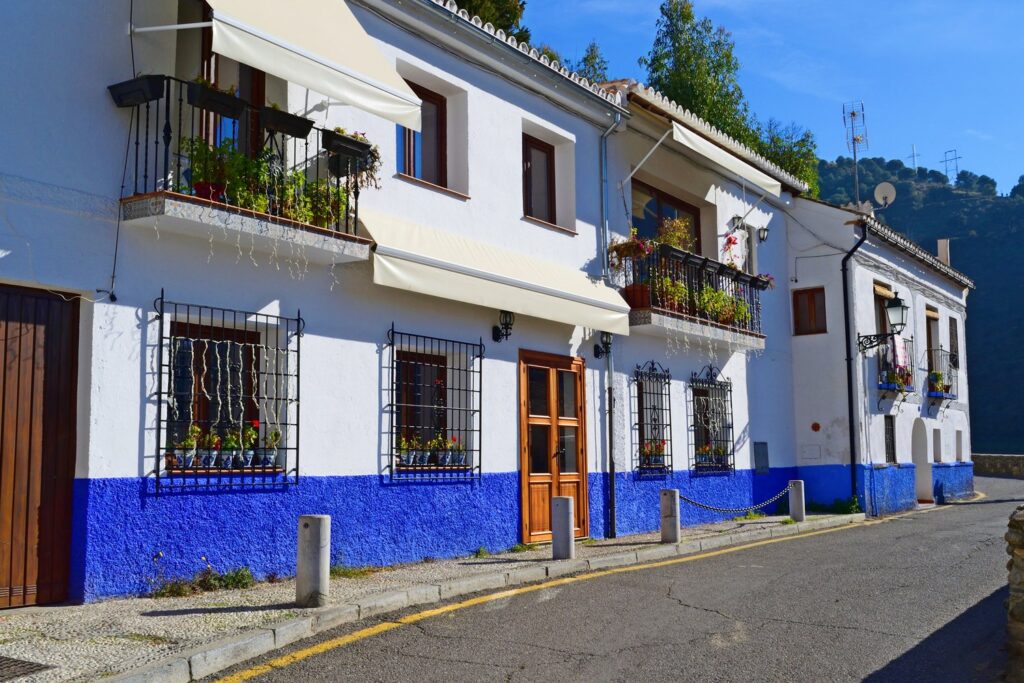
Yes. Some families still live in cave houses, alongside newcomers, artists and a small alternative community in simpler caves higher up the hill. A typical cave house has a whitewashed façade, a chimney poking out of the rock and a small terrace in front. Inside, rooms run back into the hill one behind another. The temperature stays pleasantly stable all year, so a cave needs no air conditioning and very little heating.
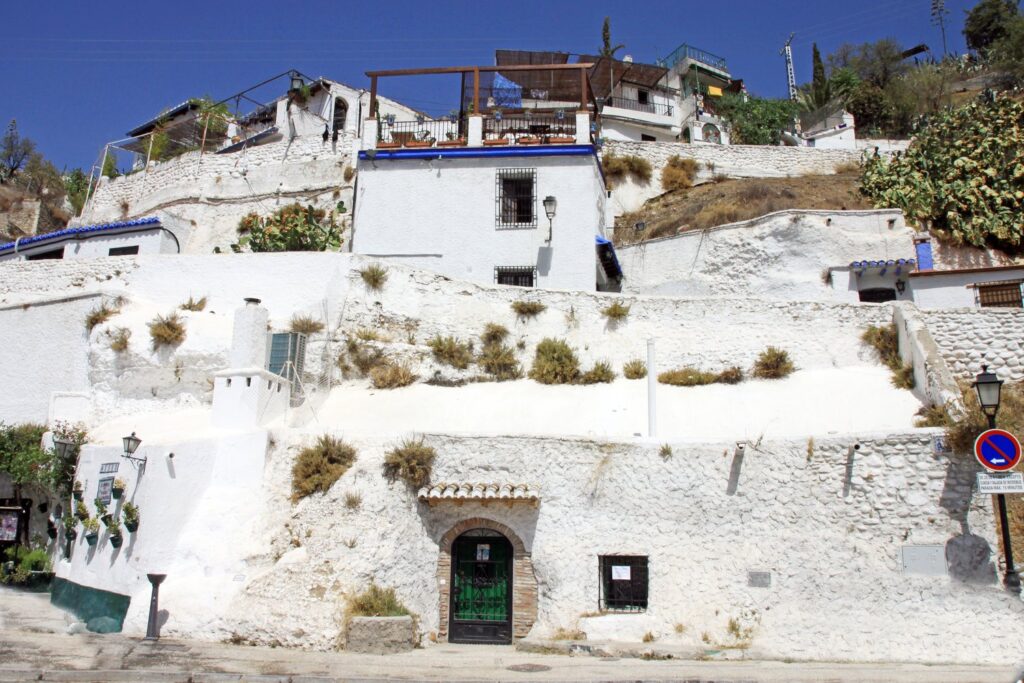
Many of the whitewashed caves along the Camino del Sacromonte are now flamenco venues, bars or restaurants. Others have been turned into cave apartments that you can rent for a night or two. Bear in mind that plenty of caves are still private homes, so don’t walk onto terraces or take photos through open doors without asking. If you want to see the inside of a cave house properly, the museum is the best place to do it.
Sacromonte Caves Museum (Museo Cuevas del Sacromonte)
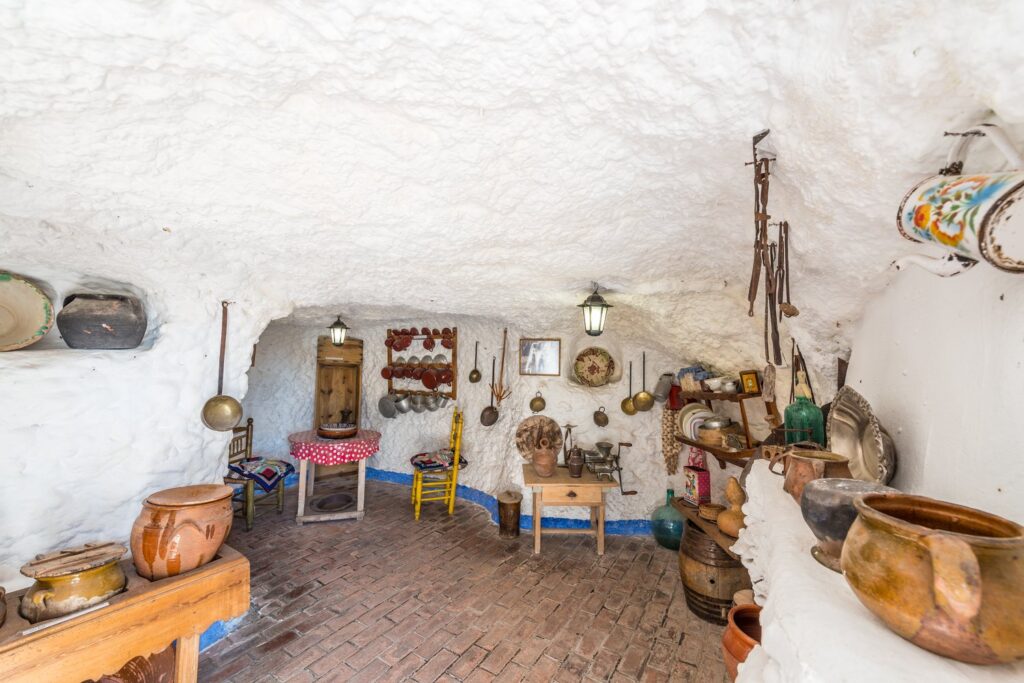
The Sacromonte Caves Museum is the best introduction to life and culture on the hill. The Museo Cuevas del Sacromonte opened in 2002 in the Barranco de los Negros, in a group of 11 original cave houses that were restored and furnished to show how people lived and worked here. It covers around 4,800 square metres, including a botanical garden with plants native to the hillside, open-air spaces and a viewpoint over the Darro river valley and the Alhambra.
What can you see at the Sacromonte Caves Museum?
Each cave has its own theme. In the living-quarters cave you’ll see a whole home dug into the rock, with a kitchen, a bedroom and a stable for animals. Other caves are dedicated to traditional trades: basketwork, weaving, pottery and blacksmithing, which were once the main sources of income for families on the hill. The flamenco cave tells the story of zambra and the artists who made Sacromonte famous, and another space looks at cave dwellings in other parts of the world.
The setting is just as memorable as the exhibits. From the terraces you get panoramic views of the Alhambra on the Sabika hill, the Generalife gardens and, in winter, the snowy peaks of the Sierra Nevada. Bring water in summer, because the paths between the caves are steep and there’s little shade.
Opening hours and tickets
- Opening hours: the museum is open every day. In the summer season (late March to late October) it’s usually open from 10am to 8pm, and in winter from 10am to 6pm. Last entry is about 20 minutes before closing.
- Tickets: the standard ticket includes a free audio guide in Spanish and English. Children under 10 go in free. Entry is good value at a very reasonable price, and you can book a Sacromonte Caves Museum ticket online before you go.
- Address: Barranco de los Negros, s/n, Sacromonte, 18010 Granada. Signs point the way from the Camino del Sacromonte, and the last stretch is a steep walk up the Vereda de Enmedio.
- Time needed: plan about 1-1.5 hours, longer if you want to sit at the viewpoint.
Flamenco in Sacromonte - Zambra in the caves
Flamenco, the great art of Andalusia, has its own style in Sacromonte, called zambra. It originated in the celebrations of Granada‘s Roma community, especially the songs and dances performed at gypsy weddings. Some historians link it to the zambras (celebrations) of the Moorish population of 16th-century Granada. The best-known part is the alboreá, a set of wedding songs, followed by livelier dances such as the cachucha and the mosca.
What makes zambra special is the space. The shows take place in long, narrow caves with copper pots and plates on the whitewashed walls, and the audience sits on chairs along both sides. The dancers perform just a step or two away from you, and the natural acoustics of the cave carry the singing, guitar and hand-clapping to every corner. It’s an intense, unforgettable experience, very different from a large theatre show.
Is there a flamenco show in the Sacromonte caves?
Yes - several family-run caves stage live flamenco shows every night of the year. These are some of the best-known venues along the Camino del Sacromonte and the lanes above it:
- Cueva de la Rocío - run by the Maya family and known for its warm atmosphere, with a classic zambra show that ends with a rumba where the audience is invited to join in.
- Cuevas Los Tarantos - one of the longest-running and most popular zambras on the hill, with an optional dinner.
- Cueva Los Amayas - an intimate, consistently well-reviewed cave, run by another of the hill’s flamenco families.
- Zambra María la Canastera - named after the dancer María Cortés, “La Canastera”, who lived in this cave and welcomed visitors to shows in her living room.
- Cueva La Faraona - a traditional cave with a strong line-up of artists, a drink included and the option of dinner before or after the show.
- Venta El Gallo - a larger venue with a restaurant, a terrace with views of the Alhambra and beginner flamenco classes.
Tips for booking flamenco shows in Sacromonte
Shows usually last about an hour and tickets often include a drink. Book ahead, especially at weekends and in spring and autumn, because the caves are small and the most popular sessions sell out. Arrive 20-30 minutes early if you’d like a seat in the front row. Several venues offer a ticket with dinner or a transfer from the city centre, which is handy if you’d rather not walk up the hill after dark. If you’re short on time, there are also guided tours that combine a walk through the Albaicín and Sacromonte with a flamenco show at the end.
Sacromonte Abbey (Abadía del Sacromonte)
At the top of the hill stands the Sacromonte Abbey, founded in the early 17th century by Archbishop Pedro de Castro. Between 1595 and 1599, treasure hunters found bones, ashes and a series of lead tablets in the caves here. The so-called Lead Books (Libros Plúmbeos), written in Arabic, claimed that Saint Cecilius, the first bishop of Granada, and his companions had been martyred on this spot. The archbishop built the abbey and a college over the caves to honour them.
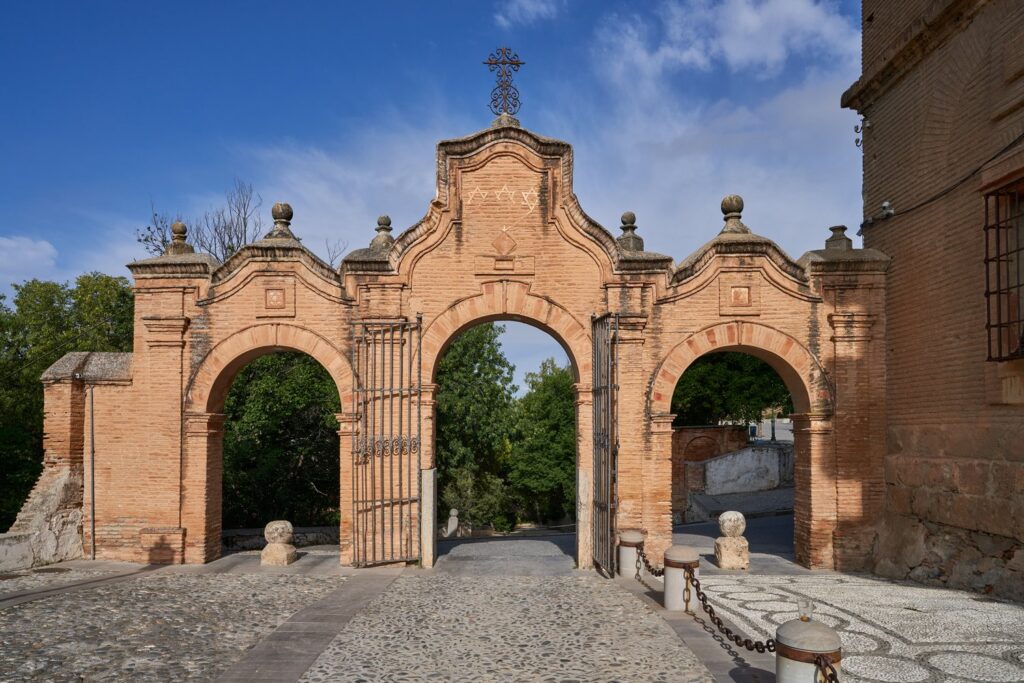
The story has a twist. In 1682, the Vatican declared the Lead Books heretical forgeries, and they were taken to Rome. They only came back to the abbey in 2000. Most historians believe they were written by Moriscos, Muslims forced to convert to Christianity, who tried to show that Christianity and Arab culture could live side by side.
Today you can visit the abbey’s church, the cloister, a museum with manuscripts and paintings and, best of all, the Holy Caves (Santas Cuevas). These are small underground chapels connected by narrow tunnels, where the relics were found. The abbey can only be visited on a guided tour. Tours usually run in the morning and afternoon, with a break at lunchtime. It’s worth booking online in advance. So, is Sacromonte Abbey worth visiting? If you like history and quiet places, it’s an easy yes. The terrace in front of the abbey also gives you a wide view over the valley.
The abbey is also the setting for Granada‘s San Cecilio pilgrimage, held on the first Sunday of February. Locals walk up the hill, share salaíllas (salty bread rolls with olive oil) and fresh broad beans, and listen to folk music in front of the church.
Views of the Alhambra from Sacromonte
Sacromonte faces the Alhambra across the Darro valley, which gives it some of the best views in Granada. Unlike the busy Mirador de San Nicolás, most of these viewpoints are quiet, and you can often have them almost to yourself.
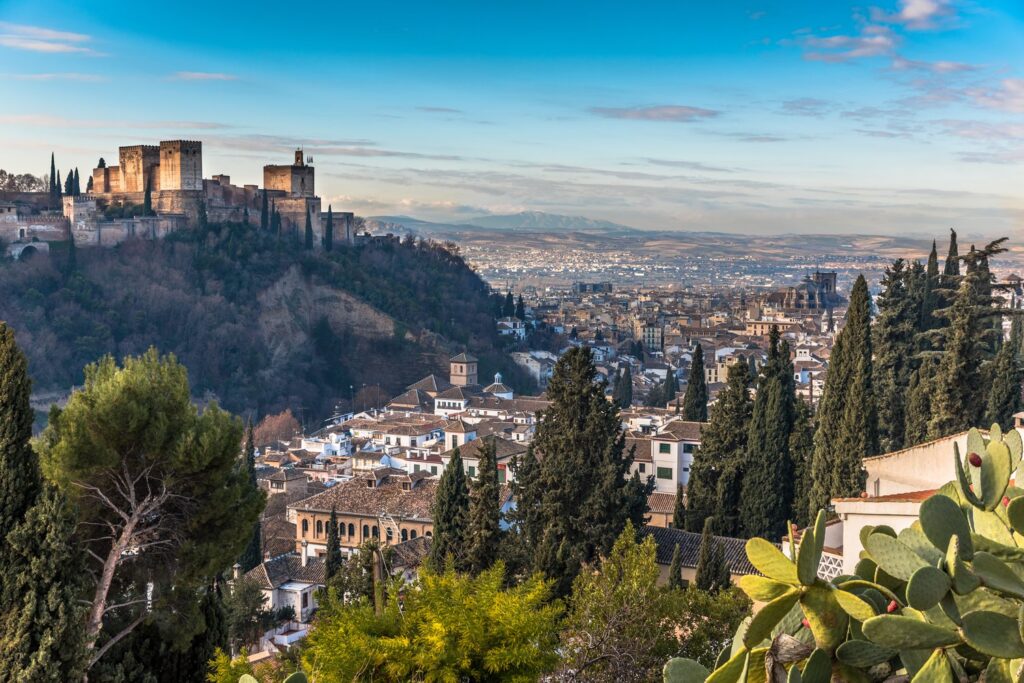
- Vereda de Enmedio - a cobbled path built at the end of the 19th century to connect the caves halfway up the hill. Several small viewpoints along it look straight at the Alhambra, and it’s beautiful at sunset.
- Mirador de las Cuevas - the viewpoint inside the Sacromonte Caves Museum, with a wide view over the valley, the Generalife and the Sierra Nevada.
- Camino del Sacromonte - the main street of the neighbourhood. Between the caves and the bars, gaps in the wall open up views of the Alhambra‘s red towers.
- Mirador de San Miguel Alto - the highest viewpoint in this part of the city, next to a small white hermitage above the Albaicín and Sacromonte. You look down on the Alhambra rather than across at it, and on clear days you can see the whole city. It’s a steep climb with no shade, so avoid the middle of the day in summer.
The best time for these breathtaking views is the late afternoon and sunset, when the walls of the Alhambra turn golden red. Stay a little longer after sunset, when the Alhambra is lit up against the night sky.
Walking tours and guided tours of Sacromonte
Sacromonte is easy to explore on your own, but a guide brings the caves to life with stories you won’t find on signs. Walking tours of the Albaicín and Sacromonte are among the most popular activities in Granada. Many run in the late afternoon and end at a viewpoint at sunset. Some include the Sacromonte Caves Museum, while others finish with a flamenco show in a cave. If the hills sound tiring, e-bike and Segway tours cover the same area with far less effort. Private tours work well for small groups or families who want to set their own pace.
How to get to Sacromonte?
On foot from the Albaicín and the city centre
From Plaza Nueva in the centre of Granada, walk along the Carrera del Darro, one of the city’s most beautiful streets, to the Paseo de los Tristes. Continue along the river and turn up the Cuesta del Chapiz, then right onto the Camino del Sacromonte. It’s a walk of about 20-30 minutes, with an uphill stretch at the end. From the Mirador de San Nicolás in the Albaicín, you can follow the narrow streets down to the Cuesta del Chapiz and join the same route in about 15-20 minutes.
By bus
The C34 minibus runs from Plaza Nueva along the Carrera del Darro and up the Camino del Sacromonte. Buses run roughly every 20 minutes, and the ride takes about 15 minutes to the top near the abbey. It saves you the steep climb and is handy for getting back after dark. The C31 and C32 lines serve the Albaicín and stop on the Cuesta del Chapiz, a short walk from the lower part of Sacromonte.
By taxi or car
Taxis can drive up the Camino del Sacromonte, which helps if you’re going to a flamenco show in the evening. Driving yourself isn’t a good idea, because the historic centre has restricted access and almost nowhere to park. If you’re exploring Andalusia by car, leave it at your hotel or in a public car park and take the bus. You can check the car hire options in Granada for trips further afield, such as the Sierra Nevada or the coast.
Is Sacromonte safe? Tips for your visit
During the day Sacromonte is safe and full of visitors. In the evening, the Camino del Sacromonte is busy with people heading to flamenco shows. As in any popular spot, keep an eye on your bag and phone, especially at viewpoints and in crowds. A few simple rules will make your visit easier:
- After dark, stick to the main street and avoid the unlit paths at the top of the hill. Take the C34 bus or a taxi back to the centre if you’re unsure of the way.
- Wear shoes with a good grip. The cobbles and dirt paths get slippery after rain.
- In summer, avoid the steep climbs at midday, carry water and use sun cream. Temperatures in July and August often reach 35°C.
- Respect the people who live here. Don’t enter private terraces, keep your voice down in residential lanes and ask before taking photos of people.
- Some small bars and stalls only take cash, so carry a little with you.
Where to eat and drink in Sacromonte
Several caves and bars along the Camino del Sacromonte serve drinks and tapas with views of the Alhambra. It’s a lovely place for a cold drink before a show, though the choice is smaller than down in the centre. For a wider selection of restaurants and the famous free tapas, head back down to the Paseo de los Tristes or the streets around Plaza Nueva. Read more about food and nightlife in our guide to Granada.
Hotels in Sacromonte, Granada
Staying in or near Sacromonte means waking up to views of the Alhambra and having flamenco shows a short walk away. The choice inside the neighbourhood is small and mostly made up of cave apartments, so many visitors stay in the Albaicín or the centre of Granada. You can also see all available hotels in Granada.
💰 Cuevas El Abanico
If you want to sleep in a real cave, this is one of the best-known places to do it. The cave apartments are dug into the hillside on the Vereda de Enmedio, right in the heart of Sacromonte and a short walk from the Caves Museum. They have lime-washed walls, simple kitchens and small terraces, and they stay cool even on hot summer days. Be ready for a steep climb from the road, but you’ll be rewarded with peace, character and views that no city hotel can match.
🏨 Hotel Casa 1800 Granada
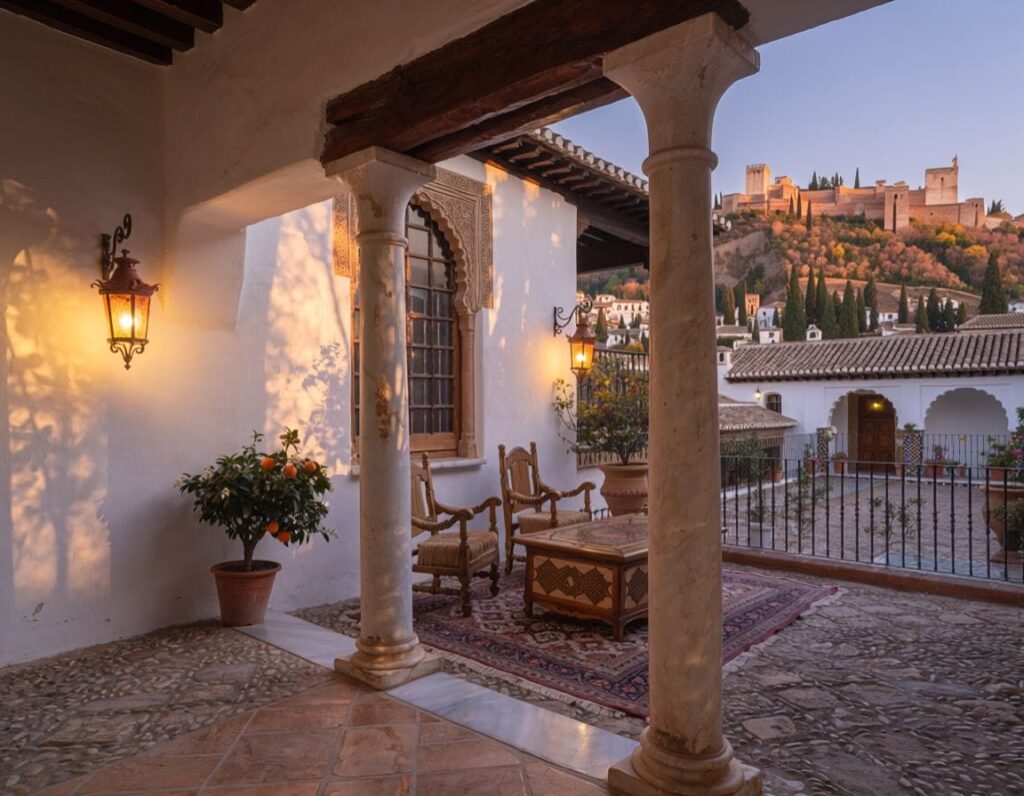
This boutique hotel sits in a restored house from 1642 in the lower Albaicín, just off the Paseo de los Tristes. Sacromonte is about 10-15 minutes away on foot. Some rooms open onto a traditional central courtyard, and the best ones look out over the Alhambra. Complimentary afternoon tea is served in the courtyard, a nice touch after a day on the hills. It’s a great choice if you want a charming, central base close to both the Alhambra and the Sacromonte caves.
💎 Parador de Granada
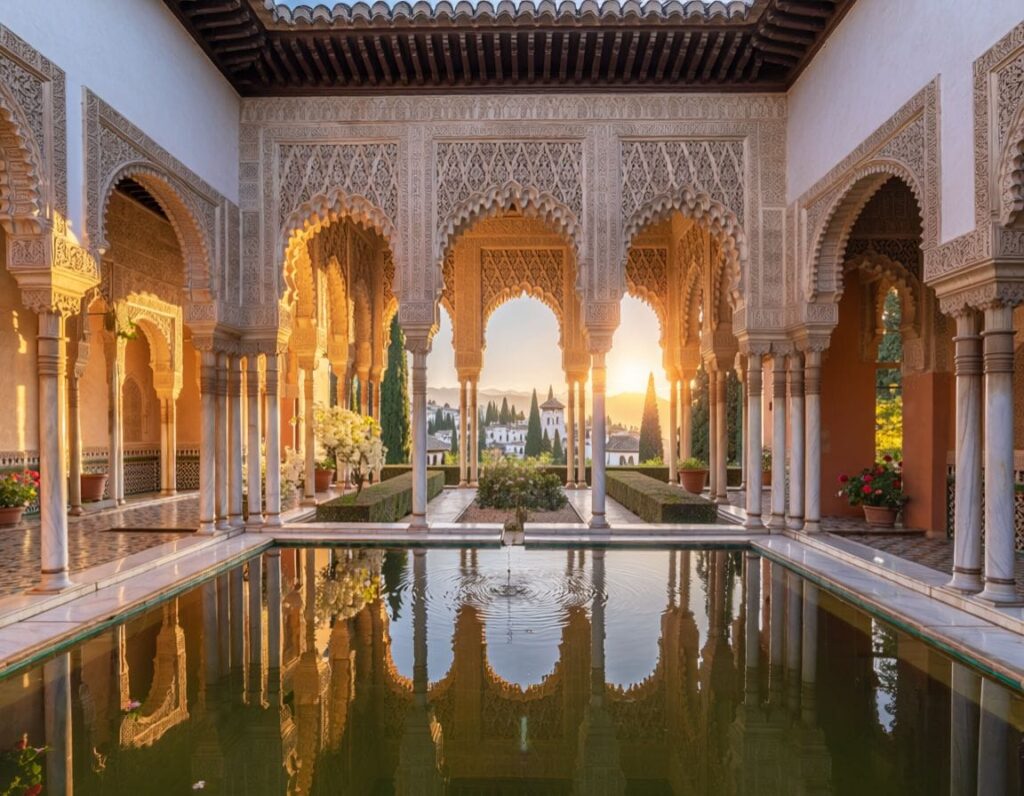
For a once-in-a-lifetime stay, book a room inside the Alhambra itself. The parador occupies the former convent of San Francisco, built on the site of a Nasrid palace, where the Catholic Monarchs were first buried. You can stroll through the gardens in the evening after the crowds have gone, and Sacromonte is a scenic walk or a short taxi ride away across the Darro valley. Rooms are limited, so book well in advance, especially in spring.

