Half an hour from the old town, cowboys still ride through what is often called Europe’s only desert. Back in town, a free tapa lands on the bar with every drink you order.
Almeria is a sunny port city in the far south-east of Spain, and it still flies under the radar of most holidaymakers. That’s a shame, because it’s a beautiful city. Its hilltop Alcazaba ranks among the largest Moorish fortresses in the country, the old town is packed with traditional tapas bars, and some of the wildest beaches on the Mediterranean coast lie less than an hour away. In this article you’ll find the best things to do in Almeria city, the most rewarding day trips around the province and practical tips on when to go, how to get there and where to stay.
💰 Torreluz Centro - Great-value rooms on Plaza Flores, a short walk from the Alcazaba and the tapas bars.
🏨 AC Hotel Almería by Marriott - A modern four-star hotel in the centre with a rooftop pool open in summer.
💎 Aire Hotel & Ancient Baths - A boutique hotel on the old town’s main square with thermal baths and Alcazaba views.
Is Almeria worth visiting?
Yes, especially if you prefer authentic cities to polished resorts. Almeria is a working port city of around 200,000 people, so you’ll share the streets with locals rather than coach parties. It sits between the Sierra de Gádor mountains and a wide bay, with North Africa just across the sea. That proximity has shaped its entire history. For centuries, it was one of the richest ports of Muslim Spain, and its name comes from the Arabic word al-Mariyya, often translated as “the watchtower”.
The landscape is what really sets it apart. Almeria is the driest corner of Europe, with around 3,000 hours of sunshine a year and barely 200 mm of rain. That climate created semi-desert scenery so convincing that film-makers used it to stand in for the American West, Arabia and ancient Egypt. Add volcanic coves, whitewashed villages and a lively food scene, and you have one of the most underrated parts of southern Spain. If you’re planning a longer trip around Andalusia, it makes a great final stop on the region’s eastern edge. The list of things to do in Almeria is also much longer than most visitors expect.
The best things to do in Almeria city
The city centre is compact and easy to explore on foot. Most of the main sights lie between the Alcazaba, the cathedral and the Paseo de Almeria, so you can see the main highlights in a day and a half without ever needing a taxi. Here are the things to do in Almeria that you shouldn’t miss.
Explore the Alcazaba of Almeria
The Alcazaba is the main reason to visit Almeria, and it deserves all the attention it gets. The word alcazaba comes from the Arabic al-qasbah, meaning citadel. Caliph Abd al-Rahman III of Córdoba ordered its construction in 955 to protect what was then a booming Mediterranean port. The fortress walls stretch along the whole ridge above the old town, and, enclosing around 43,000 m², it’s often described as the largest Muslim fortress in Spain.
The site is divided into three walled enclosures. The first is now a series of beautiful gardens with fountains and water channels. The second held the palace of the Taifa king al-Mutasim, together with baths, cisterns and a rebuilt Moorish house. The third is a Christian castle that the Catholic Monarchs added after they took the city in 1489, with a sturdy keep and a parade ground. Look out for the Muro de la Vela (Bell Wall), whose bell once warned the city of pirate attacks. Film fans may recognise the fortress, too, as it has appeared in many productions, including Game of Thrones.
Allow at least two hours and wear comfortable shoes, as the paths are steep and there’s little shade. In summer, go early in the morning or late in the afternoon, when the light turns the walls golden. Entry is free for EU citizens, while visitors from outside the EU, including the UK, pay a small fee. If you want the full story, a guided tour brings the different eras of the fortress to life. Opening hours change with the seasons, so check them before you go.
Walk the walls to Cerro de San Cristóbal
From the Alcazaba fortress, the Muralla de Jayrán (Jayrán Wall) drops into a small valley and climbs the neighbouring hill. Jayrán, the first Taifa king of Almeria, built it in the 11th century to protect the growing city. The hill is Cerro de San Cristóbal, crowned by the ruins of a castle and a large white statue of the Sacred Heart. The climb takes only 10 to 15 minutes, but it’s steep. The reward is the view that earned the hill its nickname, the balcony of Almeria, with the Alcazaba on one side and the port and the colourful houses of La Chanca on the other. Come up at sunset if you can.

Visit the fortress cathedral
Most cathedrals in Spain were built to impress. Almeria’s was also built to resist attack. After an earthquake destroyed the old cathedral in 1522, work on the Catedral de la Encarnación (Cathedral of the Incarnation) began in 1524. At the time, Barbary pirates from North Africa regularly raided the coast, so the builders gave the new church thick walls, towers and battlements. The main building work was finished in 1562, and the result looks more like a castle than a place of worship.

Inside you’ll find Gothic vaults, a carved choir by Juan de Orea and paintings by Alonso Cano in the chapels behind the high altar. Then walk round to the eastern wall to see the Sol de Portocarrero, a 16th-century carving of a smiling sun. It’s now the symbol of the whole province, and you’ll spot it everywhere, from road signs to souvenirs.
Wander the old town and Plaza de la Constitución
Almeria’s old town is a tangle of narrow streets between the cathedral and the port. Its heart is Plaza de la Constitución, which locals simply call Plaza Vieja (Old Square). This arcaded square is home to the town hall and the Pingurucho de los Coloraos, a monument to the liberals executed here in 1824.

From the square, stroll along Calle de las Tiendas, one of the old town’s main streets, to the Iglesia de Santiago with its richly carved Renaissance doorway. Continue to the Puerta de Purchena, the busy junction where the old town meets the modern city. Look out for the Aljibes de Jayrán, 11th-century Arab water cisterns hidden beneath the streets, which now house one of the city’s best-known flamenco clubs.
Go underground in the Civil War shelters
During the Spanish Civil War, Almeria was one of the last cities held by the Republic, and it was bombed dozens of times from the air and the sea. To protect the population, the architect Guillermo Langle designed a network of underground shelters, dug in 1937 and 1938, mostly around 9 m below the streets. The galleries run for more than 4 km and could hold around 40,000 people. Today you can visit nearly a kilometre of the tunnels beneath the Paseo de Almeria, including a food storeroom and a re-created operating theatre.
All visits to the Refugios de la Guerra Civil (Civil War Shelters) are guided and groups are small, so book a slot as soon as you arrive in town. Tours are usually in Spanish, but the claustrophobic galleries speak for themselves. It’s one of the most moving things to do in Almeria and a sobering reminder of the city’s turbulent history.
Follow John Lennon to the Casa del Cine
In the autumn of 1966, John Lennon spent several weeks in Almeria filming Richard Lester’s war satire How I Won the War in the Tabernas Desert. He rented a 19th-century villa called Santa Isabel on the edge of the city. It was here that he worked on one of the Beatles’ most famous songs, Strawberry Fields Forever.
The villa is now the Casa del Cine (House of Cinema), a cinema museum dedicated to the hundreds of films shot in Almeria province. You can see a re-creation of Lennon’s bedroom, vintage posters and props, and displays on stars such as Clint Eastwood, who also stayed here during filming. Back in the centre, don’t miss the bronze statue of John Lennon with his guitar in Plaza Flores. It’s one of the most photographed spots in town. The museum has limited opening hours, especially in winter, so plan your visit around them.
Discover the Museum of Almeria and the Guitar Museum
The Museum of Almeria is the city’s main archaeological museum, and it’s far more engaging than its plain exterior suggests. It focuses on two prehistoric cultures that flourished in the province. Los Millares was one of the most important Copper Age settlements in Europe, while El Argar dominated the south-east during the Bronze Age. Modern displays, skeletons and everyday objects make this ancient world surprisingly easy to imagine.
Music lovers should head to the Museo de la Guitarra Antonio de Torres, at the foot of the Alcazaba. Torres, who was born in the province in 1817, is considered the father of the modern Spanish guitar. The interactive museum shows how his designs shaped the instrument that flamenco and classical guitarists play today.
Stroll the Paseo de Almeria and the Mercado Central
The Paseo de Almeria is the city’s main boulevard, lined with 19th-century mansions, banks and pavement cafés. A short walk away stands the Mercado Central (Central Market), an iron-and-glass hall from the 1890s where locals buy fish, fruit and the province’s famous greenhouse vegetables. Produce stalls fill the ground floor. Come in the morning, when the stalls are busiest, and look for a bar nearby to try prawns straight from the bay.
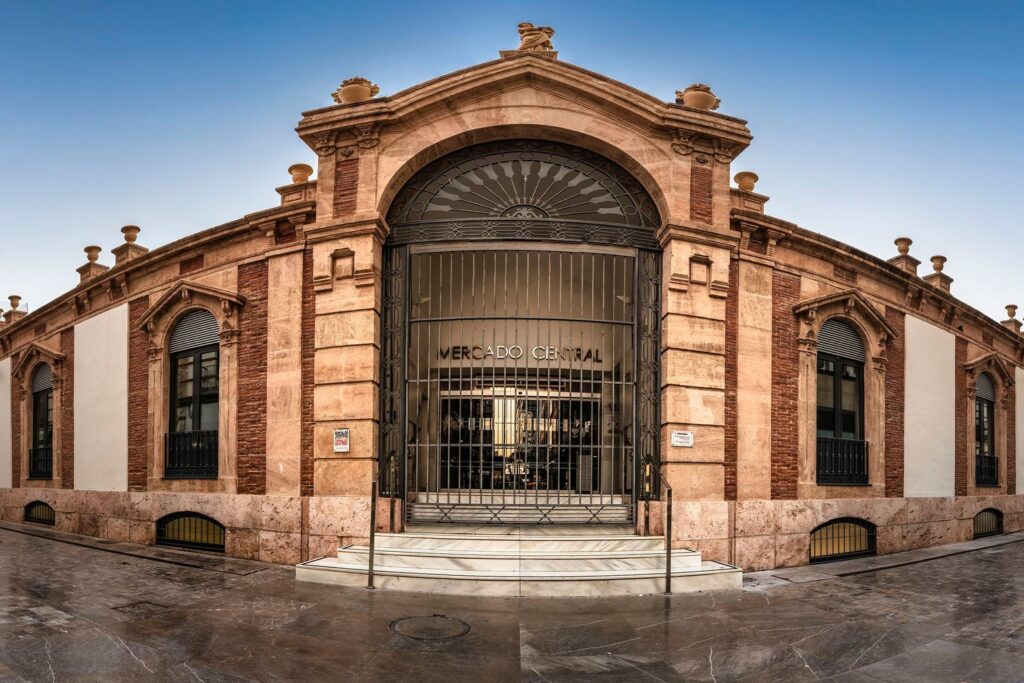
From the Paseo, walk down La Rambla, a wide avenue of palm trees, fountains and playgrounds laid out over an old dry riverbed. La Rambla leads straight to the port and the seafront, so it’s the perfect route for an evening walk.
Watch the sunset by the Cable Inglés
Down by the port stands the Cable Inglés (English Pier), a striking iron loading pier built in 1904 for a Glasgow mining company. Trains once ran along it to load iron ore from the mines of Alquife, in the province of Granada, straight into waiting ships. It closed in 1973 and is now protected as a site of cultural interest. Admire it from the surrounding gardens, ideally at sunset, when the iron girders glow orange against the bay.

Explore La Chanca, the fishermen’s quarter
Below the Alcazaba lies La Chanca, the old fishermen’s district. Its brightly painted cube houses, some of them partly dug into the hillside, look nothing like the rest of the city. It’s a working-class neighbourhood rather than a tourist attraction, so wander respectfully and stick to daylight hours. The view of its colourful façades from the fortress walls is one of the classic images of Almeria.

Go tapas hopping in the old town
Almeria is one of the last cities in Spain where you still get a free tapa with every drink. Better still, many bars let you choose it from a list. Head to the streets just below the cathedral, known as Cuatro Calles (Four Streets), and around Calle Real and Plaza de San Pedro, and do as the locals do. Tapear here means one drink and one tapa per bar, then move on. Look out for gurullos (small pasta shapes stewed with rabbit), migas, fried fish and red prawns from Garrucha.
Tapas hopping is one of the most enjoyable things to do in Almeria after dark. The bars stay busy until late, and the city’s student population keeps the nightlife lively without the crowds of the bigger Andalusian cities.
Swim at Zapillo beach and walk the seaside promenade
Almeria has a proper city beach, which is a rare treat for a provincial capital. Playa del Zapillo starts a short walk east of the city centre and continues as a long sandy strip towards Playa Nueva Almería. A seaside promenade runs alongside, with beach bars, palm trees and plenty of benches. The water is calm and shallow, which makes it a good choice for families with children. For wilder sand and clearer water, though, you’ll need to head out of town.
Things to do around Almeria: beaches, desert and white villages
Some of Almeria’s best experiences lie beyond the city limits. Within an hour’s drive you can swap Moorish walls for volcanic coves, film-set deserts and whitewashed villages. Public transport to the most beautiful spots is limited, so hiring a car gives you much more freedom.
Cabo de Gata-Níjar Natural Park
Cabo de Gata is the reason many people fall in love with Almeria. The Cabo de Gata-Níjar Natural Park is the largest protected stretch of coast in Andalusia and one of the last unspoilt sections of Spain’s Mediterranean shore. Its hills, cliffs and coves were formed by volcanoes millions of years ago, and the area is both a UNESCO Biosphere Reserve and a UNESCO Global Geopark. Its waters are protected as a marine reserve, which is why the snorkelling here is so good.
Start at the Faro de Cabo de Gata (Cabo de Gata Lighthouse), built in 1863 at the southern tip of the cape, about 40 minutes’ drive from the city. Just offshore rises the Arrecife de las Sirenas (Mermaids’ Reef), a cluster of jagged volcanic rocks named after the monk seals that once lived here. On the way, stop at the salt flats near the village of San Miguel de Cabo de Gata, where flamingos feed for much of the year.
Why is it called Cabo de Gata? The most common explanation is that the name comes from agate (ágata in Spanish), a semi-precious stone once found along this coast. And is Cabo de Gata worth visiting? Absolutely. It’s the best day trip from Almeria, and the coves are even better seen from the water on a kayak or snorkelling tour.
Almeria beaches: Genoveses, Mónsul and Playa de los Muertos
The most beautiful beaches in Almeria are all inside the natural park, and none of them is lined with hotels. Playa de los Genoveses is a wide, kilometre-long bay of golden sand framed by two headlands, just south of San José. A little further along the dirt road lies Playa de Mónsul, famous for its towering sand dune and the rock formations left by ancient lava flows. Its central rock stack appears in Indiana Jones and the Last Crusade, in the scene where Sean Connery scares a flock of seagulls into an enemy plane with his umbrella.
Further north-east, near Carboneras, Playa de los Muertos is often listed among the best beaches in Spain. A steep path leads down from the car park to its fine pebbles and turquoise water, so bring water and proper shoes. There are no bars or shops on any of these beaches, so pack everything you need. In July and August the car parks fill up early, and a shuttle bus runs from San José to Genoveses and Mónsul.
San José, Las Negras and Rodalquilar
San José is the main village in the park and the best base for exploring it. It has a small marina, a sandy beach and a good choice of restaurants and holiday flats, yet it keeps the relaxed feel of a fishing village. Further north, Las Negras is quieter still. In summer, small boats run from here to Cala de San Pedro, a secluded cove that you can otherwise only reach on foot.

Inland, Rodalquilar is a former gold-mining village. The mines closed in 1966, and their ruins now form an eerie open-air site that has appeared in several films. Nearby stands the Cortijo del Fraile, an abandoned farmhouse where a crime of passion in 1928 inspired Federico García Lorca’s play Blood Wedding.
Níjar, the village of potters
Níjar clings to the slopes of the Sierra Alhamilla, about 40 minutes’ drive from the city. Its whitewashed lanes are full of workshops selling glazed pottery and jarapas, colourful rag rugs woven on traditional looms. Climb above the village for a sweeping view across the plain to the sea. It’s easy to combine with a day in Cabo de Gata.
Tabernas Desert and the Wild West film sets
Just 30 km north of the city lies the Tabernas Desert, a protected landscape of eroded badlands that is often described as the only desert on the European continent. In the 1960s, director Sergio Leone used it to shoot spaghetti westerns such as For a Few Dollars More and The Good, the Bad and the Ugly. Hundreds of films followed, from Lawrence of Arabia to Indiana Jones and the Last Crusade.
Three old film sets survive as visitor attractions. The Oasys MiniHollywood theme park is the largest, with a Wild West town, daily shoot-outs and saloon shows, and a small zoo. Fort Bravo still hosts film shoots and feels more like a working set, while Western Leone is the smallest and quietest. To see the desert landscape itself, join a 4×4 tour along the dry riverbeds, one of the most popular things to do in Almeria province, or come back after dark for stargazing under some of the clearest skies in Europe.
Mojácar, a white village above the sea
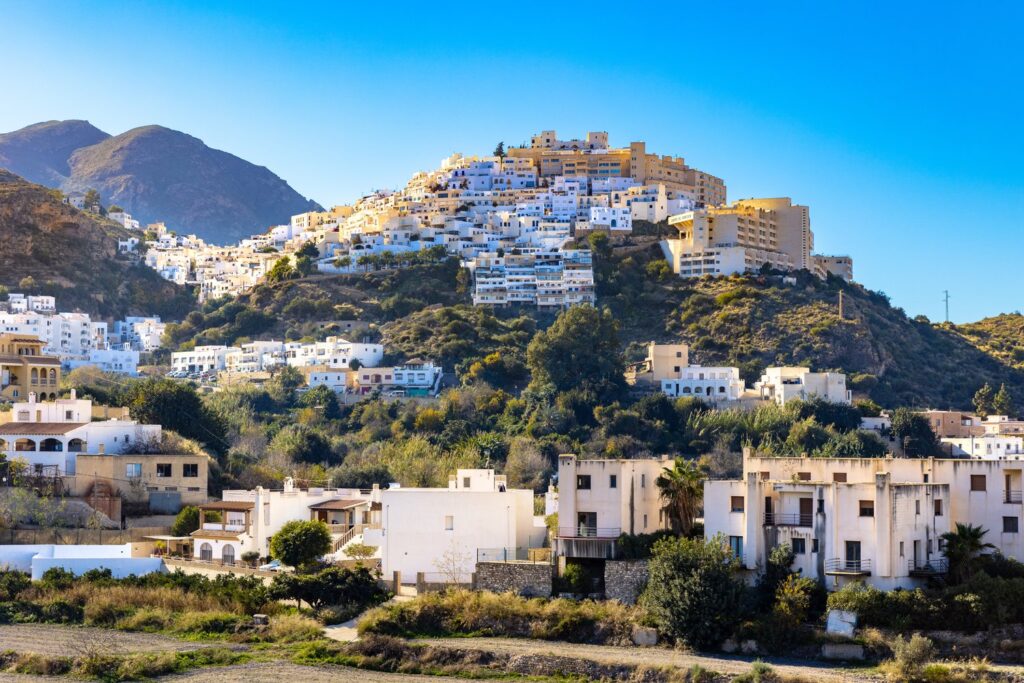
Mojácar Pueblo sits on a hilltop about an hour’s drive north-east of Almeria. Its cube-shaped white houses tumble down the slope just a couple of kilometres from the sea, and the viewpoints in the upper village look right along the coast. Mojácar is also the home of the Indalo, a prehistoric stick figure holding a rainbow, which has become the good-luck symbol of the province. Below the village, Mojácar Playa, a long string of bar-lined beaches, is especially popular with British visitors.
Further afield: the Pulpí Geode and Granada
If you have more time, head to the north of the province to see the Pulpí Geode, one of the largest visitable geodes in the world. Discovered in 1999, it opened to visitors in 2019. This hollow inside the old Mina Rica mine is about 8 m long and lined with huge, glass-clear gypsum crystals, some of them nearly 2 m in length. You can’t step inside, but the guided tour takes you right up to its opening. Group sizes are strictly limited and the site usually closes on Mondays, so book well ahead.
Granada and the Alhambra are about two hours away by car, which makes them an easy addition to a tour of eastern Andalusia.
How many days do you need in Almeria?
Two full days are enough for the main things to do in Almeria city: the Alcazaba, the cathedral, the shelters, the Casa del Cine and an evening of tapas. Add a third day for Cabo de Gata and a fourth for the Tabernas Desert or Mojácar. With a week, you can split your stay between the city and a few nights in San José, so you can enjoy the beaches early in the morning before the day-trippers arrive.
A good three-day plan looks like this. On day one, explore the Alcazaba in the morning, have lunch in the old town and visit the cathedral and the Spanish Civil War shelters in the afternoon. On day two, drive to Cabo de Gata for the lighthouse and the salt flats, then spend the afternoon on Mónsul or Genoveses. On day three, head into the Tabernas Desert in the morning and finish with the sunset from Cerro de San Cristóbal.
When is the best time to visit Almeria?
Like the rest of southern Spain, Almeria is warm all year round. Winters are mild, with daytime highs of around 17°C in January, and it rarely rains, which makes it one of the best winter-sun destinations on mainland Spain. Spring and autumn are ideal for sightseeing, hiking in Cabo de Gata and exploring the desert, with temperatures in the low to mid-20s. July and August are hot, with highs of about 31°C on the coast and considerably higher in the Tabernas Desert, so plan outdoor visits for the early morning.
Is Almeria the hottest part of Spain? Not quite. Inland cities such as Seville and Córdoba usually get hotter in summer, but Almeria is among the driest and sunniest places in Europe. The sea is warmest in August and September, which are the best months for swimming.
Getting to Almeria and getting around
Which airport should you fly into for Almeria? The city has its own airport, just 9 km east of the centre. Direct flights run from several UK airports, including London (Gatwick, Luton, Stansted and Southend), Manchester, Birmingham, Bristol, Leeds Bradford, East Midlands and Liverpool, mostly with easyJet, Jet2 and Ryanair. Many routes are seasonal, so check schedules before you plan a winter trip. Alternatively, fly into Málaga, which has far more connections, and drive about two and a half hours east.
A city bus links the airport with the centre in around half an hour. Trains pull into the main train station near the centre, which doubles as the long-distance bus station, with connections to Madrid, Seville and Granada. You can compare train and bus tickets online before you go. Next to the modern terminal stands the old railway station, a handsome iron-and-brick building from 1895.

In the city itself, you’ll walk almost everywhere. For Cabo de Gata, Tabernas and Mojácar, car hire is by far the most practical option. If you’d rather not drive, guided tours with hotel pick-up are a good alternative.
Hotels in Almeria
The best area to stay for sightseeing is the city centre around Plaza Flores, Puerta de Purchena and the old town, within walking distance of the Alcazaba and the tapas bars. If you’d rather wake up by the sea, look along the Zapillo seafront or base yourself in San José for a beach holiday in Cabo de Gata. Book early for Easter, July and August, as the best central hotels fill up quickly.
See available accommodation in Almeria
💰 Torreluz Centro
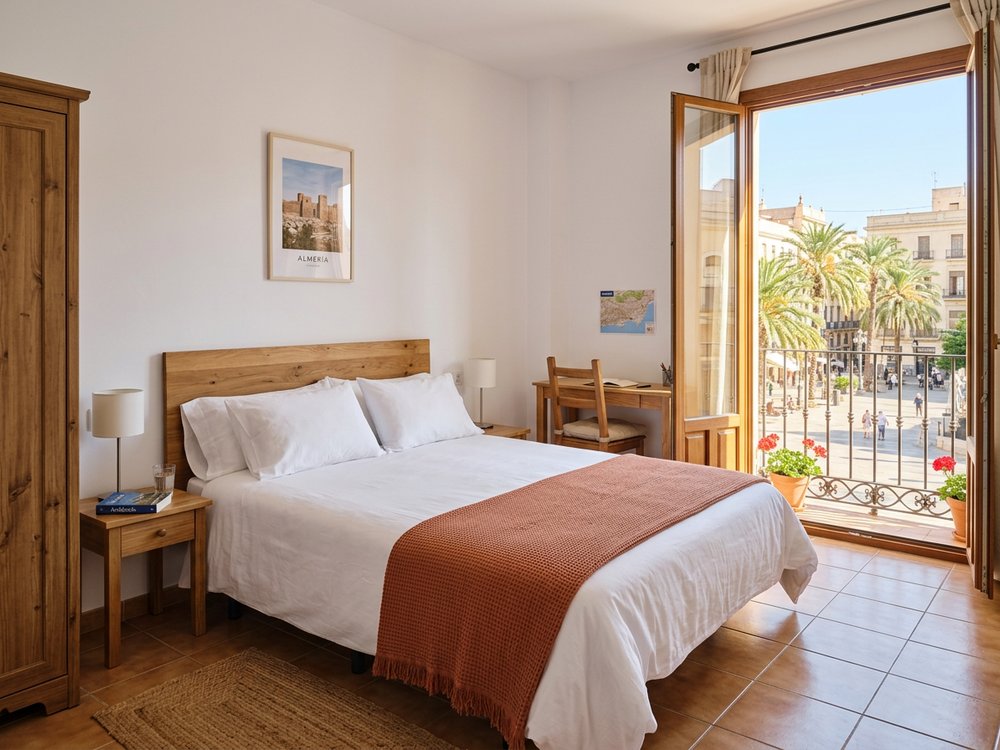
A great-value hotel on Plaza Flores, in the heart of the city and a few minutes’ walk from the cathedral, the Alcazaba and the Civil War shelters. The rooms are large and soundproofed, with air conditioning and free Wi-Fi, and there are plenty of tapas bars on the doorstep. Private parking is available, which is handy if you’re planning day trips by car. It’s a smart choice if you want a central base without paying boutique prices.
🏨 AC Hotel Almería by Marriott
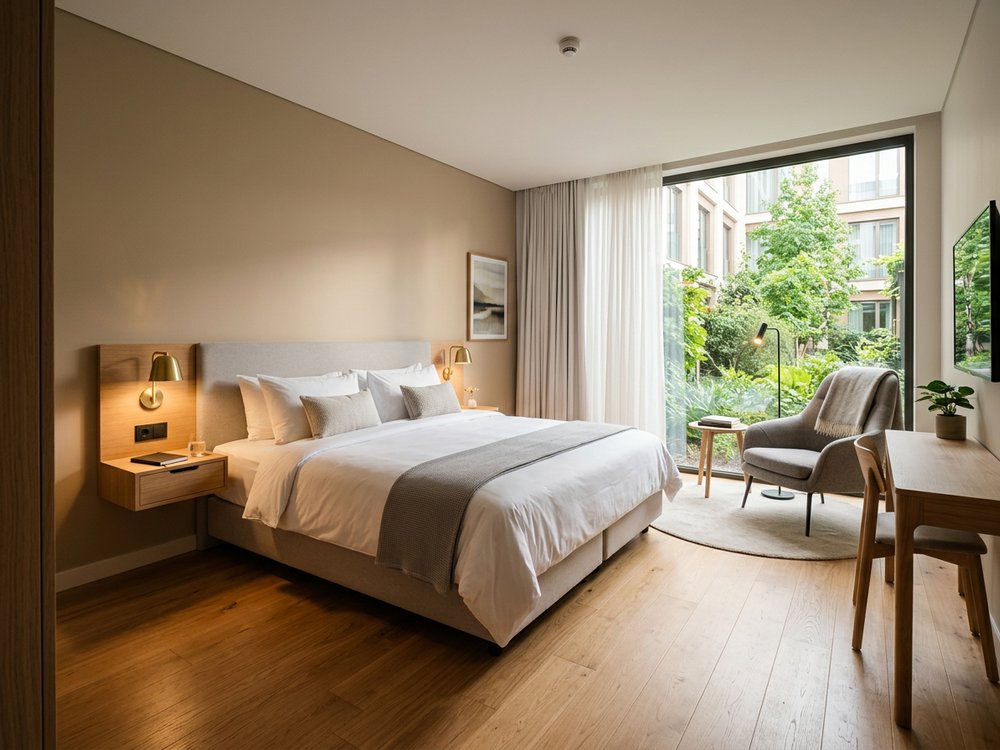
A modern four-star hotel on Plaza Flores, about six minutes’ walk from the Alcazaba and close to the old town’s best tapas streets. The rooms are stylish and spacious, with wooden floors and a choice of pillows. In summer, the rooftop pool is a great place to cool off after sightseeing, and there’s also a well-equipped gym. It suits couples and city-break travellers who want comfort right in the centre.
💎 Aire Hotel & Ancient Baths
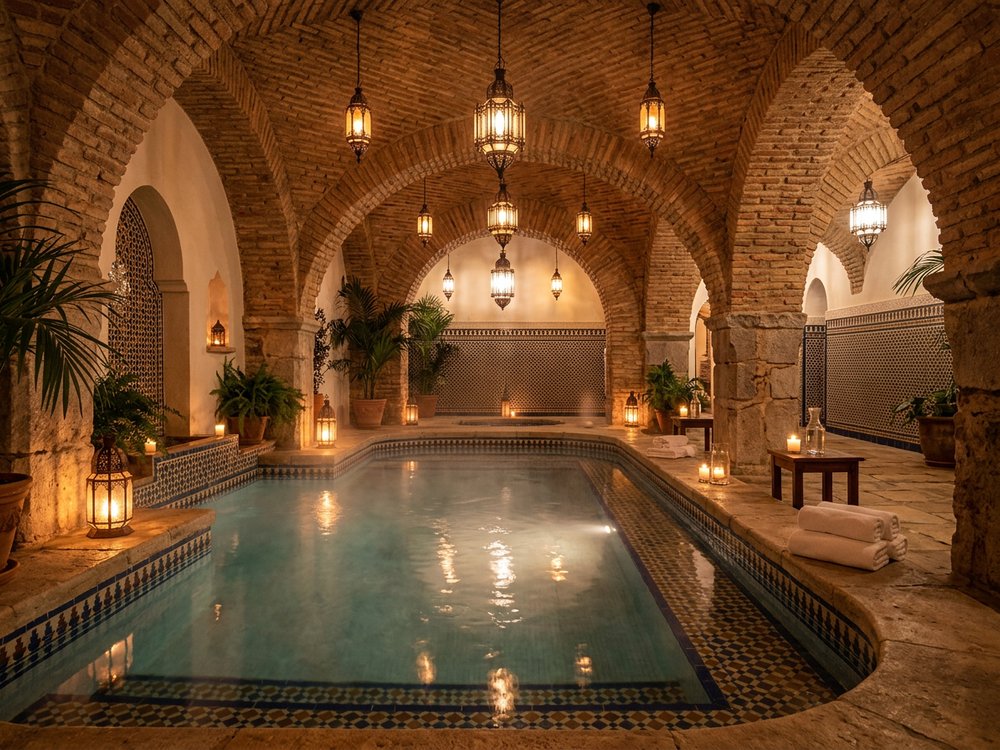
A boutique hotel in a converted 19th-century building on Plaza de la Constitución, steps from the town hall and the cathedral. Its highlight is the candlelit thermal baths, with pools at different temperatures, a steam room and massages. The rooftop pool looks straight up at the Alcazaba, which makes it a lovely spot for a drink at sunset. It’s perfect for a romantic break or for anyone who wants a touch of luxury in the old town.

