After a terrible flood in 1957, the city moved its river out of town. The dry bed it left behind now holds some of the strangest buildings in Europe.
The City of Arts and Sciences is the futuristic cultural and leisure complex that changed the way the world sees Valencia. Its white concrete buildings, glass and broken-tile mosaics stretch for around two kilometres along the old Turia riverbed, between the historic centre and the sea. In Valencian it’s called the Ciutat de les Arts i les Ciències, and in Spanish the Ciudad de las Artes y las Ciencias. For many travellers, the City of Arts and Sciences, Valencia’s top modern sight, is the reason to visit the city in the first place.
In this guide you’ll find what’s inside each building, which ones are free to walk around, how much time you need, how the tickets work, how to get there and where to stay nearby. If you’re planning a longer stay, our guide to Valencia covers the old town, the beaches and the best food in the city.
💰 B&B HOTEL Valencia Arena - a good-value modern hotel a short walk south of the complex.
🏨 Barceló Valencia - a four-star hotel about 100 metres away, with a rooftop pool.
💎 Hotel Las Arenas Balneario Resort - a luxury beachfront resort with a spa and a kids’ club.
What is the City of Arts and Sciences in Valencia?
The City of Arts and Sciences is an architectural complex of museums, an aquarium, a cinema, an opera house, gardens and bridges, built between 1996 and 2009. Most of it was designed by the Valencian architect Santiago Calatrava, while the Oceanogràfic was designed by Félix Candela. The project began with a regional government plan in the late 1980s, and it grew far bigger, and far more expensive, than first planned.
The first building completed was the Hemisfèric, which opened in 1998. The Science Museum followed in 2000, the Umbracle in 2001, the Oceanogràfic in 2003 and the Palau de les Arts in 2005. The Assut de l’Or bridge and the Àgora completed the entire complex by 2009. Today it’s one of the best-known examples of modern architecture in Spain.
Where is the City of Arts and Sciences?
The City of Arts and Sciences sits at the south-eastern end of the Turia Gardens, the green park that now fills the former riverbed. It’s about 3 km from the cathedral and the old town, and roughly the same distance from the beaches at Las Arenas and La Malvarrosa. The whole site is flat and easily accessible on foot, by bike or in a wheelchair.

The main address is Avinguda del Professor López Piñero, on the south side of the complex. The Aqua and El Saler shopping centres stand right next to it, which is handy for a cheap lunch or a rainy-day break.
The main buildings of the City of Arts and Sciences Valencia
There are six main buildings and two bridges. Each one has its own tickets and opening hours, so it helps to know what’s inside before you go.
L’Oceanogràfic - the largest aquarium in Europe
The Oceanogràfic is the biggest draw for families and the largest aquarium in Europe. It covers around 110,000 square metres, holds around 42 million litres of water and is home to tens of thousands of animals from about 500 species. Its main building, designed by Félix Candela, has a curved roof shaped like a water lily.

The aquarium is divided into areas that recreate different seas and habitats: the Mediterranean, wetlands, temperate and tropical seas, the oceans, the Antarctic, the Arctic, the islands and the Red Sea. Look out for the belugas in the Arctic zone, the penguins, the sea lions and the sharks. The highlight for most visitors is the underwater tunnel, where sharks and rays swim right over your head. There’s also a dolphinarium and an underwater restaurant surrounded by tanks of marine life.
Museu de les Ciències - the interactive science museum
The Museu de les Ciències Príncipe Felipe is a huge interactive museum that looks like the skeleton of a whale. It’s 220 metres long and has around 26,000 square metres of exhibition space, the largest of any science museum in Spain. The idea is simple: you’re meant to touch things, press buttons and try the experiments yourself.

The ground floor is free and usually hosts a temporary exhibition, along with shops, toilets and a restaurant. The interactive exhibits on the upper floors need a ticket. Science enthusiasts can easily spend three hours here, and children love the hands-on sections.
L’Hemisfèric - the IMAX cinema and digital planetarium
The Hemisfèric is the building that looks like a giant human eye. Its shell-shaped roof is the eyelid, it opens and closes over a shallow pool, and the reflection completes the eye. Inside there’s an IMAX cinema and a digital planetarium with a 900 square metre screen, the largest screening room in Spain.
The films are about space, nature and science, and they usually last under 45 minutes. Headphones are provided, so you can watch in English or several other languages. It’s a good choice for a hot afternoon or a rainy day, when you’d rather sit down for a while.
Palau de les Arts Reina Sofía - the opera house
The Palau de les Arts Reina Sofía is the opera house and performing arts centre, and the most spectacular building of the whole site. Its metal roof, shaped like a feather or a helmet, rises around 70 metres above the ground. Inside there are four main halls for opera performances, zarzuela, ballet, symphonic concerts and other musical performances.

You don’t need to book an opera to see the inside. Guided tours of around one hour run in English and Spanish, and they take you onto the stages and behind the scenes. If you love opera, check the programme before your trip, as an evening performance here is unforgettable.
L’Umbracle - the open-air garden
The Umbracle is a long, open walkway covered by white arches, around 320 metres long. It’s planted with palm trees and native plants from the Valencia region, which change colour through the seasons. Along the path you’ll find a sculpture garden with works by contemporary artists, including Yoko Ono and Miquel Navarro.

The Umbracle is free to enter and offers some of the best views over the whole complex. On summer nights, the terrace turns into an open-air club, and there’s an underground car park beneath it for visitors arriving by car.
L’Àgora - CaixaForum València
The Àgora is the tall, blue covered plaza at the end of the complex. It was the last building completed, and for years it hosted special events, concerts and sporting events such as tennis tournaments. Since 2022 it has been home to CaixaForum València, a cultural centre with art exhibitions, talks and family activities.
The Assut de l’Or bridge and the Montolivet bridge
The Assut de l’Or bridge crosses the middle of the complex. Its curved white pylon is 125 metres high, the highest point in the city, and it’s easy to spot from the beach. The Montolivet bridge, at the other end, has a southern section designed by Calatrava. Both are great spots for photos of the futuristic buildings.

Is the City of Arts and Sciences free?
Yes and no. Walking around the outside of the City of Arts and Sciences is completely free, and you can spend a happy hour or two just taking in the sweeping curves, the pools and the reflections. The Umbracle and the ground floor of the Science Museum are also free.
The Oceanogràfic, the Hemisfèric, the exhibition halls of the Science Museum and the Palau de les Arts tours all need a ticket. The free areas are a good way to get a feel for the place if you’re short on time or travelling on a budget.
City of Arts and Sciences tickets
You can buy City of Arts and Sciences tickets for each building on its own, or combined tickets that cover several of them. The most popular combinations include the Oceanogràfic, the Science Museum and the Hemisfèric. Combined tickets usually let you visit the buildings on different days, which is a real advantage if you want to spread things out.
The Oceanogràfic is the busiest building, especially in high season, at weekends and on public holidays. If you’re visiting in July, August or at Easter, book your arts and sciences tickets online before you travel. The Valencia Tourist Card also gives a discount on entry and covers public transport around the city.
How long do you need at the City of Arts and Sciences?
Plan a full day if you want to see the main attractions properly. The Oceanogràfic alone takes around four hours, and longer if you stay for the dolphin presentation. The Science Museum needs about three hours, and a Hemisfèric film takes under an hour.
If you only want to see the architecture, two or three hours of walking around the outside is enough. With children, many families split the visit into two days, with the aquarium on one day and the museum and a film on the next.
Opening hours and the best time to visit
The buildings usually open at 10am every day. The Oceanogràfic often closes around 6pm out of season and stays open much later in midsummer, while the Science Museum usually closes around 7pm, later in summer. Times change by season, and each building has its own schedule.
The best time to visit is a weekday morning, outside school holidays. Arrive at opening time for the aquarium, and come back to the outside areas in the late afternoon or after dark. The buildings are lit up at night, and the reflections in the pools are at their best around sunset. Spring and autumn are the most pleasant seasons, as the white concrete reflects a lot of heat in July and August.
How to get to the City of Arts and Sciences
The nicest way to get there from the old town is on foot or by bike through the Turia Gardens. The walk takes around 40 to 45 minutes along a green, car-free park, and there are bike hire shops in the centre.
Several city buses stop at the complex, including lines 35 and 95. The nearest metro station is Alameda, on lines 3 and 5, about a 20-minute walk away. A taxi from the old town is a short ride. If you’re driving, the car park under the Umbracle is the most convenient option. A hire car makes sense if you plan to combine Valencia with the Costa Blanca, for example Benidorm or Altea, but you won’t need one in the city itself.
Tips for families and first-time visitors
The City of Arts and Sciences is one of the best family days out in Valencia. Children usually love the Oceanogràfic most, followed by the Science Museum’s hands-on sections. Bring hats, sun cream and water in summer, as there’s little shade between the buildings.
You can bring your own food, and the Oceanogràfic has rest areas for a picnic. There are restaurants in the Science Museum and the aquarium, and plenty of cheaper options in the shopping centres next door. If your kids are animal fans, Bioparc Valencia is another great family attraction, at the far western end of the Turia Gardens. And if you’ve already seen the aquarium in Barcelona, the Oceanogràfic is on a much bigger scale.
A famous filming location
The City of Arts and Sciences looks so futuristic that film and TV crews keep coming back. It appeared in Disney’s Tomorrowland, in the Doctor Who episode “Smile” and as the headquarters of the Delos company in the third season of Westworld. More recently, parts of the Star Wars series Andor were filmed here. Fans often recognise the buildings before they know where they are.
Practical information
- City of Arts and Sciences tickets are best bought in advance. You’ll skip the ticket queue at the entrance and avoid the risk of the Oceanogràfic selling out on busy days.
- Address: Av. del Professor López Piñero, 7, 46013 València, Spain
- Buy tickets on GetYourGuide
Hotels near the City of Arts and Sciences
Staying near the City of Arts and Sciences puts you halfway between the old town and the beach, with good bus links in both directions. These three hotels suit different budgets.
💰 B&B HOTEL Valencia Arena

A good-value hotel on Avinguda d’Ausiàs March, in the Quatre Carreres district south of the complex. Rooms are simple and modern, with free wifi, and there’s covered parking for guests with a car. It’s a practical base if you want to spend your money on tickets rather than on your room.
🏨 Barceló Valencia

A modern four-star hotel on Avenida de Francia, only about 100 metres from the City of Arts and Sciences. The highlight is the 10th-floor terrace with an outdoor pool, a bar and wide views over the city. It’s the most convenient choice if you plan to spend two days at the aquarium and the museums.
💎 Hotel Las Arenas Balneario Resort
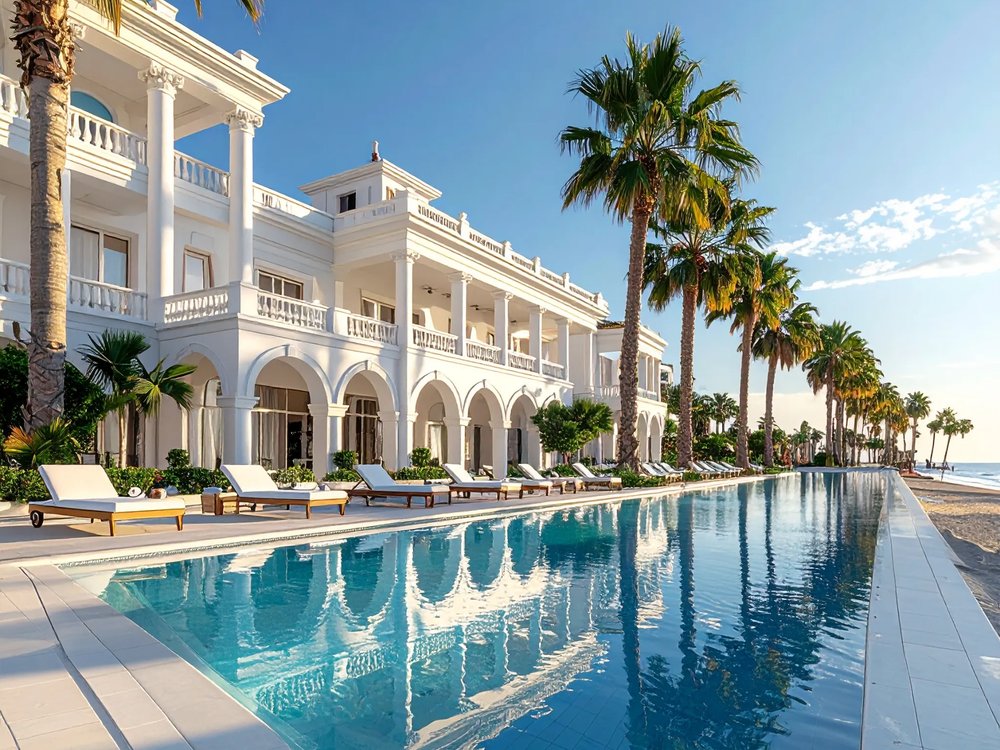
A luxury beachfront hotel on Las Arenas beach, a short taxi ride from the City of Arts and Sciences. It has indoor and outdoor pools, a spa, a fitness centre and a kids’ club. It’s the pick if you want to combine sightseeing with proper beach days.
City of Arts and Sciences FAQ
What is in the City of Arts and Sciences Valencia?
The City of Arts and Sciences has six main buildings: the Oceanogràfic aquarium, the Science Museum, the Hemisfèric IMAX cinema, the Palau de les Arts opera house, the Umbracle garden and the Àgora, now CaixaForum València. There are also two bridges and large pools and gardens around the buildings.
Who designed the City of Arts and Sciences?
Most of the complex was designed by Santiago Calatrava, an architect born in Valencia. The Oceanogràfic aquarium was designed by Félix Candela, together with other architects. Calatrava’s style, with white concrete, curves and structures inspired by nature, gives the site its look.
Is the City of Arts and Sciences in Valencia free?
Walking around the City of Arts and Sciences is free, and so are the Umbracle and the ground floor of the Science Museum. You need tickets for the Oceanogràfic, the Hemisfèric, the Science Museum’s exhibitions and guided tours of the Palau de les Arts.
How long should you spend at the City of Arts and Sciences?
Plan a full day to see the Oceanogràfic, the Science Museum and a Hemisfèric film. If you only want to see the architecture from outside, two or three hours is enough. Families often spread the visit over two days.
Is the Valencia Science Museum worth it?
Yes, especially with children or teenagers. The Museu de les Ciències is hands-on, so kids can experiment instead of just reading panels. Even if you skip the paid exhibitions, the free ground floor and the building itself are worth seeing.
What is the most famous building in Valencia?
The City of Arts and Sciences is the most famous modern landmark in Valencia, and the Hemisfèric and the Palau de les Arts are its best-known buildings. In the old town, the cathedral and its Micalet bell tower are the classic historic icons.

