In 1957 a flood swept through the city and changed the river’s course for good. The water was diverted, and the empty bed became nine kilometres of palms, playgrounds and cycle paths.
Valencia is Spain’s third-largest city, yet it rarely feels like one. You can walk from a Gothic cathedral to a 15th-century silk market in ten minutes, cycle through a park that used to be a river and finish the day with paella a stone’s throw from the Mediterranean Sea. In this article you’ll find the best things to do in Valencia, a simple two-day plan, the most rewarding day trips and practical tips on getting around and where to stay.
The city is the capital of the Valencian Community and sits on Spain’s east coast, between Barcelona and Alicante. It’s compact, flat and sunny for most of the year, which makes it one of the easiest cities in Europe to explore on foot or by bike. Most people visiting Valencia come for a long weekend, but it’s worth staying longer if you want time for the beach and a day out in the rice fields of the Albufera.
💰 Ad Hoc Carmen - Good-value hotel in a historic building in Barrio del Carmen.
🏨 One Shot Mercat 09 - Boutique four-star with a seasonal pool next to the Central Market.
💎 MYR Palacio Vallier - Five-star palace hotel steps from Plaza de la Virgen.
What is Valencia famous for?
Ask a Spaniard and you’ll hear about paella first. The dish was born in the rice-growing villages around the Albufera lagoon, and locals still argue about what belongs in the pan. Valencia is also famous for its oranges, for horchata, a sweet tiger nut drink, and for Las Fallas, a March festival that ends with giant sculptures set on fire in the streets.
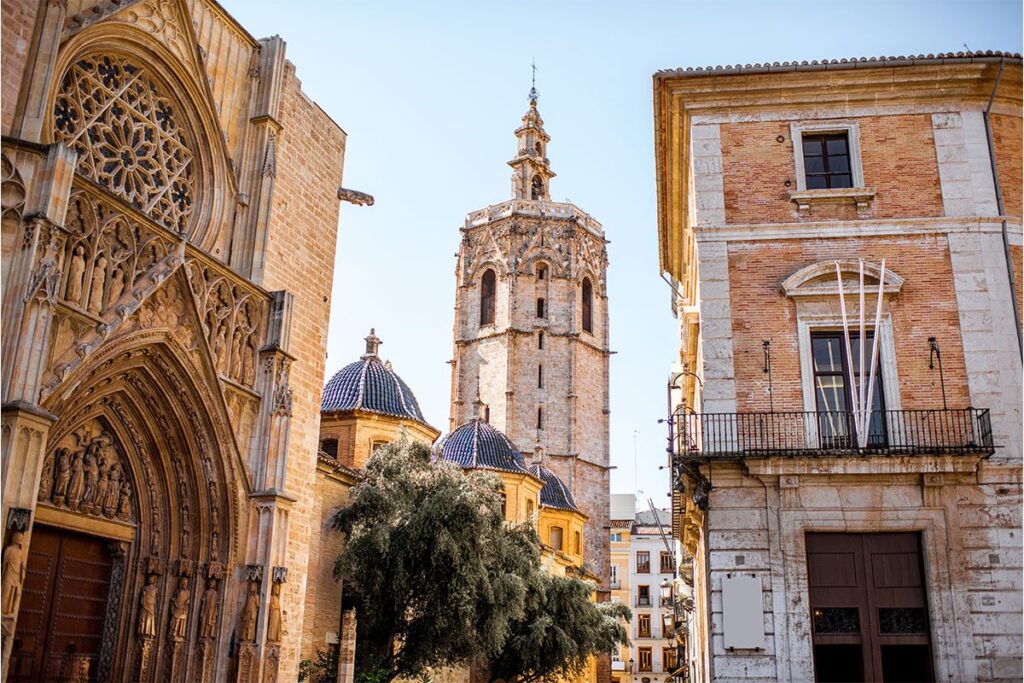
Then there’s the architecture. The old town, or Ciutat Vella, is packed with Gothic and Baroque landmarks, including the Silk Exchange, a UNESCO World Heritage Site. A few kilometres away, Santiago Calatrava’s City of Arts and Sciences looks like a set from a science fiction film. The cathedral even claims to hold the Holy Grail. Add urban beaches, a huge green park and a relaxed pace of life, and it’s easy to see why so many travellers fall for the place.
Is Valencia, Spain worth visiting?
Yes, and for many people it’s a better first taste of Spain than the big two. Valencia has fewer crowds than Barcelona, a beach you can reach by tram and enough museums to fill a rainy day. Locals and tourists alike make the most of the outdoors here, so expect busy terraces late into the evening. If you prefer cities you can explore at your own pace, without queuing for hours, Valencia is a very safe bet.
Top things to do in Valencia at a glance
Short on time? These are the places to visit in Valencia that most travellers would not want to miss: the City of Arts and Sciences and the Oceanogràfic, the cathedral and the Miguelete tower, the Silk Exchange and the Central Market, a bike ride through the Turia Gardens, an afternoon on Malvarrosa beach, paella in its home region and a sunset boat trip on the Albufera. Below you’ll find what to see and do at each of them, plus tips on food, festivals and day trips.

Admire the City of Arts and Sciences
The City of Arts and Sciences (Ciudad de las Artes y las Ciencias) is the image most people have of modern Valencia. This complex of gleaming white avant-garde architecture was designed mainly by Santiago Calatrava and opened in stages from 1998. It stretches for almost 2 kilometres along the old riverbed, with shallow pools reflecting buildings that look like eyes, shells and the ribs of a whale.
You’ll find several venues here. L’Hemisfèric is an IMAX cinema and planetarium shaped like a giant eye. The Príncipe Felipe Science Museum is hands-on and great for kids, while the Palau de les Arts Reina Sofía hosts opera and ballet. L’Umbracle is a landscaped walkway with palms and a popular terrace bar on summer nights.
The star for families is the Oceanogràfic, Europe’s largest aquarium. Its pavilions recreate oceans and seas from the Arctic to the tropics and are home to some 45,000 animals, from sharks to belugas. Don’t miss the underwater tunnel, where fish swim right over your head. Plan at least half a day for it. You don’t need a ticket to walk around the outside of the complex, and the best photos come at sunset or after dark, when the buildings are lit up.
Wander Valencia old town (Ciutat Vella)
Valencia old town is where most of the major Valencia attractions sit, all within walking distance of each other. It grew inside medieval walls that were pulled down in the 19th century, so today it’s ringed by wide boulevards and the green belt of the former river. Inside, narrow lanes open onto sunny squares lined with orange trees.
The best way to explore Valencia’s historic centre is on foot. Start at Plaza del Ayuntamiento, the grand city hall square, and follow the streets north towards the cathedral. Calle Caballeros, an old street of noble palaces, runs west from there into the bohemian Barrio del Carmen.
Plaza de la Virgen and the Water Tribunal
Plaza de la Virgen is the heart of the old town and a lovely place for a coffee. On one side stands the Basilica of Our Lady of the Forsaken, the city’s patroness, and in the middle a fountain represents the River Turia and its irrigation channels. Every Thursday at noon, the Water Tribunal meets outside the cathedral’s Apostles’ Door. This farmers’ court has settled water disputes for over a thousand years and is on UNESCO’s list of intangible heritage.

Valencia Cathedral and the Miguelete tower
Valencia Cathedral was begun in 1262 on the site of a mosque. Its three doors show three styles: Romanesque, Gothic and Baroque. Inside, a side chapel holds the Holy Chalice, a cup that tradition identifies as the Holy Grail used at the Last Supper. Don’t miss the Renaissance frescoes of angels above the main altar, rediscovered behind a later vault in 2004.
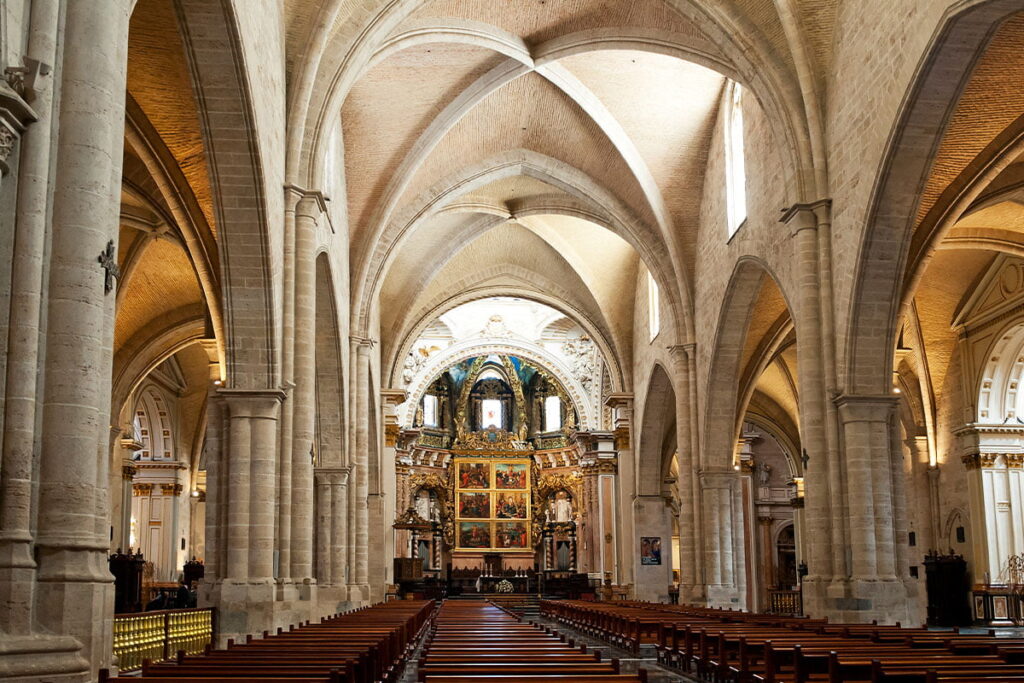
Next to the cathedral rises the octagonal Miguelete tower, the city’s symbol. Climb its 207 narrow steps for the best views in Valencia, taking in rooftops, domes and the Mediterranean on a clear day. The stairs are steep, so wear comfortable shoes and go early in summer. From the top you’ll also see Plaza de la Reina, the square with horchata bars and cafés at the foot of the tower.
Torres de Serranos and Torres de Quart
Two medieval gates survive from the old city walls. Torres de Serranos, built at the end of the 14th century, guarded the road from the north and still looks out over the Turia Gardens. You can climb it for a view across the old town. On the west side, Torres de Quart is a slightly later gate, and its stone still shows marks left by cannon fire during the Peninsular War.
Barrio del Carmen
El Carmen is the oldest and most characterful neighbourhood in Valencia. By day, it’s quiet, with crumbling palaces, tiny squares and some of the best street art in Spain. By night, it fills with bars, music and students. Look out for the remains of the Moorish and Christian walls hidden among the houses, and the IVAM, the Valencian Institute of Modern Art, with its extensive collection of works by the sculptor Julio González.

Visit the Silk Exchange and the Central Market
The Silk Exchange (Lonja de la Seda) is one of the finest secular Gothic buildings in Europe and has been a UNESCO World Heritage Site since 1996. Work began in 1482, when Valencia was one of the richest trading cities in the Mediterranean. Step into the Contract Hall, where twisted columns rise like palm trunks to a star-ribbed vault. Look up at the gargoyles outside, too, as some of them are surprisingly rude.
Right opposite stands the Central Market (Mercado Central), a Modernista masterpiece of iron, glass and ceramic tiles that opened in 1928. It’s one of the largest fresh produce markets in Europe, covering more than 8,000 square metres, with around 300 stalls selling oranges, jamón, cheese, seafood and the short-grain paella rice from the Albufera. Go in the morning, when the market is busiest, and join the locals for esmorzaret, the hearty mid-morning snack, at one of the bars inside. The market closes on Sundays.
Plaza del Mercado, the square between the two buildings, is also home to the Baroque Church of the Santos Juanes. If you love food, consider booking a paella cooking class that starts with a tour of the market. It’s one of the most popular experiences in the city.
See the “Valencian Sistine Chapel” and the city’s museums
Wondering what to do in Valencia on a rainy day? The city has excellent museums, and many of them are small enough to see in an hour. Here are the ones to put on your list.
Church of San Nicolás
From the outside, the Church of San Nicolás de Bari and San Pedro Mártir looks quite ordinary. Inside, every inch of its vault is covered with Baroque frescoes, recently restored to their original colours. It’s often called the Valencian Sistine Chapel, and once you look up, you’ll understand why.
National Museum of Ceramics
The González Martí National Museum of Ceramics is housed in the Palace of the Marqués de Dos Aguas. Its spectacular façade, carved in alabaster, is one of the most photographed in the city. Inside you’ll see centuries of Valencian tiles and pottery, period rooms and an 18th-century carriage.
Museum of Fine Arts and Hortensia Herrero Art Centre
The Museum of Fine Arts of Valencia is one of the best art galleries in Spain, with works by Goya, Velázquez, El Greco and Joaquín Sorolla, the Valencian painter of light and sea. Entry is free. For contemporary art, head to the Hortensia Herrero Art Centre, opened in 2023 in a restored palace in the old town. It displays works by international artists alongside archaeological remains uncovered during the restoration.
Cycle or stroll through the Turia Gardens
After a devastating flood in 1957, the River Turia was diverted south of the city. Instead of turning the empty riverbed into a motorway, Valencia created the Turia Gardens (Jardín del Turia), one of the largest urban parks in Spain. It’s around 9 kilometres long and links the Bioparc in the west with the City of Arts and Sciences in the east.
The park is full of life from early morning. Runners and cyclists share the paths, families picnic under the pines, and old bridges cross overhead. Look out for Gulliver Park, a giant playground in the shape of the hero from Gulliver’s Travels, and the Palau de la Música concert hall. Renting a bike is the best way to see the whole length in one go, as the paths are flat and well marked.
Meet the animals at Bioparc Valencia
Bioparc Valencia is a zoo without bars, at the western end of the Turia Gardens. Instead of cages, it uses hidden moats and natural barriers, so you feel as if you’re walking through the African savannah, equatorial forest and Madagascar. Lions, gorillas, elephants and lemurs live in landscapes recreated in great detail. It’s an ideal choice for families, and you’ll need around four hours to see it all.
Relax on a Valencia beach
Few European cities have such good beaches within the city limits. The main Valencia beach is a long strip of fine golden sand split into Playa de las Arenas and Malvarrosa beach, backed by a lively promenade with restaurants. You can get there by tram or bus from the centre in about 20 minutes. In summer the water is warm and calm, and the beaches have lifeguards, showers and sunbeds.
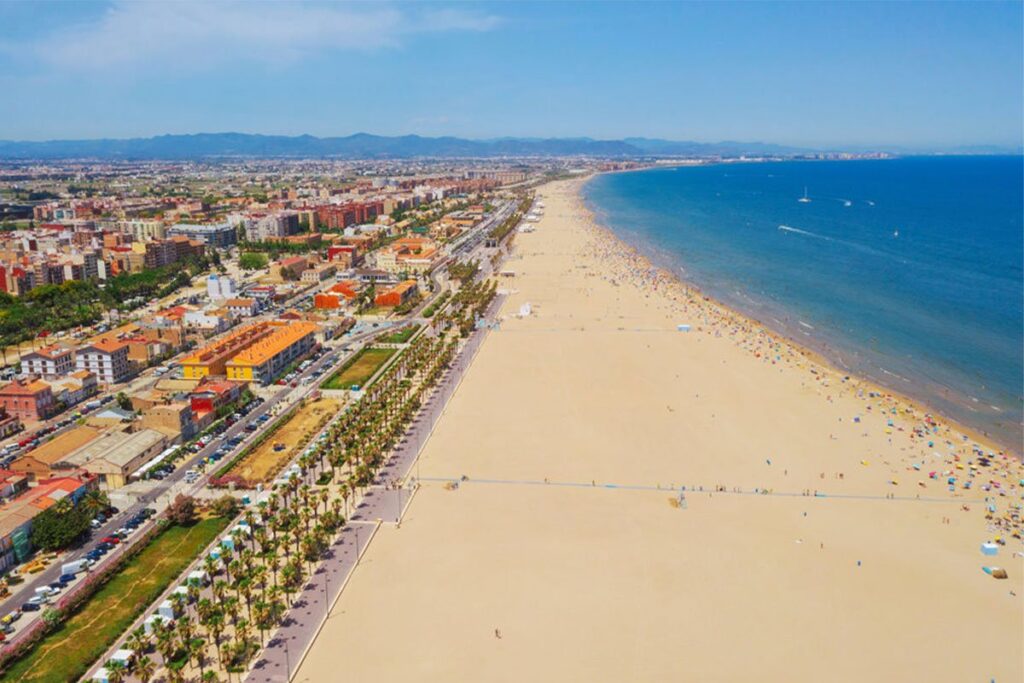
Behind the beach lies El Cabanyal, an old fishing quarter with low houses covered in colourful tiles. It’s now one of the trendiest areas of the city, with tapas bars and the Mercado del Cabanyal. If you want a quieter beach, go north to Patacona or south to the dunes of El Saler, inside the Albufera Natural Park. For a sunset drink by the sea, Marina Beach Club near the port has a swimming pool and a restaurant.
What to eat and drink in Valencia
Valencian cuisine is built around rice, vegetables and seafood. The signature dish is paella valenciana, made with chicken, rabbit, green beans and garrofó, a large white bean. Locals eat it at lunchtime, rarely in the evening, and it’s cooked to order, so expect to wait. Seafood paella, black rice with squid ink and arròs a banda, rice cooked in fish stock, are just as good. Many restaurants on the seafront at Las Arenas serve paella cooked over a wood fire.
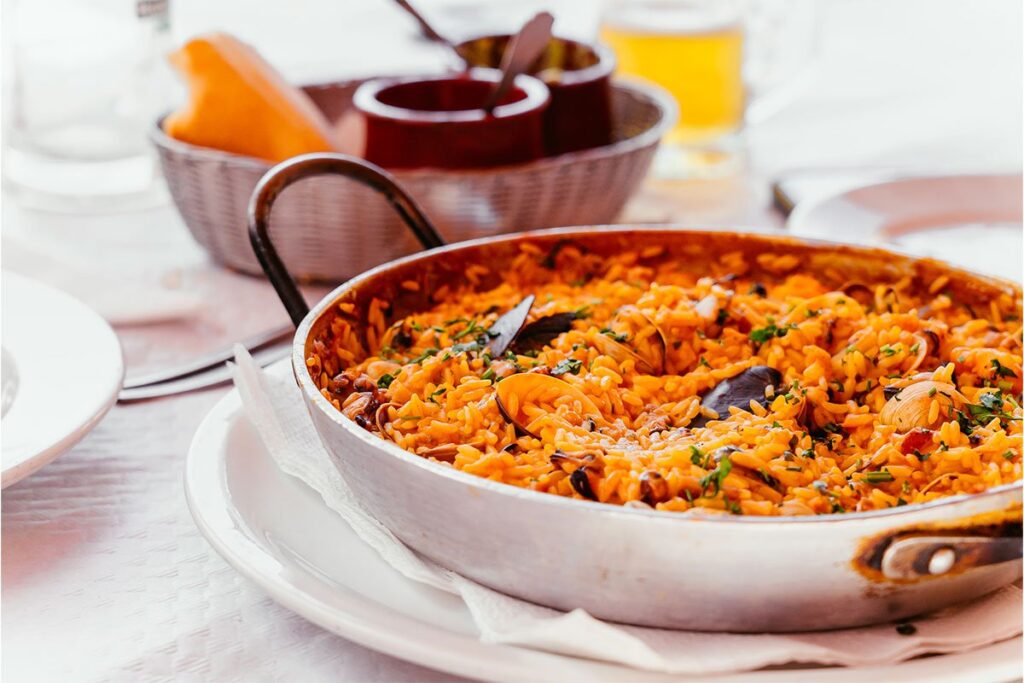
Don’t leave without trying horchata, a cold, milky drink made from tiger nuts, with fartons, long sugary pastries for dunking. Horchatería Santa Catalina, near Plaza de la Reina, has served it since the 19th century. In the evening, order agua de Valencia, a cocktail of cava, fresh orange juice, vodka and gin, created at Café Madrid in 1959. For lunch in a striking setting, the Modernista Mercado de Colón has cafés and restaurants under its colourful iron roof.
For dinner, head to Ruzafa (Russafa), a former working-class district south of the centre. Today it’s Valencia’s most creative food neighbourhood, packed with restaurants, bakeries, vermouth bars and vintage shops.
Take a boat trip in Albufera Natural Park
Albufera Natural Park lies about 10 kilometres south of the city and protects a large freshwater lagoon surrounded by rice fields, pine forests and dunes. It’s the birthplace of paella and one of the most important wetlands in Spain for birds. The village of El Palmar, on the edge of the lagoon, is full of restaurants serving rice dishes and all i pebre, a local eel stew.
The best way to see the lake is on a traditional flat-bottomed boat at sunset, when the water turns gold and pink. You can get there by local bus, by bike along the coast or as part of a tour. Combine the trip with lunch in El Palmar and a walk along the beach at El Saler.
Experience Las Fallas and Valencia’s festivals
Las Fallas is one of the wildest festivals in Spain and part of UNESCO’s intangible heritage. It’s held from 15 to 19 March in honour of Saint Joseph. The tradition began with carpenters burning their old wood to welcome spring. Today every neighbourhood builds huge satirical sculptures, called fallas, from wood, cardboard and polystyrene. From 1 March there’s a mascletà, a deafening firecracker display, every day at 2pm in Plaza del Ayuntamiento, and during the five main days the city is full of fireworks, flower offerings, brass bands and stalls selling hot chocolate and buñuelos, sweet pumpkin fritters. On the last night, the fallas are set alight in the Cremà. Only a few figures, the ninots indultats chosen by public vote, are saved from the flames.

If you’re coming for Fallas, book your accommodation well in advance, as hotels fill up months ahead. Outside March, you can see the pardoned figures saved each year at the Fallas Museum (Museu Faller).
See available accommodation in Valencia
Other festivals are worth planning around too. On the night of 23 June, Sant Joan fills the beaches with bonfires to mark the summer solstice. Corpus Christi in June brings historic carriages and giants to the streets, the summer Feria de Julio has concerts and a battle of flowers, and 9 October celebrates Valencian Community Day.
Best day trips from Valencia
Valencia makes a great base for exploring the region. Most day trips are possible by train, but car hire gives you more freedom, especially for mountain villages and hot springs.
Sagunto, just 30 minutes by train, has a Roman theatre and a vast hilltop castle with views over the coast. Xàtiva, an hour south, is crowned by a castle that stretches along a ridge. Peñíscola, a walled town on a rocky peninsula with a Templar castle, is about 90 minutes north by car and was a filming location for Game of Thrones. Inland, the thermal river pools of Montanejos are a favourite summer escape.
Further south lies the Costa Blanca. You can reach Alicante by train in about two hours, and Benidorm and the rest of the Costa Blanca resorts are easy to combine on a longer road trip along the coast.
How many days do you need in Valencia?
Two full days are enough to see the main sights at a relaxed pace. Three days let you add the beach, the Albufera and a museum or two, and four days give you time for a day trip. Here’s a simple plan for a first visit.
Day 1 - The old town and the Turia Gardens
Start with breakfast at the Central Market, then visit the Silk Exchange across the street. Walk to Plaza de la Virgen and the cathedral, and climb the Miguelete tower before it gets hot. After lunch, explore Barrio del Carmen and the Torres de Serranos. In the late afternoon, rent a bike and ride through the Turia Gardens. End the day with dinner in Ruzafa.

Day 2 - City of Arts and Sciences and the beach
Spend the morning at the City of Arts and Sciences and the Oceanogràfic. In the afternoon, take the tram to Malvarrosa beach, have a late paella lunch on the promenade and wander through El Cabanyal. If you still have energy, catch the sunset at the port or take a boat trip on the Albufera.
Day 3 - Albufera, museums or a day trip
With a third day, pick what suits you best: a morning at the Museum of Fine Arts and the Church of San Nicolás, a trip to Bioparc with children, a sunset boat trip on the Albufera with dinner in El Palmar, or a half-day trip to Sagunto. Many travellers also combine Valencia with Madrid or Barcelona, as both are easy to reach by train.
How to get to Valencia and get around
Valencia Airport is about 8 kilometres from the city centre, with direct flights from many UK and Irish airports. Metro lines 3 and 5 connect the terminal with the centre in around 25 minutes. High-speed trains link Valencia with Madrid in under two hours, and with Barcelona in about three. You can compare train and bus tickets online before you go.
In the city you’ll walk most of the time. For longer distances, use the metro, the tram to the beach or the EMT buses. The public bike scheme, Valenbisi, is designed for residents, so visitors usually rent bikes from shops in the old town. The Valencia Tourist Card includes unlimited public transport and discounts at museums, restaurants and attractions, so it can be good value if you plan a busy schedule.
When is the best time to visit Valencia?
Valencia has around 300 days of sunshine a year. Spring (April to June) and autumn (September to October) are ideal, with temperatures of 20-27°C, warm seawater in September and fewer crowds. July and August are hot and humid, often above 30°C, but perfect for the beach. Winters are mild, rarely below 10°C during the day, which makes Valencia a good off-season city break. March is the time to go for Fallas, but expect noise, crowds and higher hotel prices.
Hotels in Valencia
The best area to stay in on a first visit is Ciutat Vella, the old town, where you can walk to almost every sight. Ruzafa is perfect for food lovers, and the beach area suits a summer holiday. Here are three hotels for different budgets, all in the historic centre.
💰 Ad Hoc Carmen
A simple, good-value hotel in a 15th-century building in the heart of Barrio del Carmen, a short walk from the cathedral and the Torres de Serranos. Rooms are spacious and clean, the staff are helpful, and some windows look straight onto the historic lanes. The bars, cafés and street art of El Carmen are right outside the door. It’s an excellent base if you want to see the old town on foot without spending a fortune.
🏨 One Shot Mercat 09
A stylish four-star boutique hotel next to the Central Market and the Silk Exchange. Interiors mix modern design with nods to the building’s history, and the terrace has a seasonal swimming pool for hot summer afternoons. There’s a Mediterranean restaurant on site, and the market next door is perfect for breakfast. It suits couples and anyone who likes a prime location with a bit of design flair.
💎 MYR Palacio Vallier
A five-star hotel in a restored 19th-century palace on Plaza de Manises, just a few steps from Plaza de la Virgen. During the restoration, the remains of a 3rd-century Roman perfumery were found here - a fitting story for a palace hotel. Rooms are high-ceilinged and elegant, and the rooftop terrace overlooks the Palau de la Generalitat and the old town. Choose it for a special occasion or a luxury city break in the most beautiful part of Valencia.

