Most visitors never leave the strip of sand in front of their hotel. Drive half an hour and the water turns so clear that moored boats seem to hang in mid-air.
Mallorca, the largest of the Balearic Islands, has well over 200 beaches and coves, and they are surprisingly different from one another. On the southern coast you get long, wild stretches of fine white sand backed by dunes and salt flats. The south-east hides small calas (coves) cut into limestone, with water in every shade of turquoise. The northern coast is all about wide bays with shallow waters that are perfect for children, while the northwest coast below the Serra de Tramuntana mountains offers pebbly coves with dramatic cliffs. In this article you’ll find the best beaches in Mallorca region by region, with tips on parking, crowds and the best time to go.
💰 Hotel Playa Mondrago - A simple hotel in the pine woods, 50 m from the sand in the Mondragó Natural Park.
🏨 Hotel Honucai - An upmarket seafront hotel in Colònia de Sant Jordi, a short drive from Es Trenc.
💎 Grupotel Parc Natural & Spa - A five-star spa hotel on Playa de Muro, next to the S’Albufera Natural Park.
How to choose the best beach in Mallorca for you
The best beach in Mallorca depends on what you want from a beach day. If you dream of fine white sand and a Caribbean colour palette, head south to Es Trenc or to the coves around Santanyí. For toddlers and paddling, the long bays of Alcúdia and Playa de Muro in the north are hard to beat, with gently sloping sand and lifeguards in summer. Hikers and photographers will love the rocky coves of the Tramuntana and the wild beaches of the north-east.
Think about logistics too. The famous small calas are tiny, and in July and August they fill up by mid-morning. Large resort beaches have sun loungers, beach bars, toilets and lifeguards, while many of the most secluded beaches have no facilities at all. A hire car makes a huge difference, as public transport rarely reaches the wilder beaches. You can compare prices on car hire in Mallorca and pick the car up at Palma airport.
Southern Mallorca beaches: Es Trenc and the Ses Salines coast
The south coast between Sa Ràpita and the Cap de ses Salines lighthouse is home to some of the most beautiful Mallorca sandy beaches. There are no high-rise hotels here, only dunes, pine trees and salt pans. The calm waters are shallow on most days, and the sand is almost white.
1. Es Trenc - The island’s longest natural beach
Es Trenc is the beach most Mallorcans name when you ask them for their favourite. It stretches for several kilometres between Sa Ràpita and Colònia de Sant Jordi, and it sits inside the Es Trenc-Salobrar de Campos Natural Park. Behind the dunes you’ll find the salt flats where flor de sal is still harvested. The turquoise waters stay very shallow near the shore, so it’s lovely for a long swim or a walk along the water’s edge.
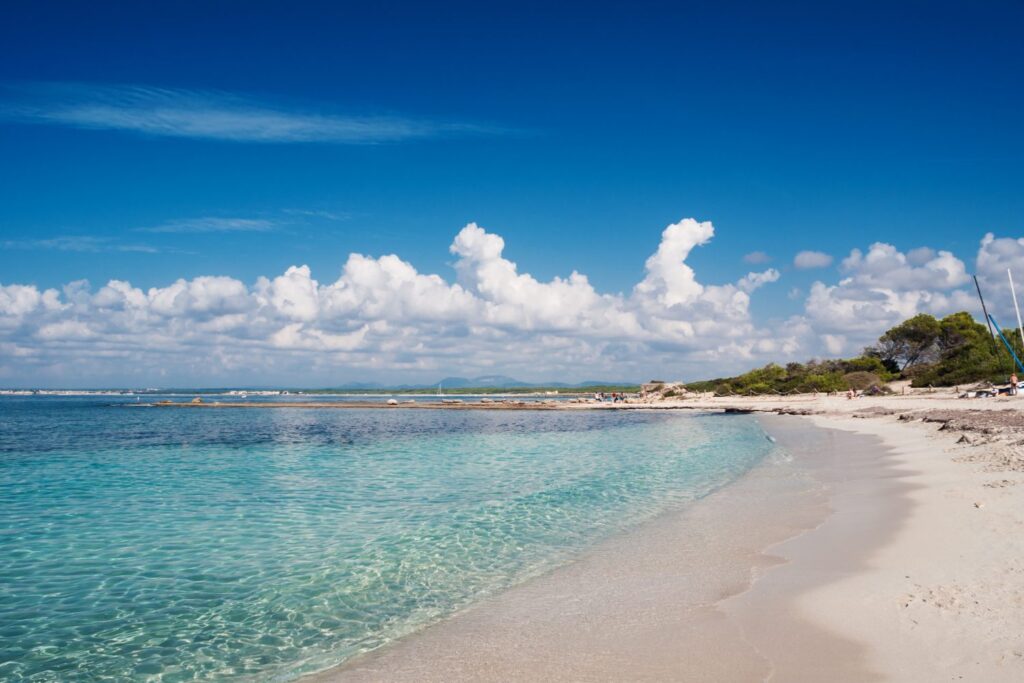
There are small beach bars and sun loungers at the main access points of Ses Covetes and near Sa Ràpita, but large sections stay completely undeveloped. Parts of the beach are traditionally used by naturists. Arrive before 10am in high summer, because the paid car parks fill up quickly. You can also walk along the coast from Colònia de Sant Jordi, which takes in a few smaller beaches on the way.
2. Es Caragol - A quiet beach beyond the lighthouse
Es Caragol is the reward for a short coastal walk. From the Cap de ses Salines lighthouse, the southernmost point of Mallorca, a path follows the rocky shore for around half an hour until you reach a long arc of pale sand. There are no buildings, no sunbeds and no bars, so bring water, food and shade. On a clear day you can see the island of Cabrera on the horizon. Because the beach is protected, it rarely feels crowded, even in August.
3. Es Carbó and the beaches of Colònia de Sant Jordi
Colònia de Sant Jordi is a relaxed fishing village with several sandy beaches within walking distance: Es Port, Es Dolç and the wilder Es Carbó to the south. Es Carbó is a long, natural beach with dunes and shallow water, reached by a coastal path. The village also runs boat trips to the Cabrera Archipelago National Park, where you can swim in the Blue Cave. It’s a good base if you want to explore Es Trenc and the southern coast without driving every day.
4. Cala Pi - A sandy inlet below a pirate watchtower
Cala Pi, in the municipality of Llucmajor west of Es Trenc, is one of the most photogenic beaches in Mallorca. A narrow inlet cuts deep between rugged cliffs and ends in a small sandy beach with very calm, shallow water. You reach it down a long flight of stone steps, so the walk back up takes some effort. On the headland stands the Torre de Cala Pi, a watchtower built in 1663 to warn of pirate raids. In the high season there’s a lifeguard, a small kiosk and sun loungers to rent.
See available places to stay in Mallorca
South-east coves: the most beautiful calas in Mallorca
The south-east coast between Cala d’Or and Porto Cristo is where you’ll find the postcard images of Mallorca. Narrow inlets cut deep into the limestone of the southeastern coast, framed by pine trees and dramatic cliffs, and the crystal clear water is ideal for snorkelling. The resort town of Cala d’Or, built around a string of small coves with pine forests behind them, makes a handy base for this stretch. These Mallorca calas are small, so timing is everything.
5. Caló des Moro - The most photographed cove
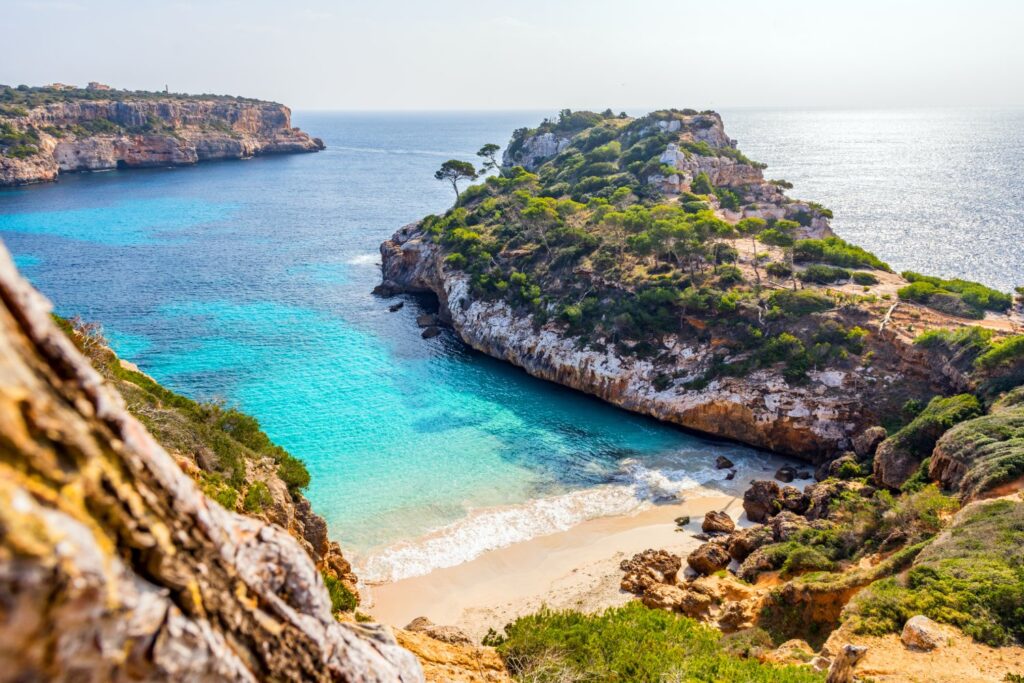
Caló des Moro is a tiny cove near Santanyí with a sliver of sand, sheer rocks and turquoise water. It became famous on social media, and in summer it gets very crowded. You have to walk in: the path from the residential area of S’Almunia takes around 15-20 minutes over uneven rock, so wear proper shoes. Go early in the morning or late in the afternoon, when the light is softer and there’s room on the sand. There are no facilities, and parking near the path is very limited.
6. Cala s’Almunia - Fishing huts and rock pools
Cala s’Almunia (often spelled Cala s’Almonia) sits right next to Caló des Moro and is often more pleasant. Old boathouses line a narrow inlet, and you swim off flat rocks and a tiny patch of sand. It’s a great spot for snorkelling, with fish around the rocks just a few metres from the shore. Many people walk past it on the way to its famous neighbour, so it can be calmer.
7. Cala Llombards - Sand between two cliffs
Cala Llombards is a sandy cove between steep cliffs, with a small beach bar and sunbeds in season. It’s easier to reach than Caló des Moro, as there’s a car park a short walk from the sand. The water stays shallow for a while, which makes it a good choice for families who want a proper cala experience. Nearby Cala Santanyí is another sandy cove, and from the coastal path you can see Es Pontàs, a natural rock arch standing in the sea.
8. Cala Mondragó - Two beaches in a natural park
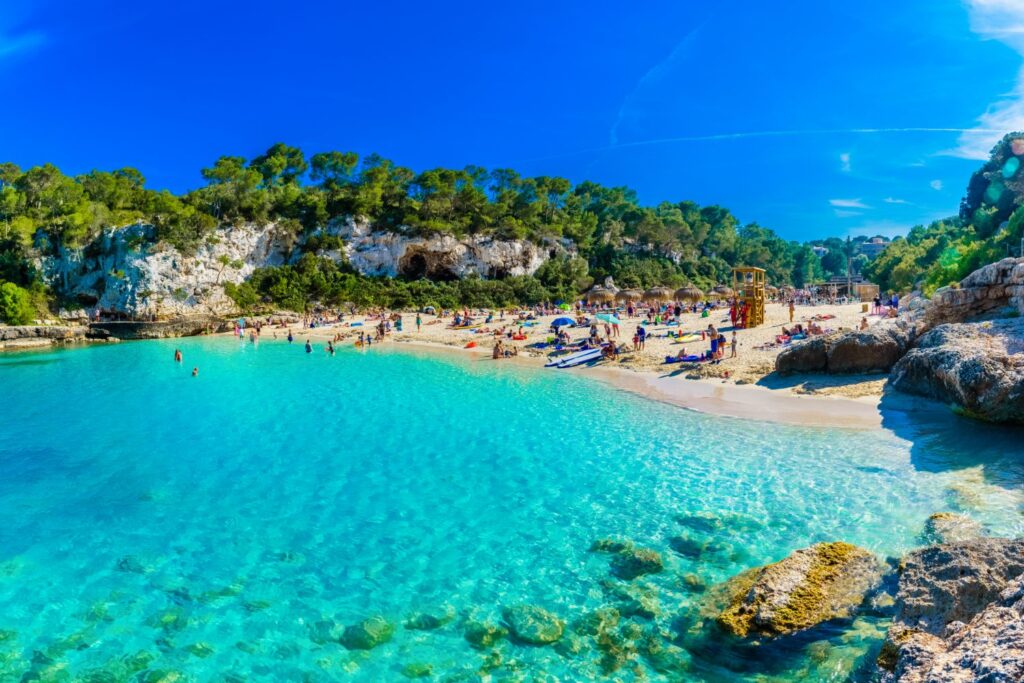
Cala Mondragó, south of Cala d’Or, is the centrepiece of the Mondragó Natural Park, a protected area of pine woods, dunes and farmland. The bay holds two sandy beaches, Sa Font de n’Alis and S’Amarador beach (Playa de s’Amarador), linked by a short footpath along the rocks. Both have sunbeds, lifeguards in summer and very calm, clear water. It’s a lovely beach for families who still want natural surroundings. Walking trails lead from the beaches into the park, so you can combine a swim with a short hike.
9. Cala Varques - A wild cove with sea caves
Cala Varques, on the east coast between Porto Cristo and Portocolom, is a favourite with locals who don’t mind a scenic hike. From the road you follow a track through the woods for about 20 minutes. The beach has no buildings and no permanent facilities, just white sand, clear water and rocky headlands with sea caves you can swim to. Bring everything you need, and take your rubbish home with you. After a swim, you can visit the nearby caves in Mallorca, including the Caves of Drach in Porto Cristo.
Northern Mallorca beaches: long bays for families
The north of Mallorca is perfect for a slow beach holiday with children. The bays of Alcúdia and Pollença are wide and sheltered, the sand is soft and the sea stays shallow for a long way out. Resorts here have everything you need, from water-sports centres to promenades lined with restaurants.
10. Playa de Muro - Dunes, pines and shallow water
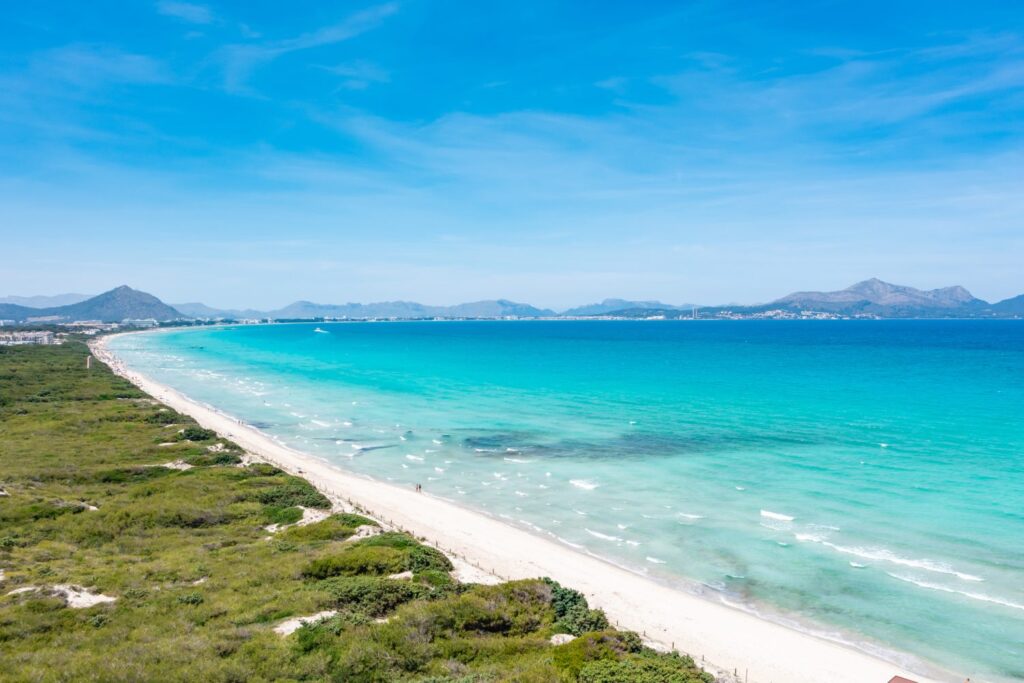
Playa de Muro is one of the longest beaches in Mallorca, running along the Bay of Alcúdia towards Can Picafort. It’s a family friendly beach with a Blue Flag, fine sand, low dunes and a pine forest behind it. Behind the resort lies S’Albufera Natural Park, a wetland famous for birdwatching. The sea is very shallow and usually calm, so even toddlers can paddle safely. Parts of the beach near the natural park feel surprisingly quiet, even in summer.
11. Alcúdia beach - Easy and family-friendly
Platja d’Alcúdia continues from Playa de Muro towards Port d’Alcúdia, with a promenade, cafés and plenty of sunbeds. It’s practical rather than wild, but the setting is lovely, with views over the bay to the mountains of Cap des Pinar. The historic walled town of Alcúdia, with its Roman ruins, is a few minutes away. If you’re travelling with children, our guide to family hotels in Mallorca lists resorts with splash parks and kids’ clubs close to the beach.
12. Platja des Coll Baix - A hidden pebble beach
Platja des Coll Baix is a pebble beach at the foot of high cliffs on the La Victòria peninsula, just east of Alcúdia. You reach it by a steep path through the forest, which takes around half an hour from the car park at the end of a dirt track. The pebbles are fine and smooth, and the water is a deep, clear blue. It’s best on calm days, as the sea can get rough when the wind blows from the north. Many visitors arrive by boat from Port d’Alcúdia instead.
13. Formentor beach - Pine trees on the water’s edge
Platja de Formentor (Playa de Formentor, also called Cala Formentor) lies on the sheltered side of the Formentor peninsula, in the far north of the island. Pine trees grow almost down to the waterline, so you can find natural shade, and the views over the Bay of Pollença are superb. The water is calm and clear, and it’s easily accessible by boat. In summer the road to Formentor is restricted to private cars (in 2026 from 15 May to 18 October, 10am to 10pm), and cars can only reach the beach car park while it has free spaces. The TIB bus from Port de Pollença and Alcúdia, or a ferry from Port de Pollença, are good alternatives.
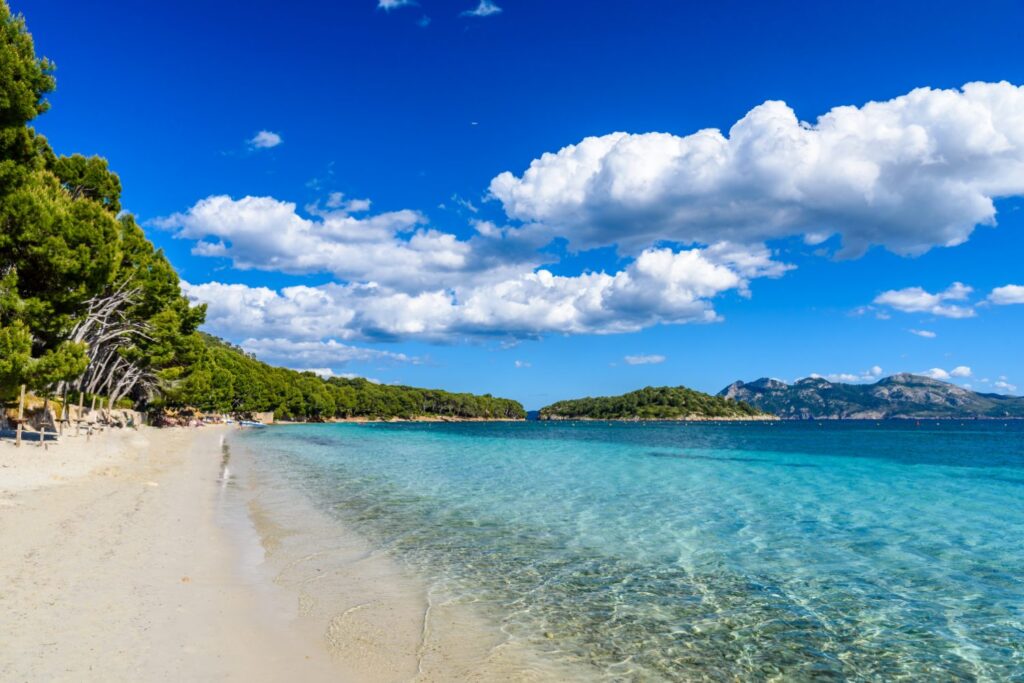
14. Cala Sant Vicenç - Four coves below the cliffs
Cala Sant Vicenç is a small resort on the northern coast near Pollença with four little coves set below the jagged Cavall Bernat ridge. The water is famously clear, and the setting feels more peaceful than the big bays. It’s a good choice for snorkelling and for evening walks along the cliffs. From here you can easily explore the old town of Pollença and its Calvari steps.
North-east beaches: Cala Agulla, Cala Mesquida and Cala Torta
The northeastern coast around Capdepera and Artà is wilder and greener than the south. Here you’ll find wide sandy beaches backed by dunes and hills, with very little development. They are some of the best beaches in Mallorca if you want space.
15. Cala Agulla - White sand near Cala Ratjada
Cala Agulla is a long sandy beach just north of the resort town of Cala Ratjada, framed by pine-covered hills. It has sunbeds, kiosks and lifeguards in summer, but the setting remains natural. Coastal paths lead from the beach to smaller coves such as Cala Moltó, where you can escape the crowds. The sand is very fine, and the water turns bright turquoise on sunny days.
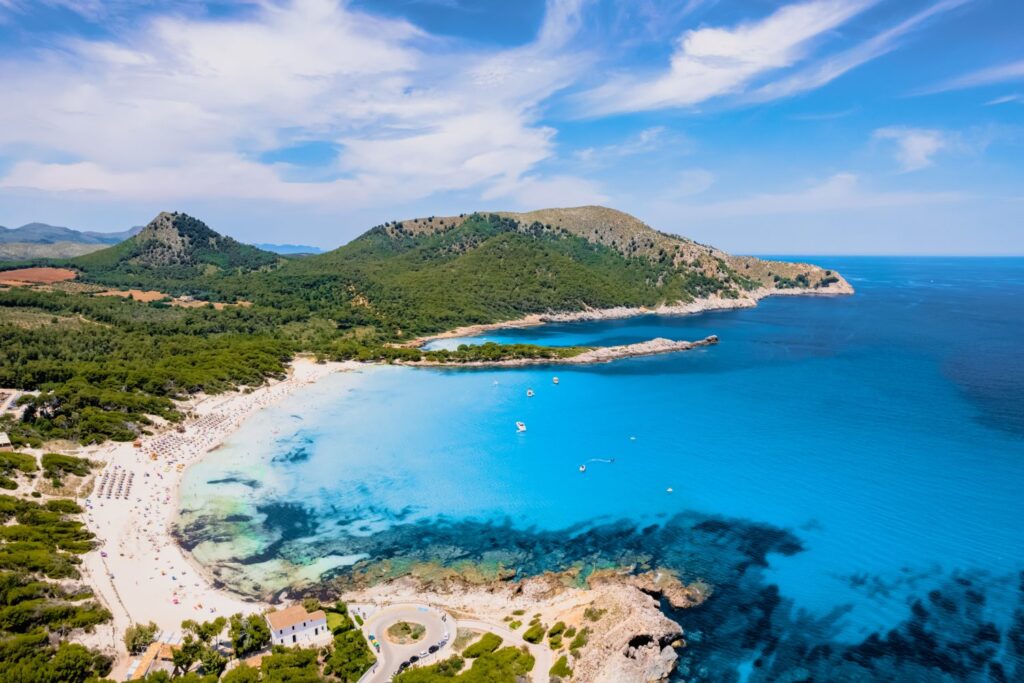
16. Cala Mesquida and Cala Torta - Dunes and wild water
Cala Mesquida is a long beach backed by high dunes and pine forests. A little further west, Cala Torta is one of the last truly undeveloped beaches in Mallorca, reached by a rough road from Artà. Both are open to the north, so waves can be strong on windy days. On calm days, though, they rank among the most beautiful beaches in Majorca, with hardly a building in sight.
West coast beaches below the Serra de Tramuntana
The west coast is dominated by the Serra de Tramuntana, a UNESCO World Heritage mountain range. Its beaches are small, rocky and often pebbly, but the natural beauty is spectacular. At the south-western tip, the small resort of Sant Elm has a sandy beach facing the island of Sa Dragonera. They are best combined with a drive through the mountains or a visit to villages such as Valldemossa and Deià.
17. Sa Calobra and the Torrent de Pareis
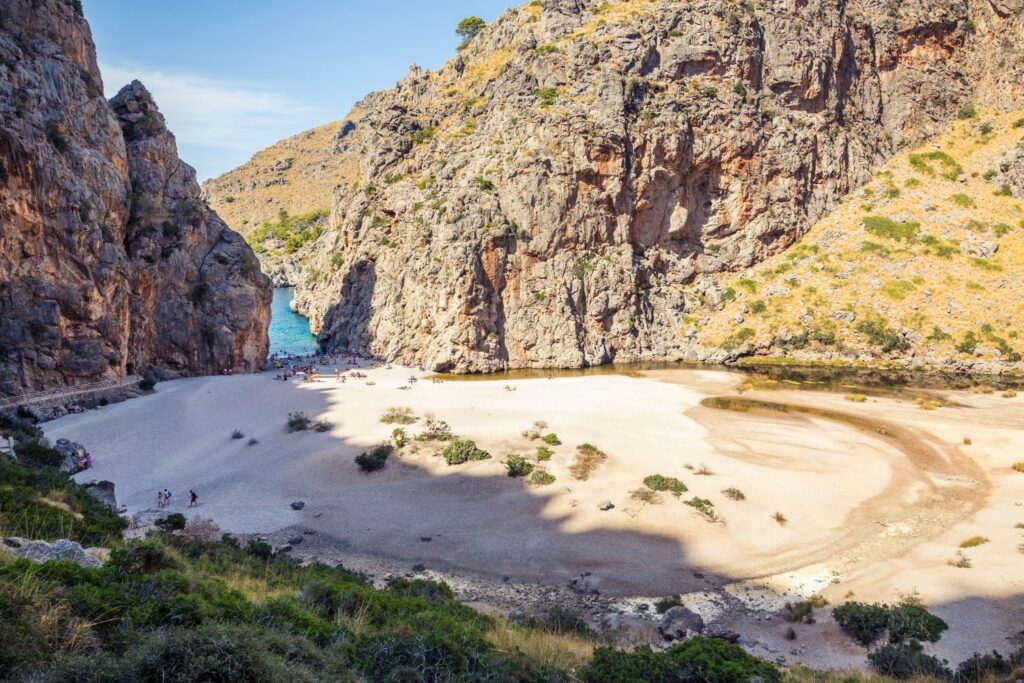
Sa Calobra is reached by one of the most famous roads in Spain, a series of hairpin bends that twist down to the sea. From the small harbour, a path through tunnels in the rock leads to the mouth of the Torrent de Pareis gorge. There, Sa Calobra beach sits between vertical cliffs, a pebbly strip where the water is a startling blue. It gets busy in the middle of the day, when coaches and boats arrive. A relaxing way to get there is by boat from Port de Sóller, which also has two easy town beaches, Platja d’en Repic and Platja d’en Través.
FUN FACT: At the hairpin known as the Nus de sa Corbata (the Tie Knot), the road loops over itself and passes under its own bridge.
18. Cala Deià - A tiny cove with seafood restaurants
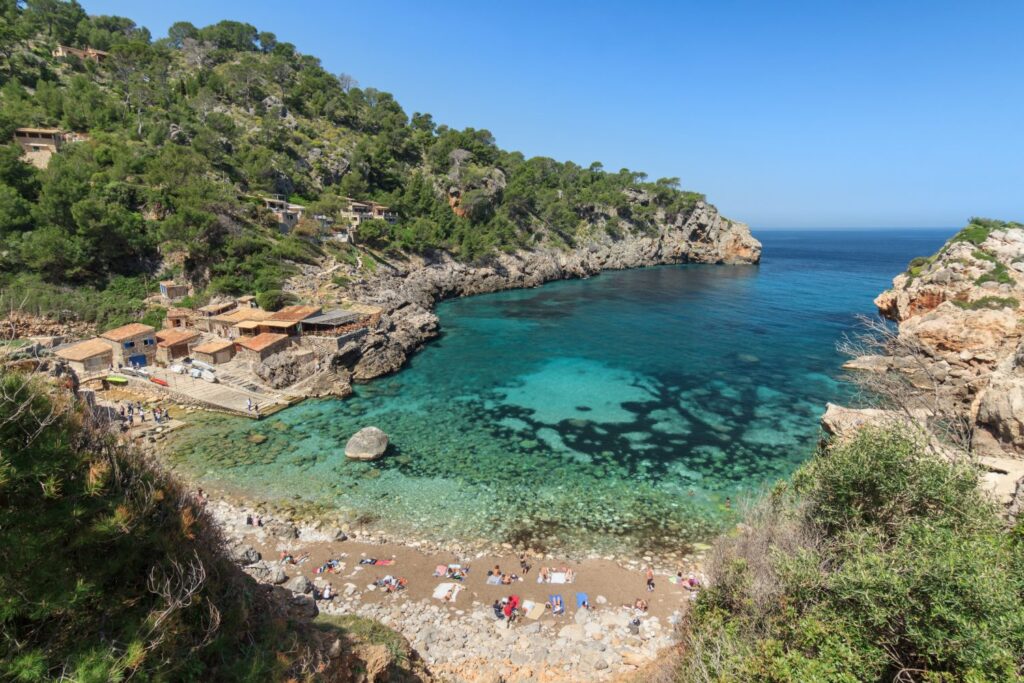
Cala Deià is a small pebble cove below the artists’ village of Deià. It has crystal clear water, fishermen’s huts and two simple seafood restaurants on the rocks, which give it a picturesque setting. The swim is wonderful, though there’s very little space to lay a towel. Parking is extremely limited, so many people walk down from the village along a pretty path, which takes around 30 minutes.
Beaches near Palma
If you’re staying in Palma de Mallorca, you don’t need to travel far for a swim. Can Pere Antoni beach is a short walk from the cathedral, and Ciudad Jardín has a more local feel. To the east, Playa de Palma is a long sandy beach with a lively atmosphere that runs towards S’Arenal, close to the Aqualand El Arenal water park. To the west, the small coves of Illetes have very clear water and are popular with Palma residents at weekends.
Further west in Calvià, Portals Vells is a group of three small coves surrounded by pine woods, with a cave chapel carved into the rock. It’s one of the prettiest beaches near Palma, though parking is tight in summer. The beach town of Santa Ponsa has a wide sandy bay that works well for families, and you can find tips on where to stay in Santa Ponsa.
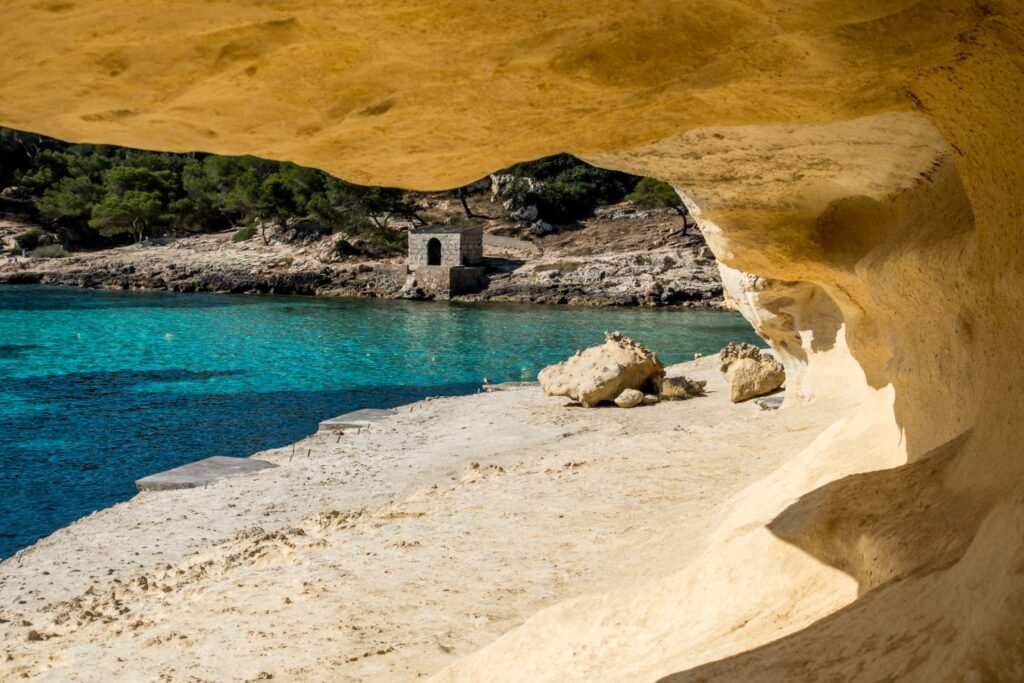
Best beaches in Mallorca for families
For young children, choose beaches with fine sand, gently shelving water and lifeguards. Playa de Muro, Alcúdia and the beaches in the Bay of Pollença are ideal, with shallow waters stretching far from the shore. Larger beaches like these also offer various water sports activities, from pedal boats to paddleboarding. Cala Mondragó and Cala Agulla are great if you want a more natural setting with facilities. Avoid long walks to remote coves with small children in the heat of the day, and remember that coves with no shade get very hot by noon.
If your children need a break from the sand, Mallorca has plenty of family attractions. You can visit the sharks at Palma Aquarium or spend a day at one of the water parks in Mallorca.
When to go and practical tips for Mallorca beaches
The beach season in Mallorca runs from May to October. In June and September the sea is warm, the beaches are calmer and parking is easier. July and August, the high season, are the hottest months, with the sea reaching around 25°C, but also the busiest. In spring the water is still cool, though the coves are almost empty.
A few tips will make your beach days easier. Arrive before 10am at popular coves, as car parks fill up early. Wear water shoes for rocky beaches and bring snorkelling gear to the calas. Don’t be surprised by dried seagrass on some beaches: Posidonia meadows protect the sand and keep the water clear. Many natural beaches have no bins, so take your rubbish with you. Finally, check the wind before you set off: if it blows from the north, head south, and vice versa.
If you want to see more of the island between beach days, read our guide to things to do in Mallorca, from Gothic Palma to the Tramuntana villages.
Hotels near Mallorca’s best beaches
Mallorca beaches are spread all around the island, so it helps to choose a base close to the coast you like best. Here are three hotels near some of the best beaches in Mallorca, from a simple stay in a natural park to a luxury spa resort on the Bay of Alcúdia.
💰 Hotel Playa Mondrago
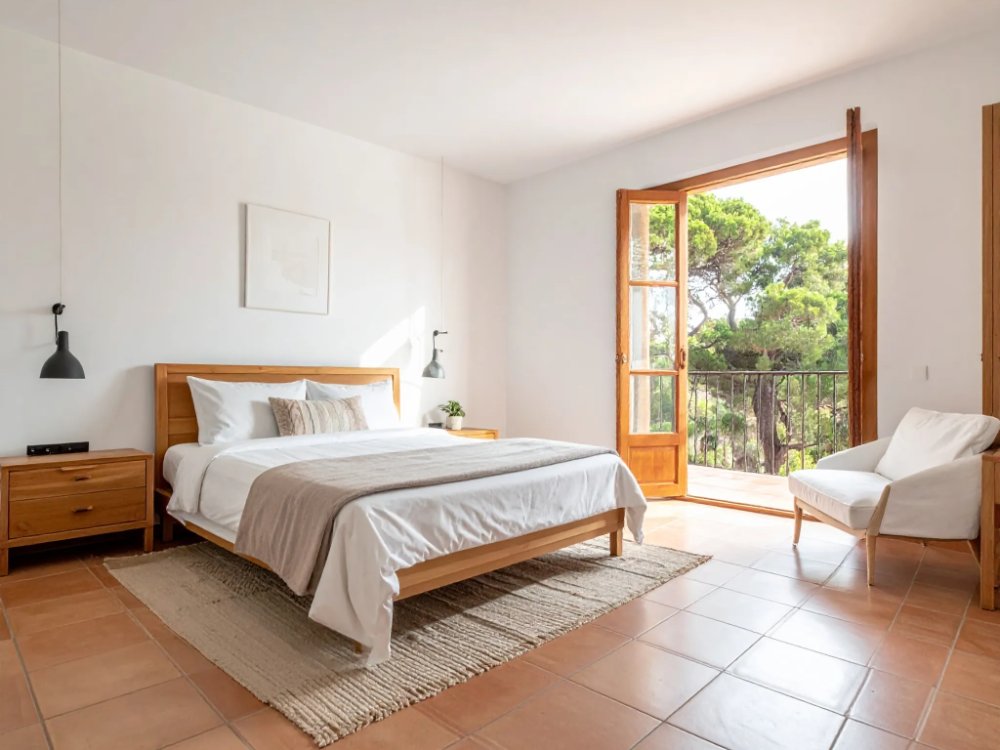
This simple hotel sits about 50 metres from the beach in the Mondragó Natural Park, surrounded by pine trees. Rooms are bright, with air conditioning and a balcony, and there’s a seasonal outdoor pool, a restaurant with a buffet breakfast and free parking. You can walk to the sand in a minute and explore the park’s coastal trails before the day visitors arrive. It’s a great choice if you want a natural setting without paying resort prices.
🏨 Hotel Honucai
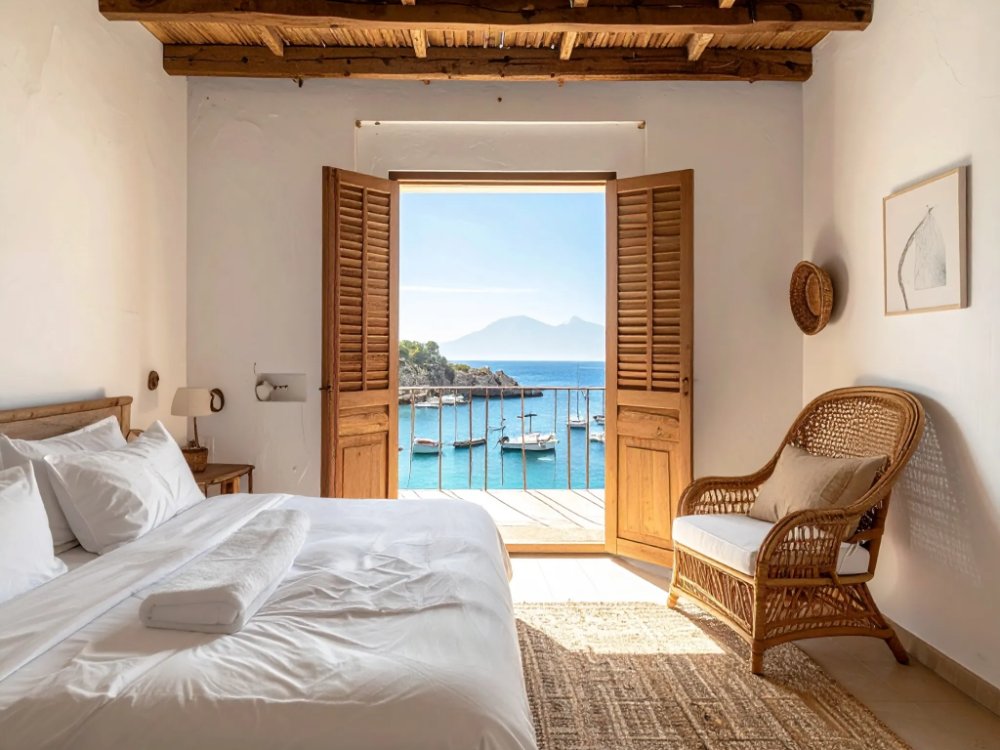
This upmarket four-star hotel stands right by the sea in Colònia de Sant Jordi, overlooking the beaches of Es Dolç and Es Carbó and the little fishing harbour. Rooms have a Mediterranean style, and there’s a small outdoor pool and free Wi-Fi. Es Trenc is only a short drive away, and the Cap de ses Salines lighthouse is about 7 km away. It suits couples who want to explore the wild southern beaches from a quiet village base.
💎 Grupotel Parc Natural & Spa
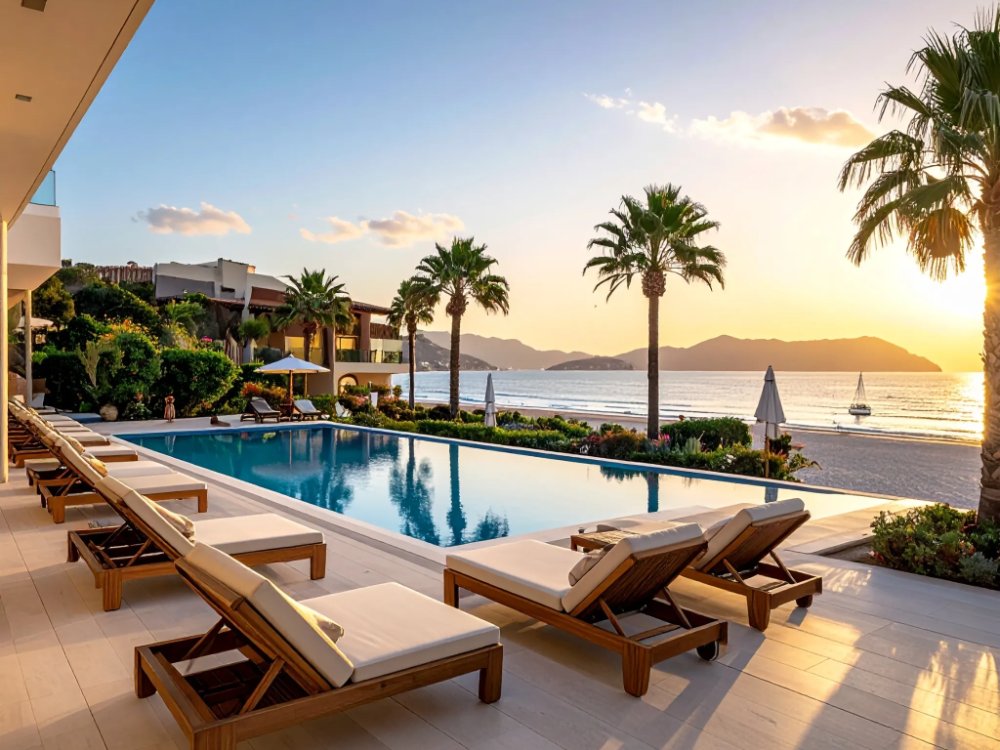
This luxury hotel lies on Playa de Muro, next to the S’Albufera Natural Park, with views over the Bay of Alcúdia. Elegant rooms and suites have terraces or balconies, and the spa offers a heated pool, a Turkish bath, a fitness centre and massages. Outside, gardens and a large pool lead towards one of the longest sandy beaches in Mallorca. It’s ideal for a relaxing holiday with shallow water and nature right on your doorstep.
Mallorca beaches FAQ
Which is the best beach in Mallorca?
Es Trenc is often called the best beach in Mallorca thanks to its several kilometres of white sand, dunes and turquoise water inside a natural park. If you prefer small coves, Caló des Moro and Cala Mondragó are the most beautiful. For families, Playa de Muro and Alcúdia are the best choices.
Where are the best sandy beaches in Mallorca?
The best sandy beaches are in the south and the north. In the south, Es Trenc, Es Caragol and the beaches of Colònia de Sant Jordi have fine white sand. In the north, Playa de Muro, Alcúdia and Formentor have long stretches of soft sand and shallow water.
Which part of Mallorca has the best beaches?
The south and south-east have the most spectacular beaches, from Es Trenc to the coves around Santanyí. The north has the best family beaches in the bays of Alcúdia and Pollença. The west coast offers dramatic scenery, but its beaches are mostly small and pebbly.
Do you need a car to reach the best beaches in Mallorca?
For the wilder beaches and coves, yes. Buses serve the big resorts, but places like Caló des Moro, Cala Varques, Es Caragol and Cala Torta are hard to reach without a car. Arrive early, as car parks near popular beaches fill up quickly in summer.
How many beaches does Mallorca have?
Mallorca has more than 200 beaches and coves, from long urban beaches near Palma to tiny calas reached only on foot or by boat. Most of the sandy beaches are on the south, south-east and north coasts. The west coast has fewer beaches, mostly small pebbly coves below the mountains.
When is the sea warm enough to swim in Mallorca?
The sea is pleasant for swimming from June to October. It’s warmest in August and early September, at around 25°C. In May and late October the water is cooler, but many people still swim on sunny days.

