For more than a thousand years, kings, rabbis, imams and painters all chose the same rocky hill wrapped in a river bend. Half an hour on a fast train is all it takes to join them.
Toledo sits on a granite hill above a tight loop of the Tagus River, about 70 km south of Madrid. Few Spanish cities pack so much into such a small space. Within a 20-minute walk you pass a Gothic cathedral, two medieval synagogues, a mosque from the year 999 and the church that guards El Greco’s greatest painting. No wonder the whole historic city has been a UNESCO World Heritage Site since 1986.
Toledo, Spain was the capital of the Visigothic kingdom, a great Moorish city and later the seat of the Castilian royal court. People still call it the city of three cultures, because Christians, Muslims and Jews shared its narrow streets for centuries. In this article you’ll find what to see in Toledo in one day, how to get there from Madrid, where to eat marzipan and where to stay if you decide one day is not enough.
💰 Hotel Santa Isabel - Budget-friendly rooms and a roof terrace facing the cathedral tower.
🏨 Parador de Toledo - A hilltop parador with a pool and the classic view of the old city.
💎 Eugenia de Montijo, Autograph Collection - A five-star palace hotel with a spa built around old Arab baths.
Is Toledo worth a day trip from Madrid?
Yes, and it’s the easiest day trip from Madrid, bar none. The high-speed Avant train from Madrid’s Atocha station reaches Toledo in around half an hour, so you can be drinking coffee in Plaza de Zocodover before 10am. The old town is compact and you can see the big sights on foot, without taxis or metro maps.
A day trip from Madrid to Toledo works best if you start early and pick four or five places to go inside. Trying to visit every church and museum is a recipe for a sore neck. If you like to linger, consider staying a night. In the evening the coach tours leave, the stone glows orange under the street lamps and the city feels like a small town again.
Not sure whether to choose this city or Segovia? Toledo is bigger, feels older and is richer in art. Segovia has the Roman aqueduct and a fairy-tale castle. With two free days, do both. With just one, choose Toledo for history and painting.
How to get from Madrid to Toledo
The train is the fastest option. Avant high-speed trains leave from Madrid Atocha and take around 33 minutes. Book a seat in advance at weekends and in spring, because trains fill up. You can compare times and fares for trains from Madrid to Toledo before you go.
Toledo’s neo-Mudéjar railway station is a sight in itself, with tiled walls and a clock tower. From there it’s a 20 to 25-minute walk uphill to the old town, or a short ride on a city bus to Plaza de Zocodover.
Buses leave from Plaza Elíptica in Madrid and take about an hour. They are cheaper and run often, which makes them handy if the trains are sold out. If you’d rather drive, the A-42 motorway gets you there in about an hour. Driving makes sense if you also want to see the windmills of La Mancha, and car hire in Madrid is easy to arrange. Leave the car in a car park below the walls, because the historic centre is a maze of one-way lanes.
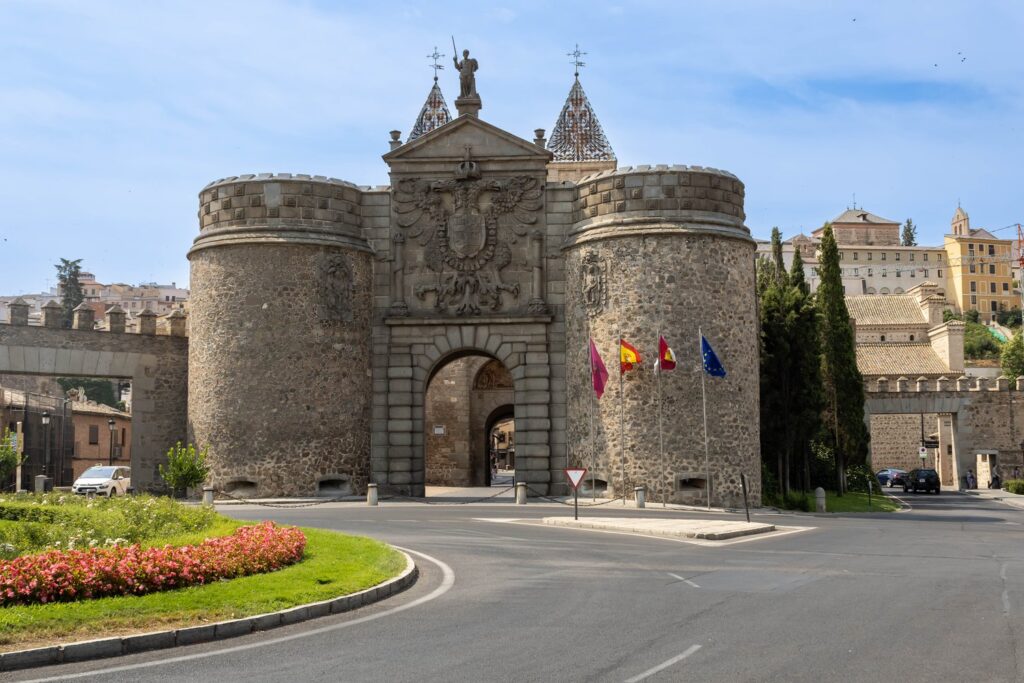
To save your legs, use the free outdoor escalators (Remonte Mecánico de Recaredo) near Puerta de Bisagra. They lift you from the foot of the hill almost to the top of the old city.
Things to do in Toledo in one day
Here are the places that make the trip worthwhile, in an order that works as a walking route. Things to do in Toledo are spread across a small area, so you can mix and match depending on your interests.
Toledo Cathedral
The Primate Cathedral of Saint Mary is the heart of the city and one of the finest Gothic churches in Spain. Building work started in 1226 and lasted more than 250 years. Inside, you walk between five naves, carved choir stalls and a huge altarpiece gilded from top to bottom.
Don’t miss the Transparente, a Baroque flourish of marble and light behind the main altar. In the sacristy you’ll find a small gallery with works by El Greco, Goya and Titian. El Greco’s The Disrobing of Christ hangs right there. The Mozarabic Chapel still hosts mass in the old Mozarabic rite, which survived the centuries in Toledo. Give the cathedral at least an hour and a half, and an audio guide helps a lot.
Alcázar de Toledo and the Army Museum
The square fortress on the highest point of the city has stood guard here since Roman times. The current building dates largely from the sixteenth century, when Charles V rebuilt it as a royal palace. It burned and was rebuilt several times, and was almost destroyed during a long siege in the Spanish Civil War in 1936.
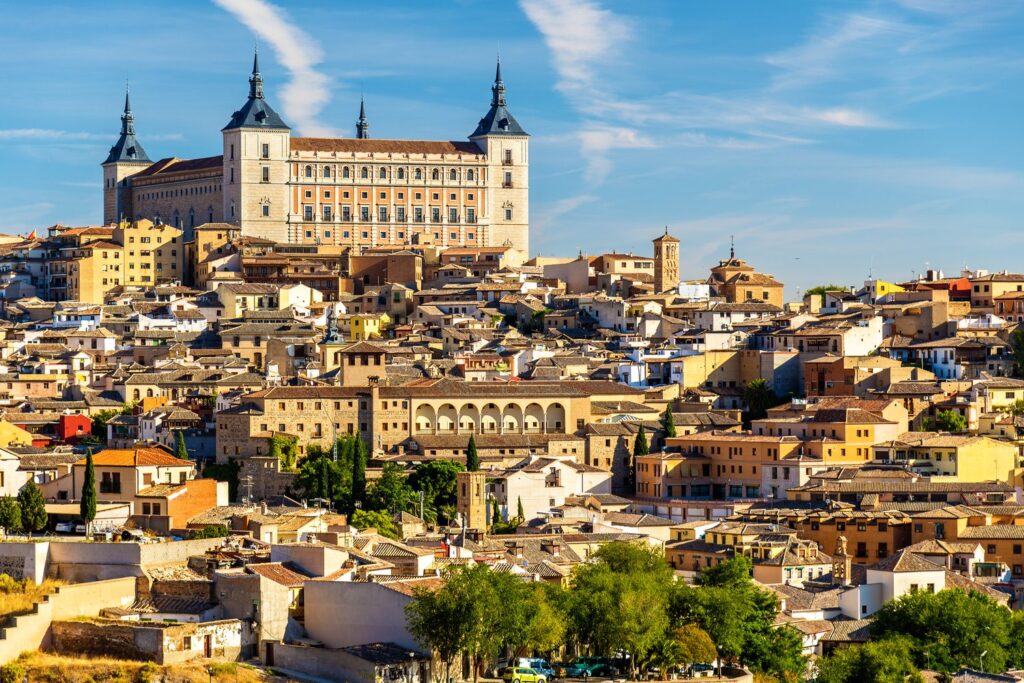
Today the Alcázar de Toledo houses the Army Museum (Museo del Ejército). Military history buffs will love it. Even if you skip the museum, walk around the outside for the panoramic view over the Tagus River and the plains of Castile-La Mancha. The cafeteria and library terrace on the top floors also offer great views.
Plaza de Zocodover
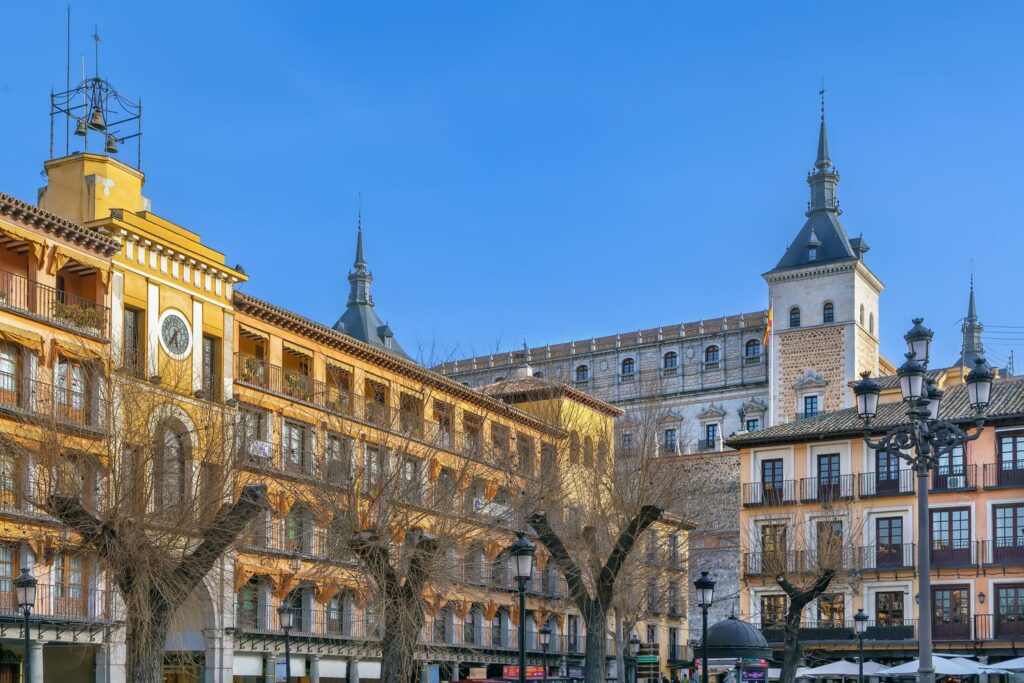
Plaza de Zocodover was the city’s market square for centuries and is still its living room. Locals meet on the benches, tourist trains leave from here and the shops sell marzipan and damascene jewellery. The Arco de la Sangre leads from the square down towards the Museo de Santa Cruz.
The Museo de Santa Cruz occupies a beautiful sixteenth-century hospital with a Plateresque doorway and a quiet cloister. Its collection includes paintings by El Greco and decorative arts from the region. Nearby, Calle Santa Fe leads past the convent of Santa Fe, where archaeological remains from Moorish and Christian times are on show.
Jewish quarter of Toledo
The Jewish quarter fills the western side of the hill. It was one of the largest Jewish communities in medieval Spain until the expulsion of 1492. Look down as you walk: small ceramic tiles with a menorah mark the streets of the old quarter.
Synagogue of Santa María la Blanca
Santa María la Blanca was built at the end of the twelfth century and later turned into a church. Inside, white horseshoe arches and pine-cone capitals create a calm forest of columns. It’s a fine example of Moorish architecture created for a Jewish community, which says a lot about the city of three cultures.
Synagogue of El Tránsito and the Sephardic Museum
The Synagogue of El Tránsito was built in 1357 by Samuel ha-Levi, treasurer to King Peter I of Castile. Its prayer hall has a wooden ceiling and walls covered in intricate carvings with Hebrew inscriptions. Upstairs you’ll see the women’s gallery. The building now houses the Sephardic Museum (Museo Sefardí), which tells the story of Jewish tradition in Spain and of the Sephardic diaspora after 1492.
Monastery of San Juan de los Reyes
The Catholic Monarchs, Isabella and Ferdinand, founded the monastery of San Juan de los Reyes in 1477. They wanted it as a royal pantheon to celebrate their victory at the Battle of Toro. In the end they were buried in Granada, but the monastery remains one of the finest examples of Isabelline Gothic.
The two-storey cloister is the highlight, with lacy stonework, gargoyles and a garden of orange trees. On the outer wall hang iron chains of Christian captives freed during the conquest of Granada. It’s a quieter stop than the cathedral, and a lovely place to sit for a few minutes.
Following El Greco through Toledo
Domenikos Theotokopoulos, the famous painter known as El Greco, arrived from Crete in 1577 and spent the rest of his life here. Toledo shaped his style, and he painted the city’s skyline more than once.
His masterpiece, The Burial of the Count of Orgaz, hangs in the small church of Santo Tomé. Painted between 1586 and 1588, it shows the burial of a local nobleman, with heaven opening above the mourners. The Museo del Greco (El Greco Museum), set in a house and garden in the Jewish quarter, recreates the atmosphere of the painter’s time and shows several of his works, including the series of apostles. Together with the cathedral sacristy and the Museo de Santa Cruz, you can easily spend half a day on El Greco alone.
Moorish and Visigothic Toledo
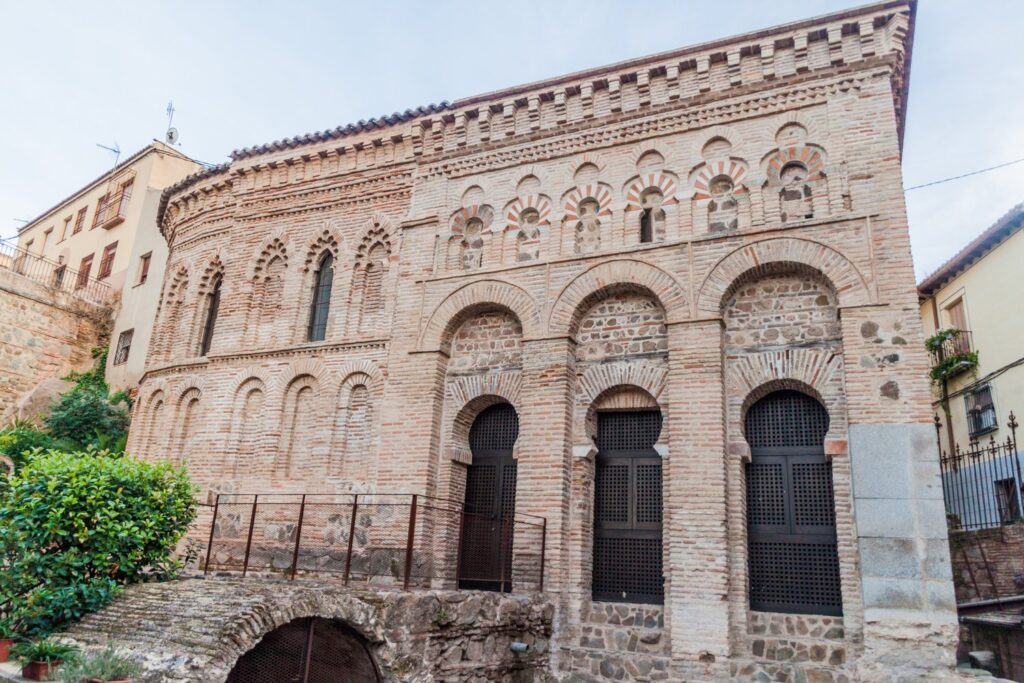
Before Christian kings took the city in 1085, Toledo was one of the most important cities of al-Andalus. The small Mosque of Cristo de la Luz was built in 999 and is one of the best-preserved Moorish buildings in Spain. Nine domes, each with a different pattern of ribs, sit on horseshoe arches. Later a Mudéjar apse was added when it became a church.
Even older layers survive too. The Museum of the Visigothic Councils and Culture, inside the church of San Román, explains the Visigothic period, when Toledo was the capital of a kingdom covering most of the Iberian Peninsula. The church’s frescoes and Visigothic church pieces are a rare sight.
FUN FACT: The Mosque of Cristo de la Luz still has its original foundation inscription in Kufic script on the facade, giving the year of its construction.
City gates and bridges over the Tagus River
The old city walls still have several gates. Puerta de Bisagra is the grand entrance from the north, rebuilt in the sixteenth century with the double-headed eagle of Charles V. Nearby stands the older Puerta de Alfonso VI, a Moorish gate with horseshoe arches. Puerta del Sol, with its Mudéjar arches, is another gate worth a photo on your way up.
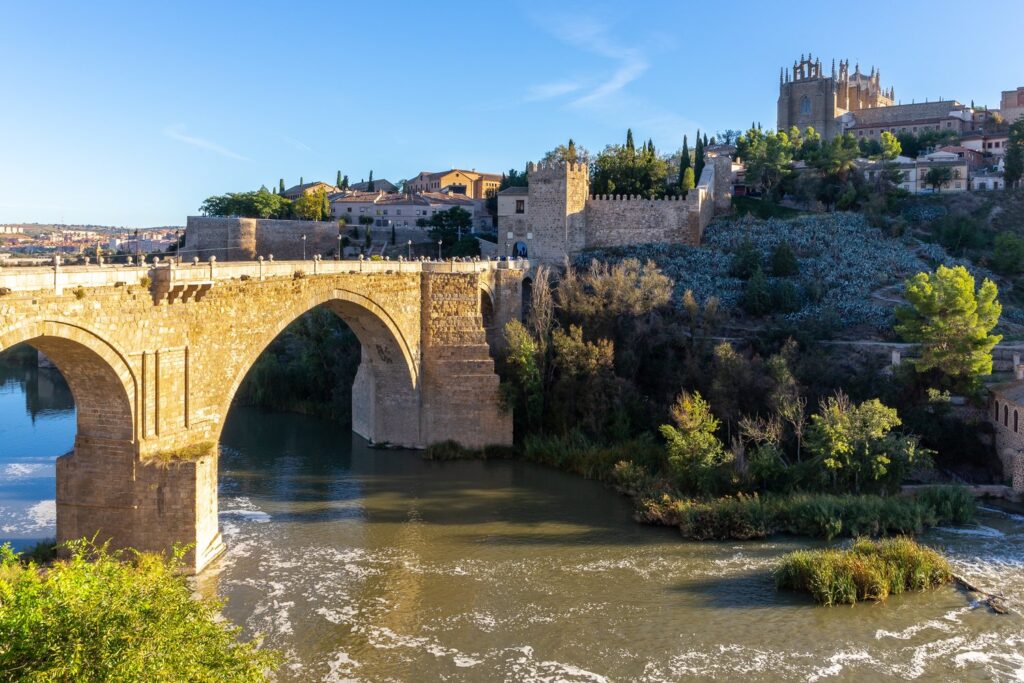
Two medieval bridges cross the Tagus River. The Alcántara Bridge, on the eastern side, has Roman origins and was rebuilt in the Middle Ages. The fourteenth-century San Martín Bridge guards the western side, close to San Juan de los Reyes. Walk across it in the late afternoon and you’ll see the old town glowing above the river.
Mirador del Valle - The best panoramic view of Toledo
For the postcard view, cross the river to Mirador del Valle on the road that circles the city. From here you see the whole old city at once, with the cathedral spire and the Alcázar rising above the tiled roofs. The view is magnificent at any time of day, but sunset is unbeatable.
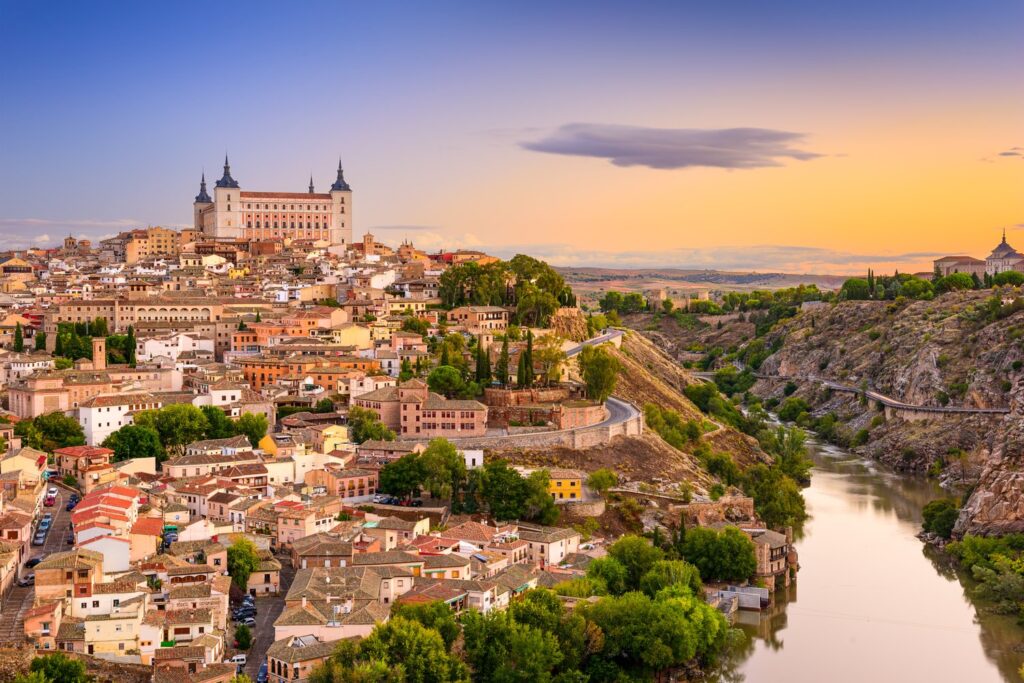
It’s around half an hour’s walk from the Alcántara Bridge, mostly along the road. Many people take the tourist train from Plaza de Zocodover or a taxi instead. If you join a guided tour from Madrid, the coach usually stops here for photos.
What to eat in Toledo
Toledo is the marzipan capital of Spain. Nuns in convents such as San Clemente have made it for centuries, and pastry shops around Plaza de Zocodover sell it in little figures and rolls. Try at least one piece with a coffee.
For lunch, look for carcamusas, a slow-cooked pork and tomato stew served in a clay dish. Partridge stew and Manchego cheese also come from the plains of La Mancha. Order a glass of local wine too, because Castile-La Mancha is one of the largest wine regions in the world. Most restaurants serve lunch from around 1.30pm.
Toledo is also famous for crafts. Swordsmiths have worked here since Roman times, and you’ll see shops full of steel blades and damascene work, with gold thread hammered into black steel.
A one-day Toledo itinerary
Morning: arrive early, ride the escalators up and start at Plaza de Zocodover. Visit the Alcázar from the outside, then head to the cathedral before the crowds peak.
Midday: walk through the Jewish quarter to Santo Tomé, the Synagogue of El Tránsito and Santa María la Blanca. Stop for lunch and a slice of marzipan.
Afternoon: visit San Juan de los Reyes and cross the San Martín Bridge. Finish at Mirador del Valle for the sunset, then catch an evening train back to Madrid.
Several monuments, such as San Juan de los Reyes, Santa María la Blanca and the Mosque of Cristo de la Luz, share a combined tourist bracelet ticket. Check opening hours before you go, because state museums such as the Sephardic Museum and the El Greco Museum close on Mondays.
If you prefer to see Toledo with a local guide, a walking tour is the easiest way to understand how the three cultures lived side by side. A guided tour from Madrid takes care of transport too.
Beyond Toledo - Windmills of La Mancha
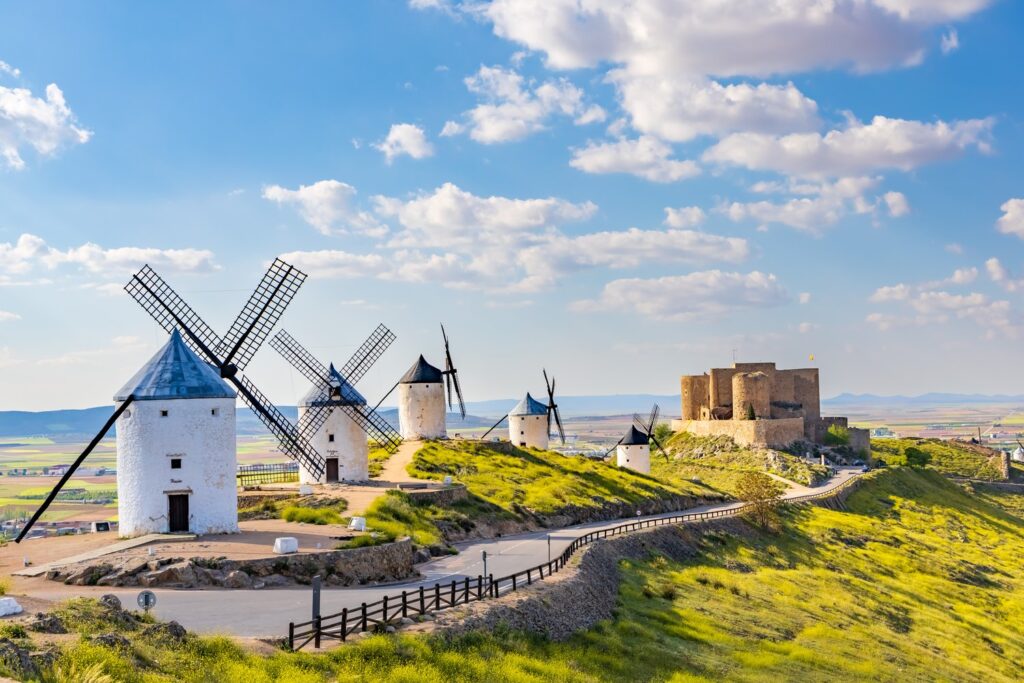
With a car or a second day, drive south to Consuegra, less than an hour from Toledo. A row of white windmills stands on a ridge next to a medieval castle, exactly the landscape that inspired Don Quixote. It pairs perfectly with a night in Toledo, and you can continue to Córdoba or back to Madrid.
The city of Toledo also hosts one of Spain’s oldest religious festivals. Corpus Christi, held in late spring, fills the streets with flowers, awnings and a solemn procession led by the cathedral’s golden monstrance.
Where to stay in Toledo
Staying overnight lets you see the old city at its quietest, early in the morning and after dark. Choose the historic centre to walk everywhere, or the hill across the river for the view.
💰 Hotel Santa Isabel
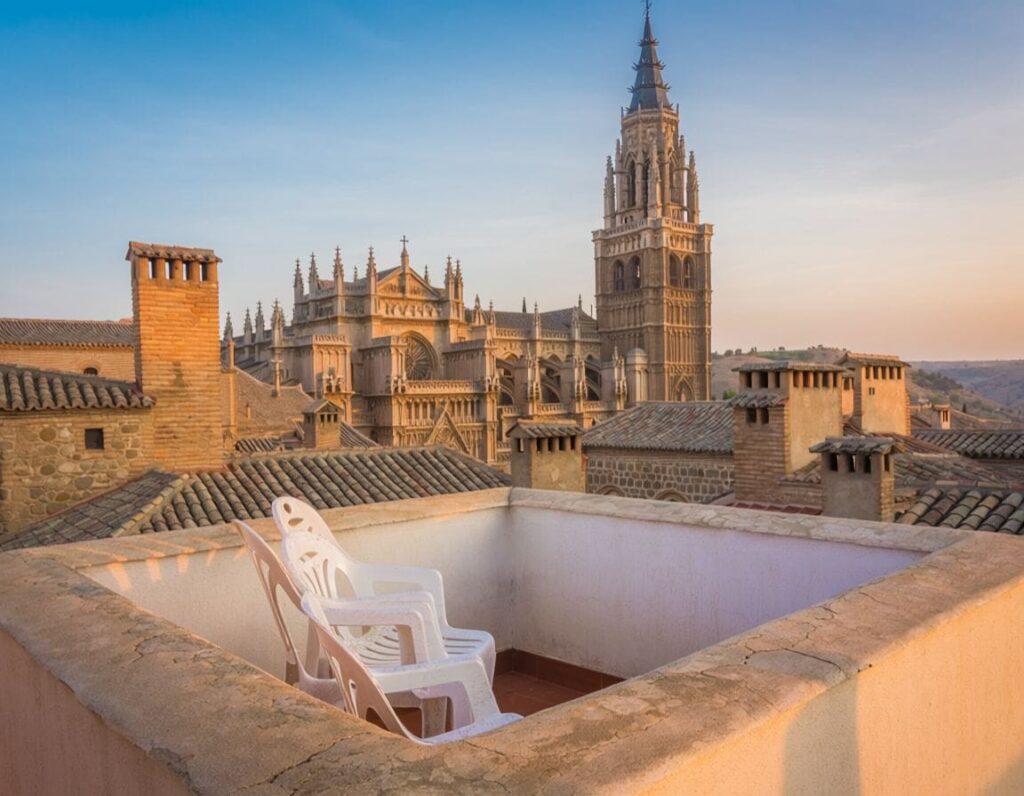
This simple, friendly hotel occupies an old stone house just a two-minute walk from the cathedral. Rooms are plain but comfortable, with air conditioning that you’ll appreciate in summer. The roof terrace looks straight at the cathedral tower, which is a treat with a glass of wine in the evening. It’s a smart choice if you want a central base on a budget and plan to spend your days exploring on foot.
🏨 Parador de Toledo
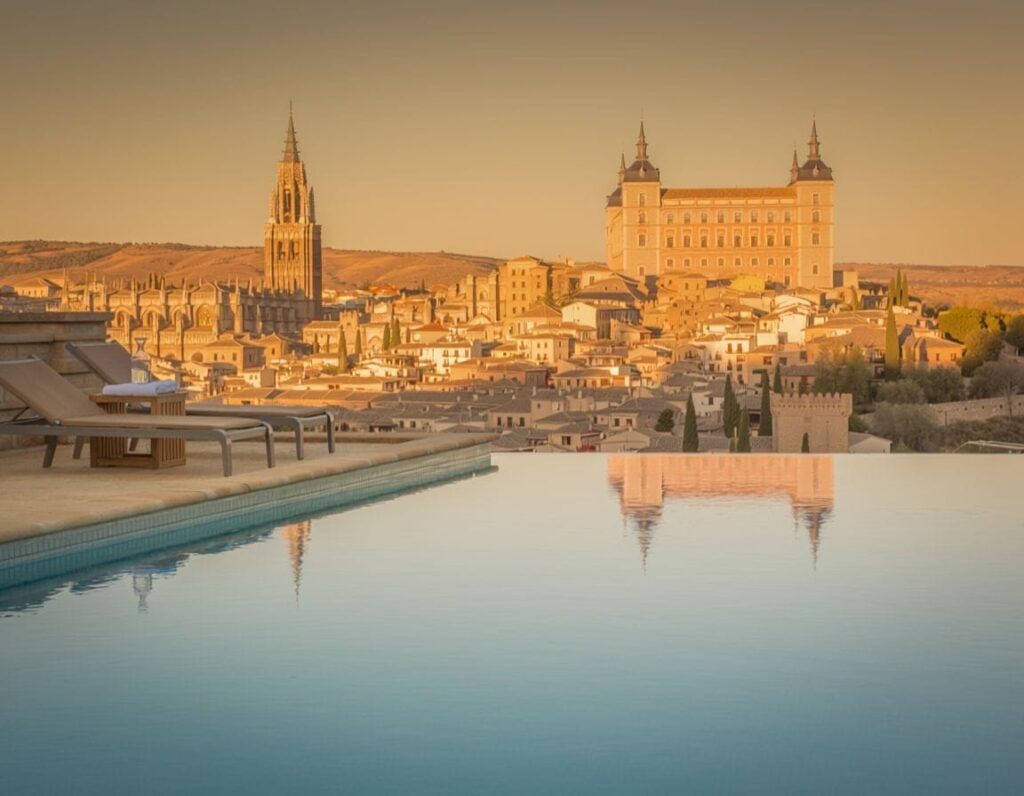
The parador stands on a hill across the Tagus, facing the old city head-on. Built in traditional Castilian style, it has an outdoor pool, a restaurant serving regional dishes and a terrace with arguably the best view in town. Many rooms have balconies overlooking the skyline. It’s ideal if you travel by car and want a relaxing stay with the panorama included.
💎 Eugenia de Montijo, Autograph Collection
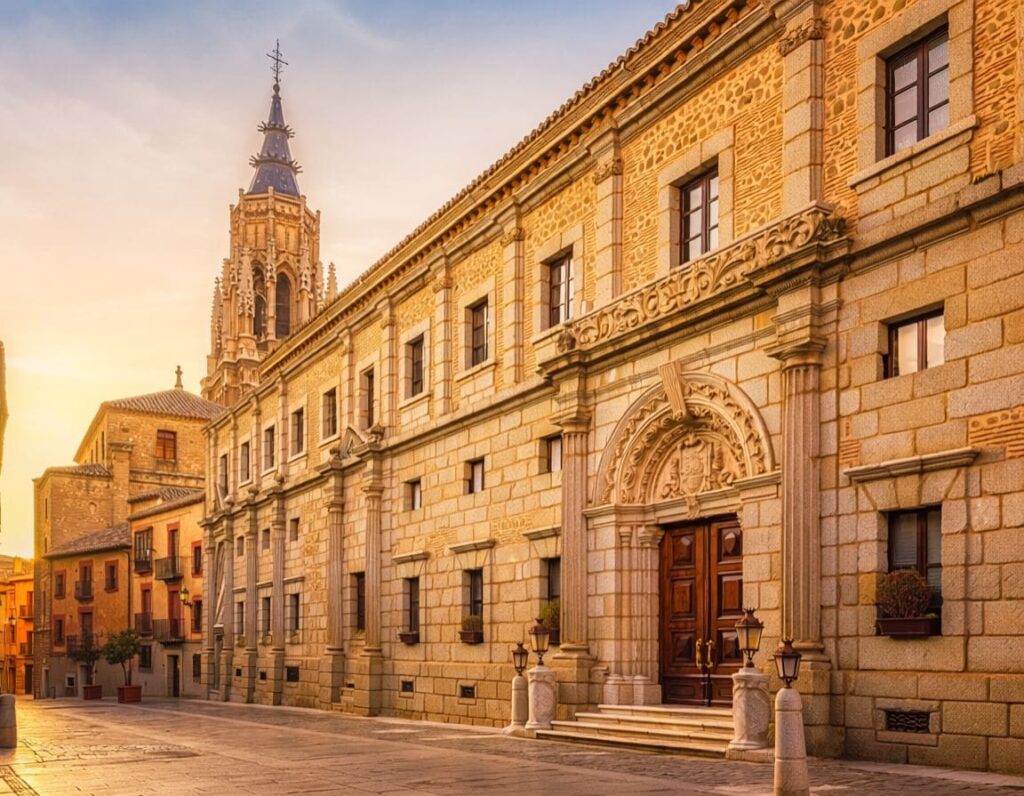
This five-star hotel fills a former palace in the very centre of the historic quarter. Elegant rooms mix original stone and wood with modern design, and there’s a spa built around the remains of old Arab baths. You can walk to the cathedral and Santo Tomé in a few minutes. It’s the place for a romantic night or a special occasion.
Toledo FAQ
How much time do you need to see Toledo?
One full day is enough to see the cathedral, the Jewish quarter, Santo Tomé and the views from Mirador del Valle. If you want to visit the museums at a slower pace or see the city lit up at night, plan one night in Toledo.
What is Toledo, Spain famous for?
Toledo is famous as the city of three cultures, where Christians, Muslims and Jews lived side by side for centuries. It’s also known for El Greco’s paintings, its Gothic cathedral, marzipan and swords made from Toledo steel.
Is Toledo walkable?
Yes, the old town is small and best explored on foot. The streets are steep and paved with cobbles, so wear comfortable shoes. Free escalators near Puerta de Bisagra help you get up the hill.
Was Toledo the capital of Spain before Madrid?
Toledo was the capital of the Visigothic kingdom and later the usual seat of the royal court of Castile. Philip II moved the court to Madrid in 1561, and Madrid has been the capital ever since.
Which is better for a day trip, Toledo or Segovia?
Both are excellent and easy to reach from Madrid. Choose Toledo for art, religious monuments and the story of three cultures. Choose Segovia for the Roman aqueduct, the Alcázar castle and roast suckling pig.

