Some 150 years ago, British doctors sent their patients here for the sea air and the mild winters. Today the same Atlantic breeze cools a promenade lined with cafés, rock pools and painted steps.
Puerto de la Cruz is the oldest holiday resort on Tenerife and still one of its most likeable towns. It sits on the northern coast, at the foot of the green Orotava Valley, with Mount Teide rising behind the rooftops. Unlike the purpose-built resorts in the south, it grew out of a real fishing village. You’ll find cobbled streets, colonial buildings with wooden balconies and a lively main square where locals still meet in the evening. In this article we’ll show you the best things to do in Puerto de la Cruz, from the old town and black sand beaches to the gardens, Loro Parque and easy day trips nearby.
💰 Hotel Monopol - A characterful hotel in a historic building from 1742, set around a traditional Canarian patio in the old town.
🏨 H10 Tenerife Playa - A four-star seafront hotel across the road from Lago Martiánez, with large pools and sea views.
💎 Hotel Botánico & The Oriental Spa Garden - A five-star hotel in tropical gardens with an award-winning spa, close to the botanical garden.
Is Puerto de la Cruz worth visiting?
Yes, especially if you want more than a sunbed. Puerto de la Cruz mixes a genuine Canarian town with good hotels, so you can spend the morning in a botanical garden and the afternoon in a natural pool. The town is compact and walkable, and most of the main sights are linked by the seafront promenade. It’s also a great base for exploring northern Tenerife, as La Orotava, Icod de los Vinos and the Teide National Park are all within an hour’s drive.

The north of the island is greener and a little cooler than the south. Clouds sometimes gather over the valley, but the mild temperatures (usually around 18-25°C) make sightseeing comfortable all year round. If you’re after guaranteed sunshine and a beach strip with nightclubs, the south coast may suit you better. If you prefer everyday Canarian life, history and nature, you’ll love it here.
Explore the old town of Puerto de la Cruz
The historic quarter of Puerto de la Cruz stretches between the fishing port, Plaza del Charco and the church square. It’s a protected conservation area with more than a hundred listed buildings, so it’s best explored slowly and on foot. Look up as you walk: many houses still have carved wooden balconies, heavy doors and inner patios full of plants.
Plaza del Charco
Plaza del Charco is the heart of the town and the best place to start your walk. Its name means “puddle square”, because seawater used to flood it at high tide. Today it’s shaded by tall palm trees and Indian laurel trees brought from Cuba. Residents meet here for coffee, children play by the fountain, and street musicians often perform after dark. Grab a table on one of the terraces and watch local life go by.

During carnival, the square becomes the centre of the celebrations. The fun ends with the Burial of the Sardine (Entierro de la Sardina), a mock funeral procession that finishes with fireworks and the burning of a giant paper sardine.
Casa de la Real Aduana and the fishing port
A short walk from the square brings you to the small fishing port, where brightly painted boats still bob in the water. Right above it stands the Casa de la Real Aduana (the Royal Customs House), built in 1620 and one of the oldest buildings in town. It dates from the days when wine and other goods from the Orotava Valley were shipped from this harbour to Europe and the Americas. Today the building houses the tourist information office.
Next to it, the Museo de Arte Contemporáneo Eduardo Westerdahl (MACEW) shows contemporary art in a historic building. It’s a small but rewarding stop if you enjoy modern Canarian and Spanish artists.
Iglesia de Nuestra Señora de la Peña de Francia
The main church of Puerto de la Cruz stands on Plaza de la Iglesia, a pretty square with gardens, benches and a fountain. The church was built in the 17th century and has a nave and two aisles, a wooden Mudéjar ceiling and richly decorated altars. Inside you’ll also find the carved figure of the Gran Poder de Dios, one of the most venerated images in town. Its July festival is among the biggest events of the year.
Don’t miss the nearby Ermita de San Juan, a tiny chapel attached to the Iglesia de San Francisco. Built between 1599 and 1608, it’s the oldest structure in town.
La Ranilla district and street art
La Ranilla is the old fishermen’s quarter, just west of Plaza del Charco. It’s a district of low, colourful buildings, narrow streets and small tascas where you can taste fresh fish. In recent years it has also become an open-air gallery. The street art festival MUECA and the Puerto Street Art project have covered many walls with large murals, so there’s a new mural around almost every corner.

Wander through the surrounding streets, where residents decorate the façades with plants and flowers. The whole district has a relaxed, local feel, very different from the busy seafront promenade.
Walk along the seafront promenade
The promenade links the west and east ends of town, so you can take in many of the sights in a single walk. Start at Castillo San Felipe by Playa Jardín, continue through La Ranilla and the port, and finish at Paseo de San Telmo and Lago Martiánez. The whole route takes about an hour at a gentle pace, plus time for coffee stops.
Castillo San Felipe
Castillo San Felipe is a small fort built between 1641 and 1655 to protect the harbour from pirates and corsairs. It’s an irregular pentagon made of dark volcanic stone. Over the centuries it served as a hospital, a warehouse and even a restaurant. Restored by the town council in the 1990s, it’s now a cultural centre hosting art exhibitions and concerts. Entry is usually free, so it’s worth popping in if you’re heading to the beach.
Paseo de San Telmo and Ermita de San Telmo
Paseo de San Telmo is the most elegant stretch of the promenade, with shops, cafés and sweeping views over the Atlantic Ocean. At its centre stands the white Ermita de San Telmo, a small chapel dedicated to the patron saint of sailors. The present building dates from the late 18th century. In July, the figures of the Virgen del Carmen and San Telmo are carried to the port and taken out to sea on fishing boats, one of the most moving local traditions.
Below the promenade you’ll see Playa de San Telmo, a small cove with natural rock pools. When the sea is rough, the waves crash spectacularly against the rocks, so take care and keep a safe distance.
Mirador de la Paz and the Agatha Christie steps
At the eastern end of town, a colourful staircase climbs from the coast to the Mirador de la Paz. The steps are painted with the titles of Agatha Christie’s novels. The writer stayed in Puerto de la Cruz in 1927, and the town still celebrates her visit with a bust at the viewpoint and an Agatha Christie festival. Her stay is said to have inspired at least one story from The Mysterious Mr Quin.
From the top, the viewpoint offers one of the best panoramas in town, with Playa Martiánez, Lago Martiánez and the whole coastline below you. Come at sunset, when the light turns the sea golden and the whole town starts to glow.
Puerto de la Cruz beaches and natural pools
The beaches of Puerto de la Cruz are made of black volcanic sand, a reminder of the island’s fiery origins. The northern coast faces the open Atlantic Ocean, so the sea is often choppy and currents can be strong. Always swim where there are lifeguards and follow the flags. When the sea is too rough, head to Lago Martiánez, where you can swim safely in seawater pools.
Playa Jardín
Playa Jardín is the largest and most popular beach in town. Designed by the Canarian artist César Manrique and opened in the 1990s, it lives up to its name (“garden beach”). Paths lead through lush gardens with local plants, waterfalls and stone walls to three black sand coves: Playa del Castillo, Playa del Charcón and Punta Brava. Breakwaters protect swimmers from the biggest waves, and you’ll find sunbed hire, showers, toilets and plenty of cafés along the promenade.
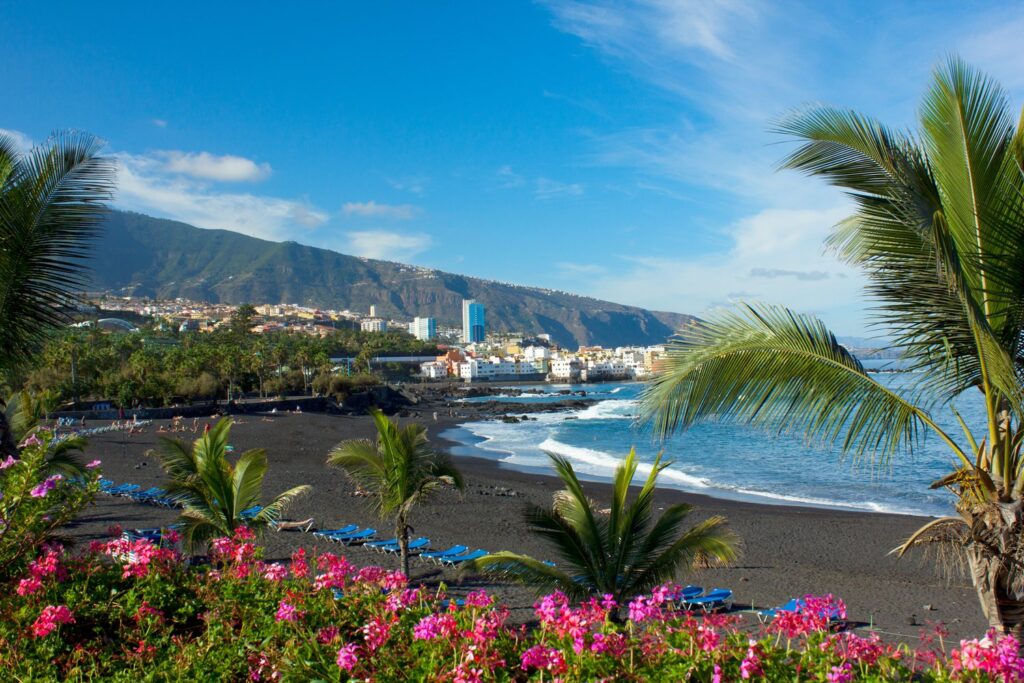
Playa Jardín is also the closest beach to Loro Parque, so it’s a good place to cool off after a day at the zoo. On clear days you can see the peak of Mount Teide in the background.
Playa Martiánez and Playa del Muelle
Playa Martiánez lies at the eastern end of town, below the Mirador de la Paz. Its waves make it popular with surfers and bodyboarders, while sunbathers relax on the dark sand. Closer to the centre you’ll find Playa del Muelle, a tiny cove by the fishing port. It’s too small for a long day on the sand, but perfect for a quick dip.

Lago Martiánez
Lago Martiánez (officially Complejo Costa Martiánez) is one of the most famous swimming spots in the Canary Islands. This complex of seawater swimming pools was designed by César Manrique and opened in 1977. Manrique combined white surfaces, black volcanic rock, palm trees and sculptures to create a resort-style lagoon right on the ocean. The central lake with its island and fountain is the highlight, but there are also smaller swimming pools for children.
It’s a good alternative to the beaches when the waves are high. Arrive early in summer, because sunbeds fill up quickly, and bring water shoes for the rocky edges.
Discover the gardens of Puerto de la Cruz
Thanks to its mild climate, Puerto de la Cruz has been a garden town for centuries. Nature lovers will find exotic trees, orchids and flower gardens just a short walk from the centre.
Botanical garden (Jardín de Aclimatación de La Orotava)
The botanical garden was founded in 1788 by order of King Charles III. Its official name is Jardín de Aclimatación de La Orotava, because the town once belonged to La Orotava. Plants collected in Spain’s colonies in the Americas and Asia were brought here to acclimatise before travelling on to the royal gardens in Madrid. The idea didn’t quite work, as many plants struggled in the colder climate of the Spanish mainland, but the garden flourished.
Today it holds thousands of tropical and subtropical plants, including palm trees, bromeliads and orchids. The star of the garden is a gigantic fig tree with aerial roots that look like a jungle in miniature. Allow at least an hour, and come in the morning, when the garden has a more peaceful atmosphere. The garden lies in the La Paz area, about 30 minutes’ walk uphill from the centre, so you may prefer a bus or taxi.
Sitio Litre orchid garden
Sitio Litre is the oldest garden on Tenerife, set around a private manor house dating from 1730. In 1774, it was bought by the British merchant Archibald Little, whose surname later turned into “Litre”. The garden has the largest orchid collection on the island and the oldest dragon tree in Puerto de la Cruz. Famous guests included Alexander von Humboldt and Agatha Christie. Stroll along the stone paths, look for the koi pond and the croquet lawn, and finish with a drink in the small café.
Spend a day at Loro Parque
Loro Parque is the most famous attraction in Puerto de la Cruz and one of the most visited places on Tenerife. It opened in 1972 as a small parrot park, and today it’s a huge zoo and botanical park on the edge of Punta Brava. You’ll see one of the world’s largest parrot collections, as well as gorillas, jaguars, penguins in a giant icy penguinarium, sea lions and dolphins. The park also has an aquarium with a shark tunnel and tropical gardens.

Plan a full day here, especially with children, and check the show times at the entrance. A free little train runs between the town centre and the park, so you don’t need a car. Book your tickets online in advance to skip the queues in high season. If you’re also planning a water park day, a combined ticket with Siam Park in Costa Adeje is worth considering.
Where to eat in Puerto de la Cruz
Puerto de la Cruz has some of the best food on the north coast. On the busiest streets, avoid restaurants with plastic menus and photos of every dish. Instead, head to La Ranilla or the streets around Plaza del Charco, where small tascas serve fresh fish and Canarian dishes.

Try papas arrugadas, small wrinkled potatoes boiled in salty water and served with red and green mojo sauces. Order grilled local fish, octopus or garbanzas, a hearty chickpea stew. For dessert, look for bienmesabe, an almond cream, and finish with a barraquito, a layered coffee with condensed milk, liqueur and cinnamon. In the hills above town you’ll also find guachinches, simple family-run places serving homemade food and their own wine.
More things to do in Puerto de la Cruz: festivals and events
Puerto de la Cruz loves a party, and local festivals are a great way to experience the town. The carnival in February or March is one of the liveliest on Tenerife. Its most famous event is the Mascarita Ponte Tacón, a race for men in high heels. In July, the Fiestas de Julio honour the Gran Poder de Dios and the Virgen del Carmen with processions, music and fireworks.
The town also hosts cultural festivals, including MUECA, which fills the streets with art, music and theatre. If your holiday dates are flexible, check the local calendar before you book.
Day trips from Puerto de la Cruz
Puerto de la Cruz is an excellent base for exploring the north of Tenerife. Most of these places are less than an hour’s drive away, and many are also reachable by bus.
La Orotava is the closest and one of the prettiest historic towns on the island. Its steep cobbled streets are lined with colonial mansions, and the famous Casa de los Balcones shows off traditional wooden balconies and a beautiful patio. In June, the town covers its streets with flower carpets for Corpus Christi.
Above the valley rises Teide National Park, a UNESCO World Heritage Site with lunar landscapes and the highest peak in Spain. You can take the cable car towards the summit of Teide or join an organised tour with transport from town. In the west, Icod de los Vinos is famous for its ancient dragon tree, and Garachico is known for its natural swimming pools formed by lava.
To the east, San Cristóbal de La Laguna is another UNESCO World Heritage Site and the island’s cultural capital. A little further on lies the capital, Santa Cruz de Tenerife, with its striking auditorium, museums and the famous carnival. If you prefer dramatic coastline, a trip to the cliffs of Los Gigantes combines well with whale-watching from the south coast.
How to get to Puerto de la Cruz
The nearest airport is Tenerife North Airport (Los Rodeos), about 25 km away. The drive takes around 25-30 minutes. Most flights from the UK, however, land at Tenerife South Airport, about 90 km from town. The transfer takes roughly an hour and a quarter by car or taxi.
Public transport on Tenerife is run by TITSA buses. Direct services connect both airports and Santa Cruz with the bus station in Puerto de la Cruz. If you want to explore the north at your own pace, car hire is the most flexible option. Parking in the old town can be tricky, so look for a hotel with parking or use the public car parks near the centre.
How many days do you need in Puerto de la Cruz?
Two or three days are enough to see the main sights. Spend one day in the old town and on the promenade, another at Loro Parque, and use the third for the gardens and Lago Martiánez. If you’d like to explore more of northern Tenerife, plan a week. That gives you time for day trips to La Orotava, Teide and Garachico, and still leaves room for lazy afternoons by the sea.
History, gardens, black sand beaches or a family day at the zoo: there are plenty of things to do in Puerto de la Cruz. It’s a town that rewards slow travellers, so give yourself time to wander and enjoy it at a local pace.
Hotels in Puerto de la Cruz
Puerto de la Cruz has a wide choice of hotels, from historic townhouses in the old town to large resort hotels with pools and sea views. Staying in the centre means you can walk to the promenade, the port and the best restaurants.
💰 Hotel Monopol
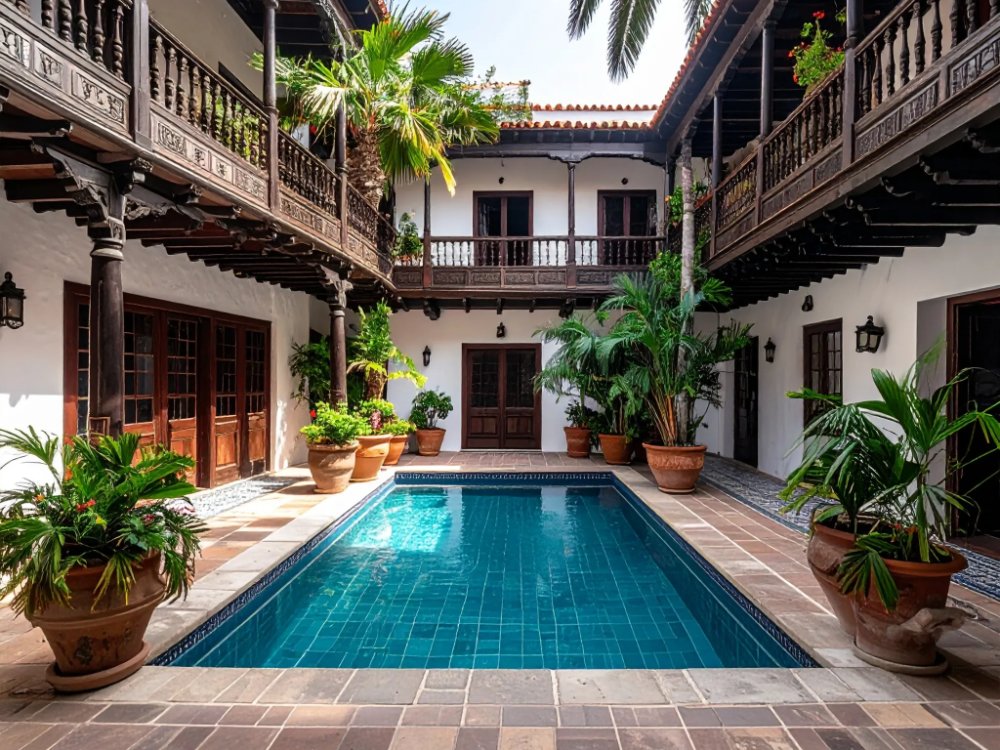
A characterful hotel in a historic building from 1742 on Calle Quintana, right opposite the Iglesia de Nuestra Señora de la Peña de Francia. The rooms are arranged around a traditional Canarian patio full of plants. There’s a small heated pool and sun terraces on the upper floors. It’s great value if you want to stay in the old town, a few minutes’ walk from Plaza del Charco and the promenade.
🏨 H10 Tenerife Playa
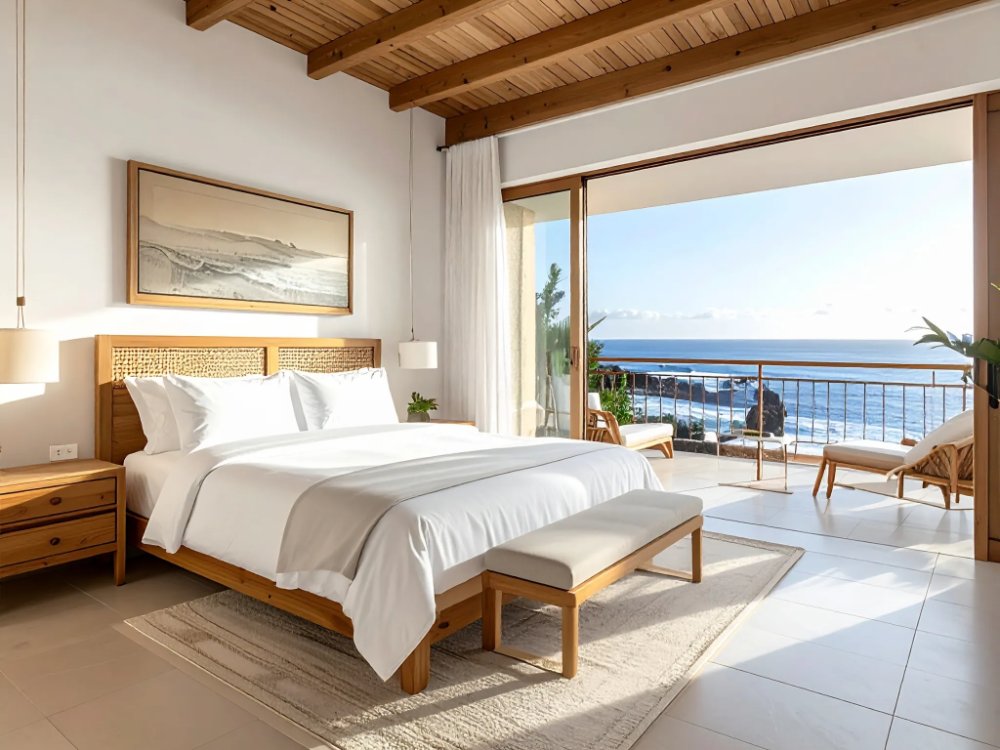
A four-star hotel on Avenida de Colón, across the road from Lago Martiánez and close to Playa Martiánez. Many of its bright, air-conditioned rooms have sea views, and the hotel has large pools, a buffet restaurant with a sea-view terrace and evening entertainment. The old town is about a 10-minute walk along the promenade. It’s ideal if you want a classic seaside holiday with everything on your doorstep.
💎 Hotel Botánico & The Oriental Spa Garden
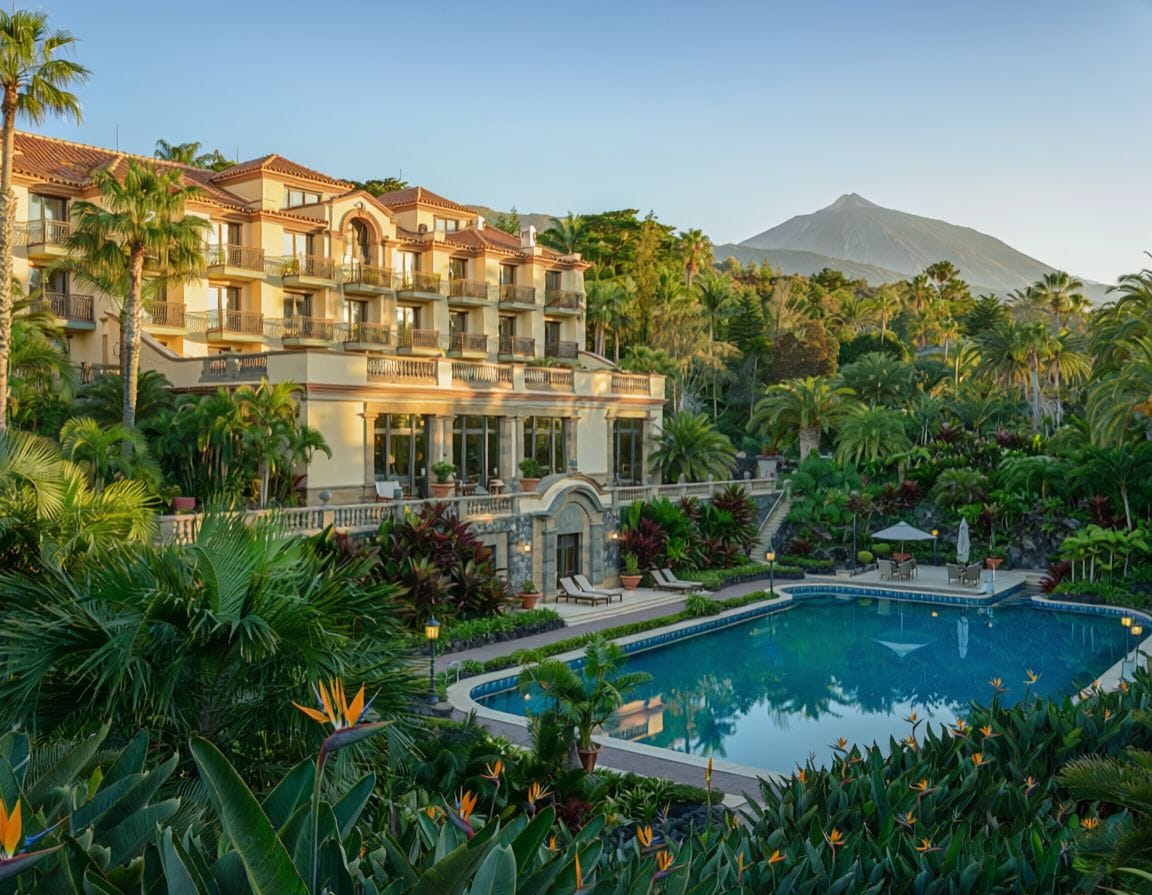
A five-star member of The Leading Hotels of the World, set in tropical gardens in the green La Paz area, close to the botanical garden. Its highlight is The Oriental Spa Garden, an award-winning spa with Thai-inspired treatments, pools and relaxation areas. Guests can choose between several restaurants and a large pool in the gardens. It’s the perfect choice for a romantic break or a relaxing stay away from the crowds.

