Drive an hour uphill from the beach and the air turns thin and cool, the pines give way to lava, and you find yourself on the floor of a crater roughly 16 km across.
Teide National Park covers the high, volcanic heart of Tenerife, and it is the place most visitors remember long after the sunburn has faded. The park protects the Las Cañadas caldera, the twin volcanoes of Teide and Pico Viejo, and a landscape of lava flows, pumice plains and strange rock towers. It was declared a national park in 1954 and became a UNESCO World Heritage Site in 2007. Each year more than four million people come here, which makes it the most visited national park in Spain. This article is about visiting the park itself: the viewpoints, the trails, the stars and the practical side of getting there. If you want to climb to the summit or learn about the volcano’s height and eruptions, read our separate guide to Mount Teide.
💰 Hotel Rural Victoria - A characterful hotel in a historic building in the old centre of La Orotava.
🏨 Hotel Las Águilas Tenerife - A four-star hotel with a pool on a hillside above the Orotava Valley.
💎 Hotel Botánico & The Oriental Spa Garden - A five-star spa hotel in Puerto de la Cruz, about an hour from the park.
Teide National Park at a glance
The national park covers almost 190 square kilometres in the centre of the island. Most of it sits inside Las Cañadas del Teide, a huge collapsed crater ringed by cliffs. Its floor lies at around 2,000 metres above sea level, and from it rises Mount Teide, at 3,715 metres Spain’s highest peak and the highest mountain in the Canary Islands. Locals often call it Pico del Teide. Next to it stands Pico Viejo, the older and wider cone that last erupted in 1798. Together they form the Teide Pico Viejo stratovolcano, which is still classed as an active volcano, although it is closely monitored and quiet today.
Entry to the park is free and there is no gate or ticket booth. The TF-21 road crosses the caldera from north to south, with car parks, viewpoints and visitor centres along the way. You pay only for extras, such as the Teide cable car, guided tours or a meal at the Parador.
How to get to Teide National Park
Four roads climb into the park, and each one is a scenic drive in its own right. From the north, the TF-21 comes up from La Orotava through pine forests and reaches the El Portillo junction in about 40 minutes. The TF-24 runs along the island’s spine from La Laguna and La Esperanza, with views over the clouds and the Teide Observatory. From the south, the TF-21 climbs from Vilaflor, and the TF-38 links the park with Chío and the west coast near Los Gigantes.
Driving gives you the most freedom, and a rental car lets you stop at viewpoints at your own pace. From Costa Adeje or Los Cristianos allow about an hour to the Roques de García. From Puerto de la Cruz it takes a similar time, and from Santa Cruz de Tenerife around an hour and a quarter via the TF-24. The roads are good but winding, so take it slowly and watch for cyclists. There is free parking at all the main stops, but the car parks at the Roques de García and the cable car base station fill up by mid-morning.
Without a car, TITSA public buses run once a day: line 342 from the south coast and line 348 from Puerto de la Cruz. They leave in the morning and return in the afternoon, which gives you a few hours in the park but little flexibility. For most visitors without a car, a tour is the easier option.
Teide National Park tours from the coast
Day trips from the resorts usually combine the park with other highlights of the island. A popular route crosses the caldera, stops at the Roques de García and then drops down to the cliffs of Masca, the old dragon tree in Icod de los Vinos and the harbour town of Garachico. Tours like this include hotel pick-up from Costa Adeje, Los Cristianos or Puerto de la Cruz, so nobody has to drive the hairpins. They suit families and anyone who wants to see the volcanic landscape without planning the logistics.
Roques de García and the Ucanca plain
The Roques de García are the most photographed rock formations in the park and the best first stop. These eroded towers of old volcanic rock stand in a row opposite the Parador, with Mount Teide rising right behind them. The most famous is Roque Cinchado, a narrow stone tree that seems to balance on a thin base. Spanish visitors may recognise it from the old 1,000-peseta note. Next to it towers La Catedral, a massive rock that climbers know well.
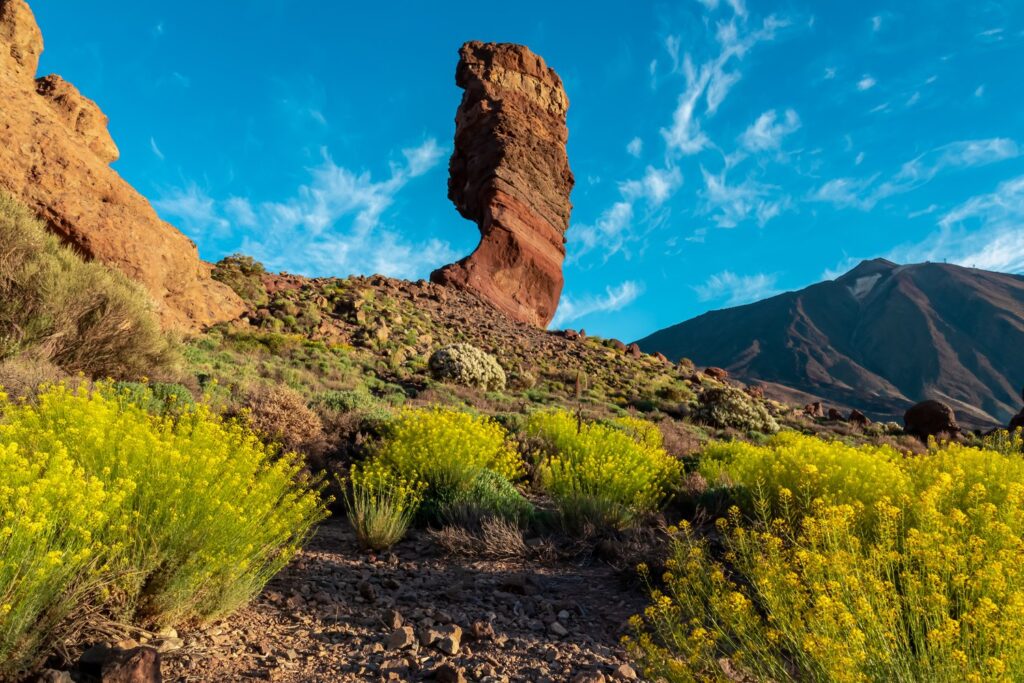
From the viewpoint you look down onto the Llano de Ucanca, a flat, pale plain where water collects after winter rain. Trail number 3 makes a loop of about 3.5 km around the Roques de García. It takes around two hours at an easy pace, with one short, steep section on the way back. If you only have time for one walk in Teide National Park, this is the one. Go early in the morning or late in the afternoon, when the low light paints the rocks red and the coach groups have gone.
The best viewpoints in Teide National Park
You don’t need to hike to see the park at its best. Many viewpoints lie a short walk from the road, and each one shows a different side of the caldera, from lava fields to unique rock formations.
Minas de San José and the lunar plains
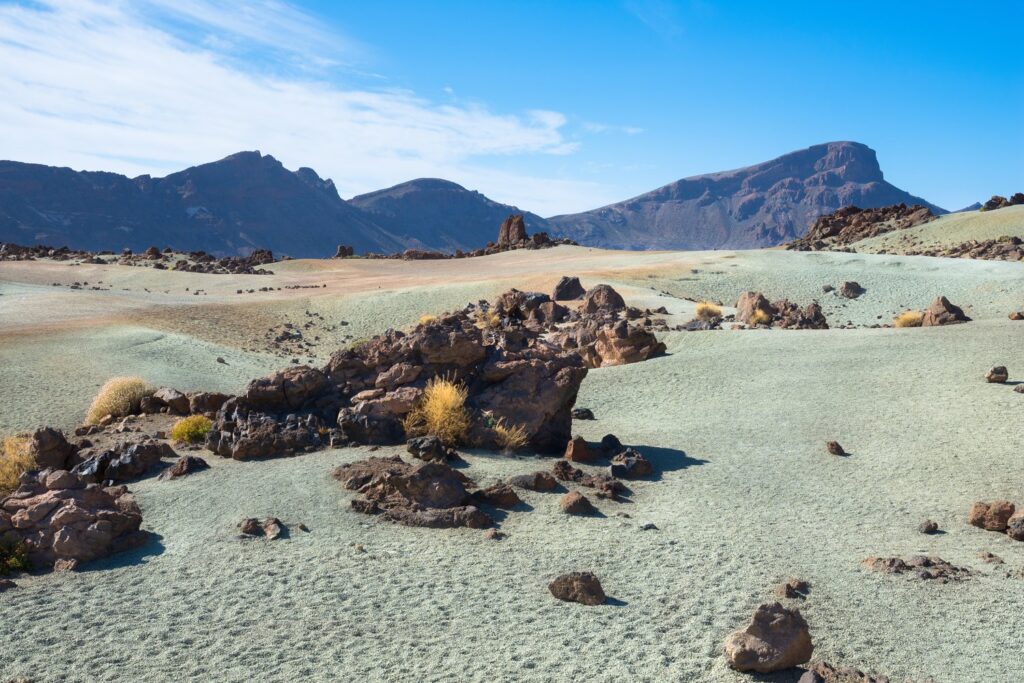
Between El Portillo and the cable car, the road crosses fields of pale pumice dotted with dark lava bombs. At Minas de San José you can walk a few hundred metres across this sand-like ground, which looks more like the Moon than a Spanish island. Further south, near the Parador, Los Azulejos shows rocks stained green and blue by minerals, a colour you rarely see in volcanic landscapes.
Pico Viejo viewpoint and Las Narices del Teide
On the TF-38, the Pico Viejo viewpoint looks across a black sea of lava towards the volcano’s crater. Below it you can see Las Narices del Teide, the “nostrils” that opened during the 1798 eruption. On clear days the view stretches to the neighbouring islands of La Gomera and La Palma.
Mirador de los Zapatos de la Reina
The name means “the Queen’s Shoes”, after a rock that locals say looks like a lady’s slipper. It sits on the TF-21 close to the Roques de García and is a good place to look back across the Ucanca plain towards the cliffs of the caldera wall.
Hiking in Teide National Park
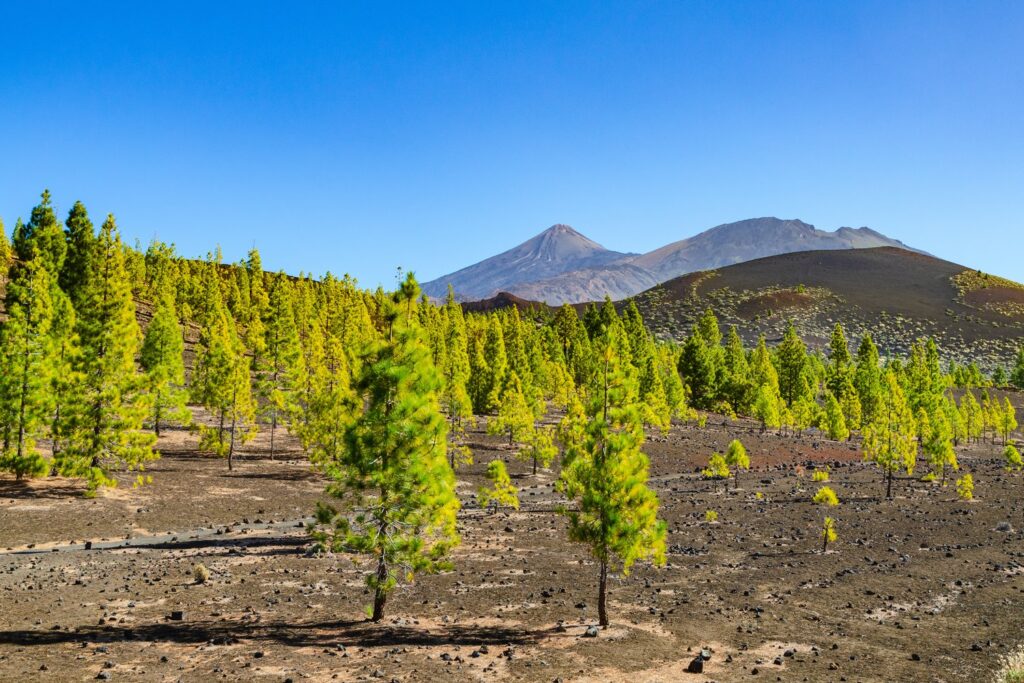
The park has dozens of marked trails, from short nature walks to challenging hikes across the caldera. Most start from the main road, and the visitor centres give out free maps. Trail number 4, the Siete Cañadas route, follows the foot of the caldera wall from El Portillo to the Parador and is long but mostly flat. The Samara trail on the TF-38 is a gentle loop past young volcanic cones and Canary pines, ideal for an hour or two.
The hike from Montaña Blanca to the Altavista refuge and the summit is a different matter. It climbs more than 1,300 metres, the thin air makes every step harder and the last stretch needs a permit, so we cover it in our Mount Teide guide. Whatever you choose, carry plenty of water, start early and remember that you are walking at high altitude.
The Teide cable car in brief
The Teide cable car starts at the base station at 2,356 metres above sea level on the TF-21 and reaches La Rambleta at 3,555 metres in about eight minutes. From the upper station, two short trails need no permit: trail 11 leads to La Fortaleza viewpoint, with spectacular views over the north of the island, and trail 12 goes to the Pico Viejo viewpoint, which looks into the old crater. The final path to the summit, the Telesforo Bravo trail, requires a separate permit, and the cable car ticket does not include it. Strong wind or ice can close the cable car at short notice, so keep a back-up plan. Everything about tickets, the summit permit and altitude sickness is in our article about Mount Teide.
Stargazing and the Teide Observatory
When the day visitors leave, Teide National Park shows its second face. The park sits above the clouds, far from big cities, and the island has strict rules on light pollution. The result is one of the darkest skies in Europe, with the Milky Way clearly visible on moonless nights. Sunset tours drive up to the caldera, watch Teide cast its long shadow over the sea of clouds and then stay for stargazing with telescopes and a guide.
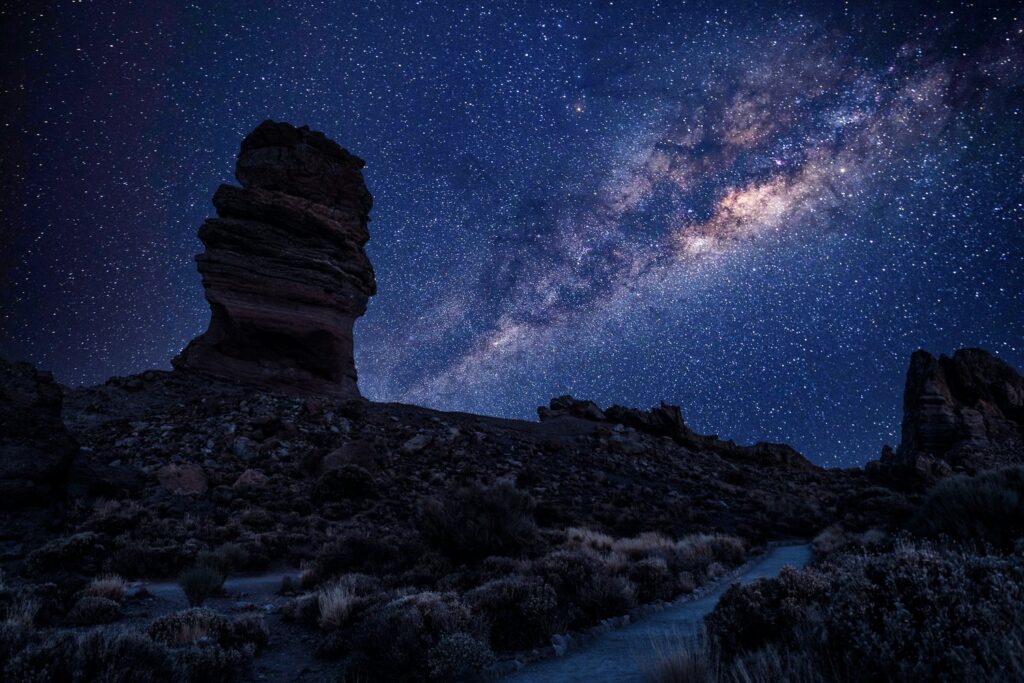
On the eastern edge of the park, the Teide Observatory at Izaña has studied the sun since the 1960s. Its white domes are visible from the TF-24, and you can only go inside on a guided visit booked in advance. Even without a tour, a night in the park is an unforgettable experience. Bring warm clothing, because temperatures at 2,000 metres can drop close to 0°C after dark, even in summer.
Plants and wildlife of the park
At first sight the caldera looks bare, but it is home to many endemic species found nowhere else on Earth. The red tajinaste, known in English as Teide bugloss, sends up spikes of red flowers up to three metres tall. It blooms from late April to June, when the park is at its most colourful. Look also for the tiny Teide violet, which grows among the rocks at very high altitude.
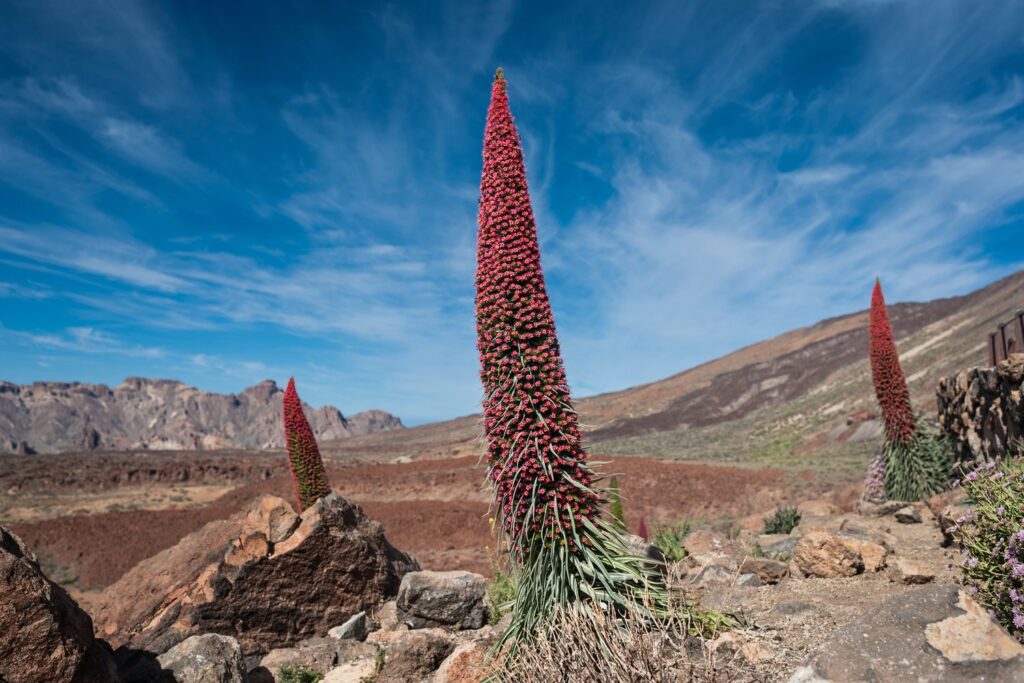
The animal you will see most often is the Tenerife lizard, which basks on warm stones near the car parks. Please don’t feed it. In the pine forests on the way up, keep an eye out for the Tenerife blue chaffinch, a bird found only on this island. Its close relative lives in the pine forests of Gran Canaria. You can learn more about these plant species at the botanical garden of the El Portillo visitors centre.
Visitor centres in and around the park
The El Portillo visitors centre, at the northern entrance where the TF-21 and TF-24 meet, is the best place to start. It has an exhibition on the park’s geological history, a short film and a garden with labelled native plants. On the southern side, the Cañada Blanca visitor centre stands near the Parador and the Roques de García. In the town of La Orotava, the Telesforo Bravo centre is a useful stop on a rainy day. Staff at all of them can tell you which trails and roads are open, which matters in winter, when snow sometimes closes the higher roads.
When to visit and what to bring
Teide National Park is open all year, and every season has its charm. Spring brings the red tajinaste in flower, summer offers stable weather and long evenings, and winter can cover the volcano in snow. The best time of day is early morning, when the air is clearest and the car parks are still quiet.
The weather at 2,000 metres is very different from the coast. It can be 25°C on the beach and 10°C at the Roques de García, with strong sun and a cold wind at the same time. Pack layers, a windproof jacket, sun protection, a hat and sunglasses. Bring water and snacks, because apart from the Parador, the cable car café with its souvenir shop and a couple of kiosks there are few places to eat.
How long to spend in the park
Plan at least half a day for the highlights: the drive across the caldera, the Roques de García loop and a few viewpoints. A full day lets you add the cable car or a longer hike and come down via a different road. If you want to stay for sunset and stargazing, consider a night in the park or nearby, so you don’t have to drive the mountain roads late at night.
Visiting Teide National Park with kids
Children love the “Moon walk” feeling of the lava fields, and short trails such as the Roques de García loop or Minas de San José work well for families. Bring a carrier rather than a pushchair, because paths are rocky and uneven. Children under three are not allowed on the cable car, and doctors advise care at high altitude for very young children and anyone with heart or breathing problems. Plan regular breaks, plenty of drinks and snacks, and turn back if anyone feels dizzy. After the park, the rest of the day can go to the pools and parrots of Loro Park in Puerto de la Cruz.
Park rules worth knowing
The park is strictly protected, and rangers do check. Stay on marked trails, don’t take stones or plants and don’t build little rock towers. Flying drones and camping are not allowed without special permission. Park only in marked car parks, never on the roadside. The island government has also announced plans to manage private car access and add shuttle buses, so check the latest rules before you travel. Following these simple rules helps keep the volcanic landscape as unspoilt as it is today.
Hotels near Teide National Park
Staying close to the park lets you see the Roques de García early, before the crowds, and stay late for the stars. The only hotel inside the park is the Parador de Las Cañadas del Teide, right opposite the Roques de García. The towns on the northern slopes are great alternatives, with easy access via the TF-21. For more ideas, browse places to stay on Tenerife.
💰 Hotel Rural Victoria
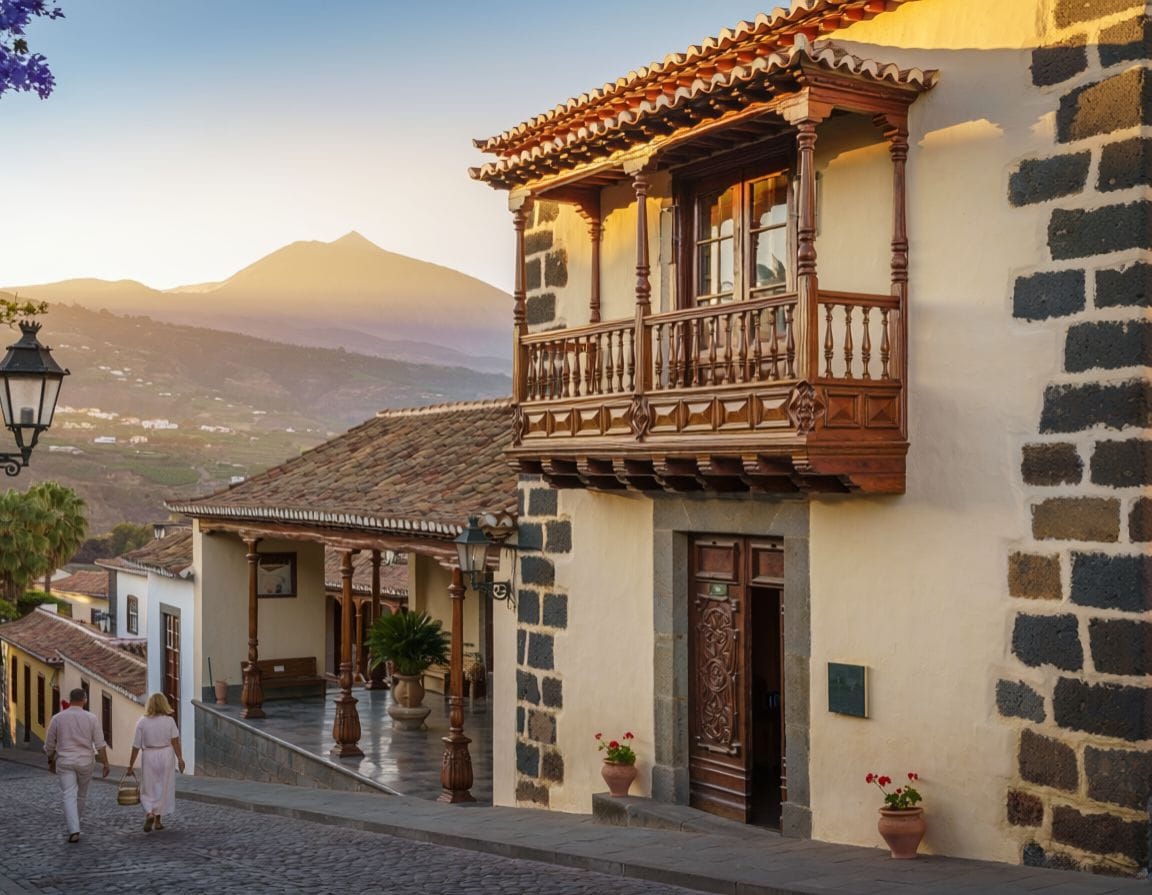
This good-value hotel occupies a historic building in the old centre of La Orotava, with a traditional courtyard and carved wooden balconies. From here it is about a 40-minute drive up the TF-21 through the pine forest to El Portillo. The rooms are simple but full of character, and the town’s churches, gardens and restaurants are right outside the door. It suits travellers who want to combine the national park with the north of the island.
🏨 Hotel Las Águilas Tenerife
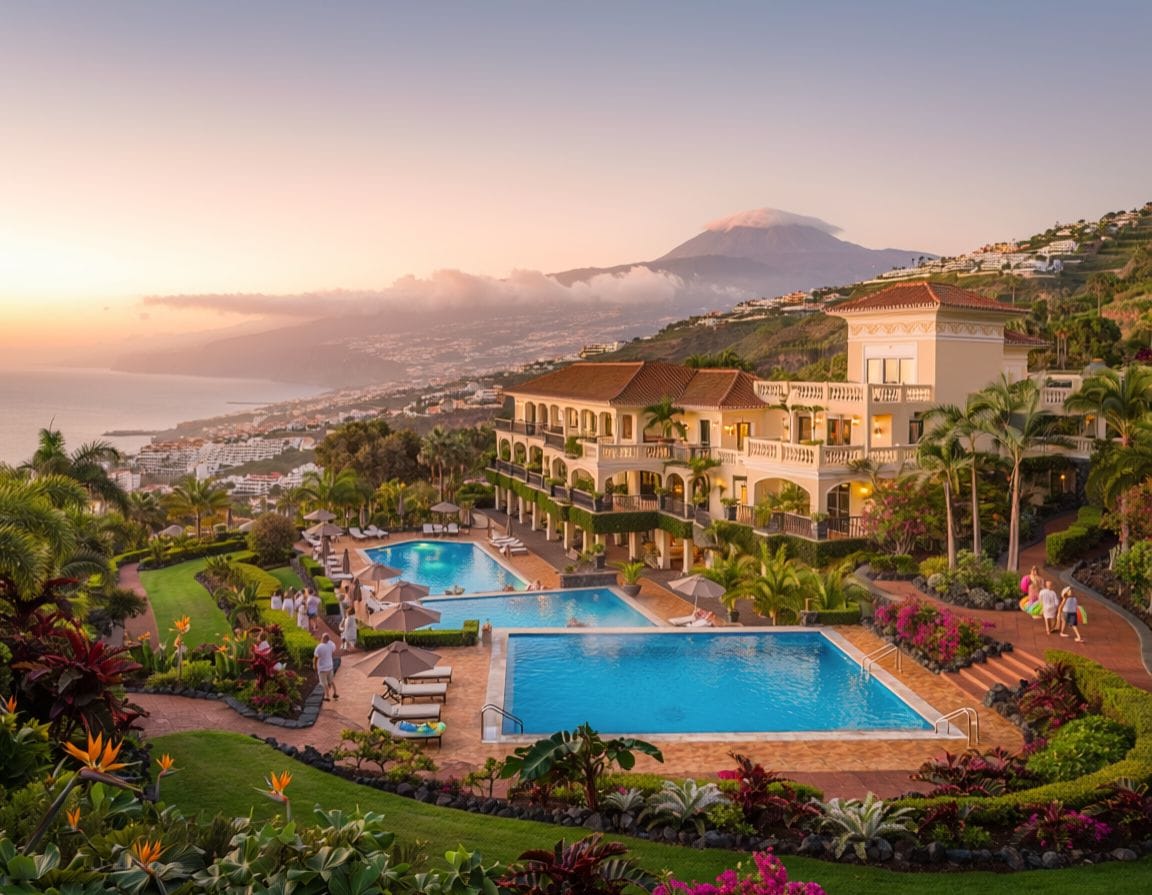
This four-star hotel stands on a hillside above the Orotava Valley, on the edge of La Orotava, with views of Mount Teide and the Atlantic. It has an outdoor pool, a restaurant and spacious rooms, many with balconies. The drive to the park is short, and the coast of Puerto de la Cruz is only a few minutes away. It is a comfortable base for families and couples who want quiet evenings after a day in the mountains.
💎 Hotel Botánico & The Oriental Spa Garden
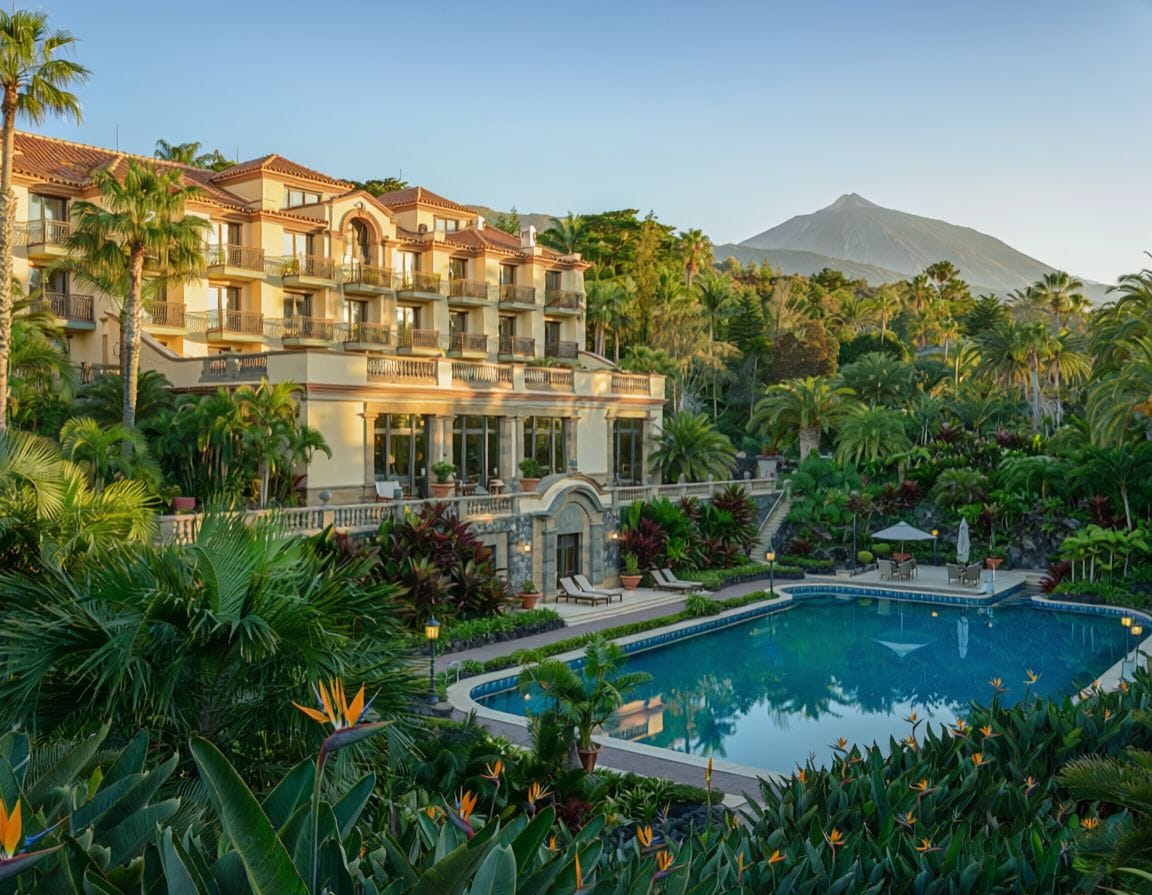
This five-star hotel sits in the green La Paz district of Puerto de la Cruz, next to the town’s famous botanical garden. Its large spa with Asian-inspired treatments is the perfect reward after a hike at high altitude. You will find tropical gardens, several pools and refined restaurants, and the park is about an hour’s drive away. It is ideal for a luxurious stay on the island’s greener northern coast.
Teide National Park FAQ
Is Teide National Park free to visit?
Yes, entry to Teide National Park is free, and you can drive through it, park and walk the marked trails without a ticket. You pay only for extras such as the cable car, guided tours, observatory visits or meals. The summit trail needs a separate permit.
Is Teide National Park worth visiting?
Yes, it is the most impressive natural sight in the Canary Islands and a welcome change from the beaches. In half a day you can see the Roques de García, lava fields and crater viewpoints, and at night the sky is one of the clearest in Europe.
Can you visit Teide National Park without a car?
Yes, but with less flexibility. TITSA buses 342 and 348 run once a day from the south coast and from Puerto de la Cruz, and many tours offer hotel pick-up. A tour is the simplest option if you don’t want to drive the mountain roads.
Is Teide higher than Ben Nevis?
Yes, by a long way. Mount Teide, Spain’s highest point, rises to 3,715 metres, almost three times the height of Ben Nevis at 1,345 metres. Measured from the ocean floor, it is around 7,500 metres tall. Even the caldera floor at around 2,000 metres is higher than any mountain in the UK.
When did Teide last erupt?
The Teide volcano last erupted in 1798, when Las Narices del Teide opened on the slope of Pico Viejo. The most recent eruption on the island was Chinyero in 1909. Teide is still an active volcano, but it is closely monitored and safe to visit.

