In the winter of 1838, a sickly composer rented a monk’s cell to escape Paris with the woman he loved. Almost two centuries later, his piano still stands by the window, facing the olive groves.
Valldemossa is a stone village tucked into a green valley in the west of Mallorca, the largest of the Balearic Islands, about 17 km north of Palma. Honey-coloured houses climb the hillside, flower pots line every doorstep and the bell tower of the old monastery rises above the rooftops. It’s one of the most beautiful towns on the island and an easy half-day trip from the capital city. If you’re holidaying on the island and want a break from the beach resorts, this is the place to start. In this article, you’ll find the best things to do in Valldemossa, from the Carthusian monastery where Chopin spent a winter to viewpoints, hikes and local pastries. You’ll also get practical tips on getting there, parking and the best time to go, so you can plan your visit in minutes.
💰 Ca’s Papà - Small family-run hotel a minute’s walk from the Real Cartuja.
🏨 Es Petit de Valldemossa - Eight-room boutique hotel with a breakfast terrace facing the mountains.
💎 Mirabó de Valldemossa - Boutique hotel on a 16th-century olive estate with a pool and village views.
Why visit Valldemossa, Mallorca?
The village sits at around 400 metres above sea level in the Serra de Tramuntana, the mountain range that runs along the north-west coast of Mallorca. In 2011 the whole range was named a UNESCO World Heritage Site for its cultural landscape of dry-stone walls, terraced hillsides and ancient olive groves. Valldemossa is a perfect introduction to its natural beauty. The air is cooler than on the coast, the views go on for miles and the village centre is small enough to explore on foot.
History is the other big draw. The kings of Mallorca built a summer residence here in the 14th century. Carthusian monks later turned it into a monastery, and in the 19th century Frédéric Chopin and the French writer George Sand made the village famous across Europe. Add a strong local identity, a saint born in the village and a lively Sunday market, and you’ll see why so many people visit Valldemossa on their first trip to the island.
Is it worth visiting? Yes, but timing matters. Valldemossa, Mallorca is a popular tourist destination, and by late morning coach groups fill the main streets. Arrive early or stay for the evening, and you’ll discover a calmer, more welcoming side of this charming village.
Visit the Real Cartuja de Valldemossa
The Real Cartuja de Valldemossa, also called the Valldemossa Charterhouse, is the heart of the village and the first stop for most visitors. In 1399 King Martin I of Aragon gave the old royal palace to Carthusian monks, who expanded it into a Carthusian monastery. The monks lived here in silence until 1835, when the Spanish government confiscated church property. The cells were then sold off to private owners, and some were rented out to travellers.
Inside La Cartuja de Valldemossa you’ll walk through long arcaded corridors, the cloister and the Neoclassical church, built between 1751 and 1812, with colourful frescoes on its vaults. Don’t miss the old pharmacy. Its shelves are still lined with 17th- and 18th-century ceramic jars and glass bottles, used by the monks to prepare remedies from mountain herbs. There’s also a small collection of modern art, including works by Joan Miró.
The best part of the Cartuja might be outdoors. The terraces and gardens behind the cells look straight down the valley towards the sea, with almond trees, lemon trees and olive groves below. Go when the doors open, as the corridors get crowded quickly in summer. Opening hours change with the season, so check them the day before your visit.
Chopin and George Sand’s cell
Frédéric Chopin arrived with George Sand and her two children in December 1838 and spent the winter of 1838-39 in the monastery. They hoped the Mediterranean winter would help his weak lungs. Instead, it rained for weeks, the cell was damp and the locals were wary of the unmarried couple from Paris. Chopin’s health got worse, but he kept composing and finished his Préludes, Op. 28 here. Sand later described the stay, rather bitterly, in her book “A Winter in Majorca”.
Today, two former cells house the Chopin and George Sand Museum. You’ll see a piano the composer used, handwritten scores, letters, portraits and a lock of his hair. The tiny garden in front of the cell has one of the best views in the whole monastery. Stand there for a moment and you’ll understand why both of them, despite everything, called the place beautiful.
Explore the Palace of King Sancho
Right next to the Carthusian monastery stands the Palace of King Sancho (Palau del Rei Sanç). King James II of Mallorca built a royal palace here in the early 14th century, around 1309, and his son Sancho, who suffered from asthma, used it as a summer residence to escape the heat of Palma. It’s the oldest building in the village and the original core of the whole complex.

The rooms are decorated with period furniture, paintings and tapestries, and the main hall has a painted ceiling. At set times a pianist plays a short Chopin recital in the palace, which is a lovely way to hear his music in a place so closely tied to him. Climb the tower if it’s open. From the top, you can see the rooftops of the old town, the church spire of Sant Bartomeu and the Tramuntana mountains all around.
The palace and the monastery are usually visited together. If you’d like to skip the ticket queue, book your entry online in advance.
Wander the old town and its cobbled streets
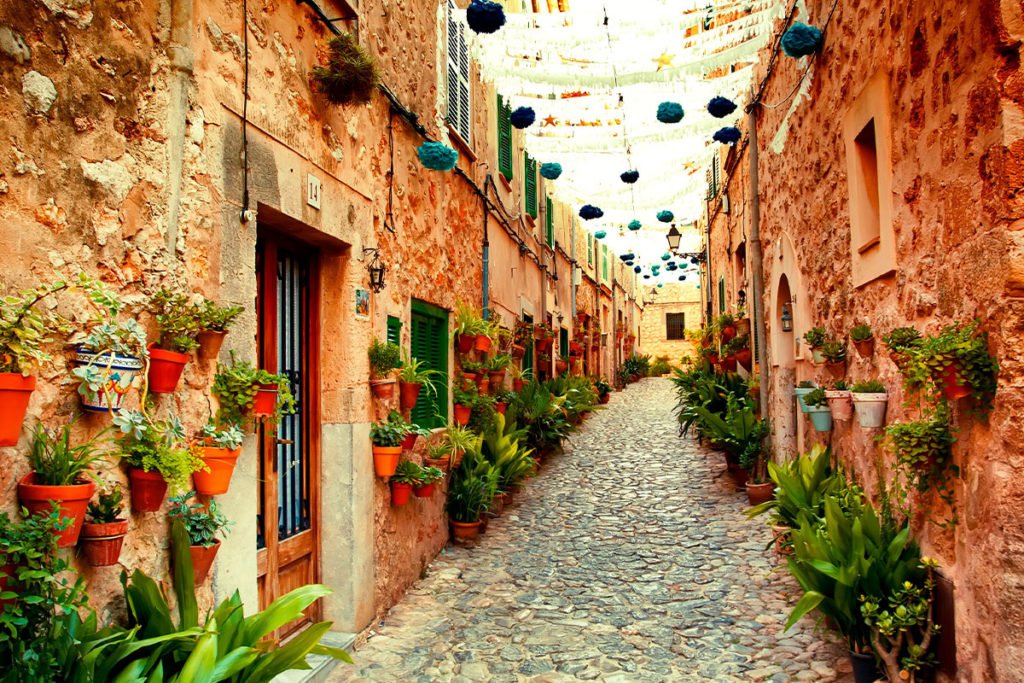
Once you’ve seen the Carthusian monastery, put the map away and just walk. The old town is a tangle of narrow streets, stone steps and cobbled lanes, with green wooden shutters and potted geraniums on almost every house. It takes only a few minutes to cross the village centre, but you could easily spend an hour exploring its quiet corners.

Look out for small ceramic tiles on the walls next to the front doors. Each one shows a scene from the life of Santa Catalina Thomas, the village’s own saint, with a short prayer asking for her protection. Almost every house has one, and spotting them becomes a little game as you walk around.
Valldemossa town is also great for some unhurried shopping. Along the main street, Carrer de la Cartoixa, and around the square you’ll find boutique shops, small galleries and gift shops selling ceramics, leather goods, linen and local olive oil.
Carrer de la Rectoria and the birthplace of Saint Catalina Thomas
Carrer de la Rectoria is probably the most photographed lane in the village. It runs beside the church, between honey-coloured stone houses covered in plants. Halfway along you’ll find the house where Saint Catalina Thomas was born in 1531. It’s now a tiny chapel with a statue of the saint and a few personal mementoes.
Catalina, known locally as “la Beata”, was an orphaned farm girl who became an Augustinian nun in Palma. She was canonised in 1930 and remains Mallorca‘s best-loved saint. Every year on 28 July, the village honours her with the Festes de la Beata, a procession with a decorated cart and a young girl dressed as the saint.
Church of Sant Bartomeu
At the lower end of the village stands the parish church of Sant Bartomeu. Its origins go back to the 13th century, soon after the Christian conquest of Mallorca, but most of what you see today was rebuilt in the 18th century. The bell tower is a landmark visible from many viewpoints, and the interior is simple, bright and peaceful.
Few visitors make it this far, so it’s a good place for a quiet break. Saint Bartholomew is the patron saint of the village, and his feast day on 24 August brings concerts and celebrations to the streets.
Relax in Plaça Cartoixa and the King Juan Carlos gardens
Plaça Cartoixa, the square in front of the monastery, is the social centre of the village. Grab a table on one of the café terraces, order a coffee and watch the comings and goings of locals and visitors. People-watching here is one of the simplest things to do in Valldemossa, and a great break between the Cartuja and the old town.

Just behind the monastery you’ll find the Jardins Rei Joan Carles, a public garden named after King Juan Carlos I. It’s free to enter and much quieter than the square, with shady trees, sculptures and a fountain. These lush gardens are a pleasant place to sit on a hot afternoon, when the square is at its busiest.
Try coca de patata and Mallorcan food
Coca de patata is the taste of Valldemossa. It’s a soft, sweet bun made with boiled potatoes, dusted with icing sugar and usually eaten with coffee or hot chocolate. The most famous place to try it is Ca’n Molinas, a family bakery that has been making it for around a century. There’s often a queue, but it moves quickly.

For a proper meal, go for traditional Mallorcan dishes. QuitaPenas Valldemossa is a small, popular spot known for its pa amb oli, local bread rubbed with tomato and drizzled with olive oil, served on boards with cheese and cured meats. Es Taller serves creative tapas and globally inspired dishes, while Can Costa, just outside the village, specialises in classic island cooking such as roast suckling pig and lamb. Many local pastries are made with lard, so ask if you avoid animal products.
Don’t leave without a bottle of olive oil. Olive growing has shaped this landscape for centuries, and the terraces you see around the village were built to grow olive trees.
Enjoy the best viewpoints in Valldemossa
Valldemossa is all about breathtaking views. One of the best is Sa Miranda des Lledoners, a small terrace right next to the walls of the royal palace. It looks over the lower part of the village and the church spire, with the mountains behind. Inside the Cartuja, the gardens of the Chopin cell and the monastery terraces look straight down the valley.

For the classic postcard shot of the whole village, head to the roadside viewpoints on the Ma-1110 just outside town. Mirador de Valldemossa II has a bit more parking space. Walking there along the road can feel risky, as there’s no proper path and cars pass in both directions. The best light is in the late afternoon, when the stone houses glow warm gold.
Go hiking in the Tramuntana mountains
Hiking is one of the best things to do in Valldemossa for nature lovers. Several marked trails start right at the edge of the village and wind through terraced farmland, holm oak forests and old olive groves. The mountains around the village are also popular for road cycling, rock climbing and canyoning. You’ll find maps and route advice at the tourist office near the main car park.
The most famous route is the Archduke’s Path (Camí de s’Arxiduc). It follows old mule tracks built by Archduke Ludwig Salvator of Austria, who fell in love with this coast in the 19th century and bought several estates here. The trail climbs to a high ridge with stunning views over western Mallorca and the sea. It’s a demanding half-day hike, so set off early, bring plenty of water and wear proper shoes.
An easier option is the walk from Valldemossa to Deià, sometimes called the route of the olive trees. It crosses peaceful terraced hillsides and drops down to one of the most picturesque mountain villages on the island. You can return by bus from Deià. If you prefer a guided walk with transport from Palma, there are small-group tours that combine the village with a short mountain hike to a viewpoint.
Drive down to Port de Valldemossa
Port de Valldemossa is a tiny fishing hamlet on the coast below the village. It’s about 6 km away, but the road is narrow, steep and full of tight bends, so take it slowly. You may need to pull over or reverse to let other cars pass. There’s no bus, so you’ll need a car.
At the bottom, you’ll find a small pebble cove, a handful of houses, fishing boats and a seafood restaurant. It’s not one of the island’s big beach towns, but the setting under the cliffs is wild and dramatic. Parking is very limited and fills up fast on sunny days, so go early or late.
Browse the Sunday market and join the festivals
Valldemossa hosts a weekly market on Sunday mornings, all year round. It’s small, but it’s a nice way to watch the village wake up. Stalls sell fruit, vegetables, cheese, sobrassada sausage, olive oil, crafts and souvenirs.
If you’re travelling in summer, plan around the festivals. The Festes de la Beata on 28 July are the biggest celebration of the year. The Chopin Festival brings piano concerts to the monastery cloister in August, and the feast of Sant Bartomeu follows on 24 August. In July, the village also holds Artdemossa, an evening of art, exhibitions and live music in the streets.
Plan a day trip with Deià and Sóller
Valldemossa is a natural first stop on a day trip along the west coast. Drive or take the bus about 10 minutes north to Deià, a hillside village of stone houses where the poet Robert Graves lived for many years. On the way you’ll pass the Son Marroig estate, one of the Archduke’s former homes. Its gardens overlook Sa Foradada, a rocky peninsula with a hole in it, and the sunsets here are famous.
Continue to Sóller, a charming town in a valley full of orange groves, and then take the old tram down to Port de Sóller. From there, boats sail along the cliffs to Sa Calobra. You can even ride the vintage wooden train from Sóller back to Palma, a classic way to finish the day. Many organised tours from the resorts combine all of these stops if you’d rather not drive.
How to get to Valldemossa from Palma?
Valldemossa is easy to reach from Palma de Mallorca. By car, the Ma-1110 road takes you there in about 25 minutes. The last section climbs through the mountains with lots of bends, but it’s well surfaced and easy to drive. Car hire gives you the most freedom, especially if you want to add Deià, Sóller or Port de Valldemossa to the same day. From Palma Airport, the drive takes around 35 minutes.

Without a car, take TIB bus 203 from the Estació Intermodal in Palma, under Plaça d’Espanya. The ride takes about half an hour, and the line continues to Deià, Sóller and Port de Sóller. In high season, buses can fill up, so arrive at the stop early.
Parking in Valldemossa
The village has several paid car parks at its entrance, along the main road from Palma. In summer, they fill up by mid-morning, and street parking in the old town is reserved for residents. Arrive before 10am to find a space easily. From the car parks, it’s only a five-minute walk to the monastery and the main square.
When is the best time to visit Valldemossa?
Spring and early summer, from April to June, are the best months to visit Valldemossa. The hills are green, the gardens are in bloom and temperatures are pleasant for walking, usually around 20-25°C. September and October are just as good, with warm days and fewer crowds. July and August can be very hot and busy, so plan to arrive early in the morning or come back in the evening.

Winter is a surprisingly good time to visit Valldemossa too. The village is quiet, the Tramuntana mountains are often misty and you might just feel what Chopin and George Sand felt in 1838. Some cafés and shops close in the low season, though, and it can rain for several days in a row.
How long do you need in Valldemossa?
You can walk around the whole village in about an hour. With a visit to the monastery and the palace, a coffee and a slice of coca de patata, plan for around three hours. That makes it a perfect half-day trip from Palma.

If you’d like to hike, drive down to the coast or continue to Deià and Sóller, give it a full day. And if you want to see the village without the crowds, stay overnight. In the evening, after the last coaches leave, Valldemossa becomes a peaceful retreat with a completely different atmosphere. Book your room well in advance, as the village has only a few small hotels.
See available places to stay in Valldemossa
Hotels in Valldemossa
Valldemossa has no big resorts, only a handful of small hotels and rural estates. Staying here means quiet nights, cool mountain air and the village almost to yourself in the morning. Here are three places for different budgets.
💰 Ca’s Papà
A small, family-run hotel in the village centre, just a minute’s walk from the Real Cartuja and the Palace of King Sancho. The rooms are simple and traditional, with views of the mountains or the rooftops. Guests often praise the generous breakfast buffet and the friendly staff. It’s a good choice if you want a central, good-value base and plan to spend most of the day outdoors.
🏨 Es Petit de Valldemossa
A charming boutique hotel with just eight rooms, a short walk from the main sights. Some rooms have a balcony or terrace, and breakfast is served à la carte on a terrace with mountain views. There’s also a small garden and a lounge bar for a glass of local wine in the evening. It suits couples looking for a cosy, personal stay right in the old town.
💎 Mirabó de Valldemossa
A family-run boutique hotel on a 16th-century olive estate on the hillside facing the village. It has only nine rooms, an outdoor pool and a restaurant in the old olive press. Several rooms and terraces look straight across the valley to Valldemossa, a view that gave the hotel its name. It’s perfect for a romantic escape or a special occasion, surrounded by olive trees and complete silence.

