Thirteen white geese patrol a Gothic cloister in the middle of a city of almost two million people. Nobody has ever explained them better than with a legend.
Barcelona Cathedral is the spiritual heart of the old town and one of the finest examples of Catalan Gothic architecture. Its official name is the Cathedral of the Holy Cross and Saint Eulalia, the Catedral de la Santa Creu i Santa Eulàlia, but locals simply call it La Seu. Its spiky neo-Gothic façade rises over the square of Pla de la Seu, on the edge of the Gothic Quarter of Barcelona.
In this article you’ll find the best time to visit, how the opening hours and tickets work, what to see inside, from the crypt of Santa Eulalia to the rooftop, and where to stay nearby. Don’t confuse it with the Sagrada Familia, which is a basilica, not the cathedral.
💰 Hostal Levante Barcelona - Good-value guesthouse on a quiet lane near Plaça Reial.
🏨 H10 Madison - Four-star superior hotel with a rooftop pool facing the cathedral.
💎 Mercer Hotel Barcelona - Five-star hideaway built into the Roman wall in the Gothic Quarter.
Barcelona Cathedral history in brief
The site has been sacred for a very long time. A Roman-era Christian basilica stood here, followed by a Romanesque cathedral consecrated in 1058. Construction of the present Gothic cathedral began in 1298 under King James II, and most of the building, including the cloister, was finished by around 1450.
The main façade, however, stayed plain for centuries because there was no money to finish it. It was only completed between 1887 and 1890, paid for by the banker Manuel Girona, following a medieval design. The central tower over the crossing was added in 1913. So the front you photograph today is younger than the Eiffel Tower, while the nave behind it is more than 600 years old.
When is the best time to visit Barcelona Cathedral?
The best time to visit is early on a weekday morning, during the free worship hours from 8.30am, or right at 10am when the cultural visit opens. The square in front is calm, the light through the stained glass windows is soft and you’ll share the cloister with the geese rather than with tour groups.
Avoid the middle of the day in summer, when cruise passengers and walking tours arrive together. On Sunday mornings the cathedral is busy with mass, which is a lovely experience if you want to attend, but not ideal for sightseeing. Late afternoon in winter is also pleasant, with low sun on the façade.
Opening hours and tickets
The cathedral has two kinds of access. During worship hours, usually early in the morning and in the evening, you can enter free of charge to pray or attend mass, but you can’t visit the choir, the rooftop or the museum. The cultural visit, with a ticket, runs from Monday to Saturday from 10am, with earlier closing on Saturdays, and gives access to the whole building. Hours change on Sundays, holidays and during special services, so check the timetable for your day.
Book the cultural visit online in advance in spring and summer to skip the queue at the door. The ticket includes the main nave and side chapels, the cloister, the choir, the chapter house museum and the lift to the roof.
Dress code
The cathedral is an active church, and staff at the door check clothing. Cover your shoulders and knees, and avoid beachwear and very short skirts or shorts. A light scarf in your bag solves the problem on hot days.
What to see inside Barcelona Cathedral
Inside, the cathedral has a central nave and two side aisles lined with more than 25 side chapels. The central nave is about 26 metres high, and the darkness of the Gothic interior makes the gold of the altarpieces glow. Allow at least an hour to see the main spaces.
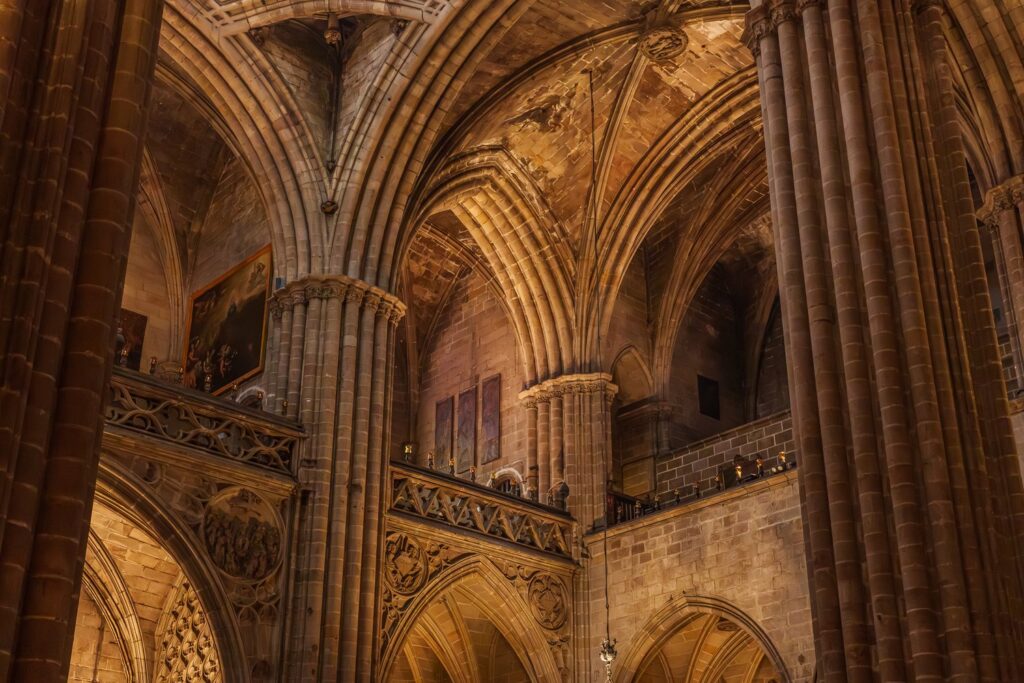
The crypt of Santa Eulalia
Below the main altar, a short flight of steps leads to the crypt of Saint Eulalia, the co-patron saint of Barcelona. According to tradition, she was a 13-year-old girl martyred in Roman times for refusing to give up her faith. Her relics rest in a beautiful alabaster sarcophagus from the 14th century, carved by an Italian sculptor.
The choir and the Golden Fleece
In the middle of the nave, the wooden choir stalls date from the late 14th and 15th centuries. In 1519 Emperor Charles V held a chapter of the Order of the Golden Fleece here, and the coats of arms of the knights were painted on the backs of the stalls. It’s one of the most surprising sights in the cathedral.
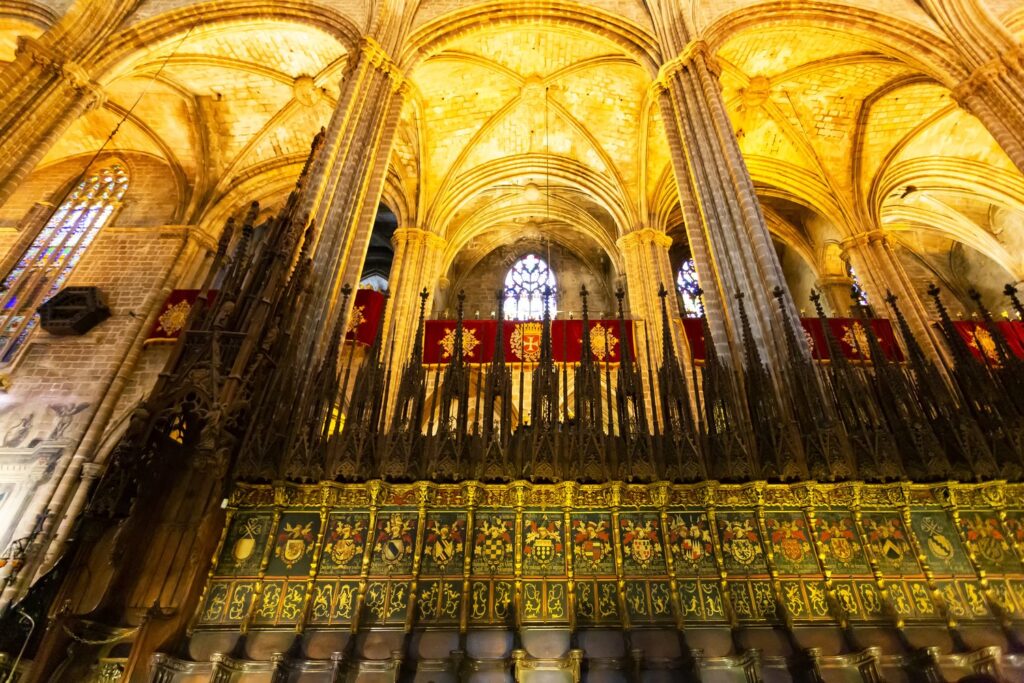
The cloister and the thirteen geese
The cloister, finished in the 15th century, is the most peaceful corner of the cathedral, with palm trees, magnolias and a mossy fountain. Here live the famous thirteen geese, one for each year of Santa Eulalia’s life. Geese were also once kept as guards, as their noise warned of intruders.
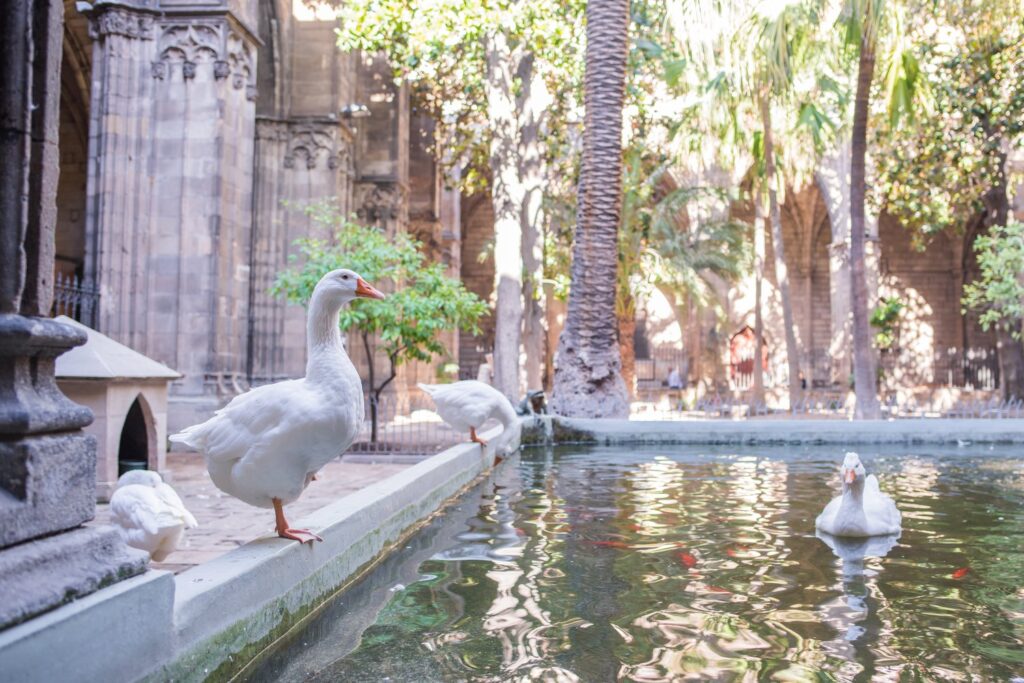
Look out for the small fountain with a statue of St George. At Corpus Christi, an egg dances on its jet of water in the tradition called L’ou com balla, recorded since at least the 17th century. The chapter house museum off the cloister displays paintings, including a Pietà by Bartolomé Bermejo.
The Christ of Lepanto
In the chapel of the Holy Sacrament, look for the Christ of Lepanto, a crucifix with a strangely bent body. Legend says it was on the flagship at the Battle of Lepanto in 1571 and dodged a cannonball.
The rooftop terraces
For a different view of the old town, take the lift to the rooftop terraces. You walk among pinnacles and gargoyles, with mythical creatures on the gutters and views over the towers to the sea and Montjuïc. Even many locals have never been up there.
The terraces are included in the cultural visit. They can close in bad weather or strong wind, so go up early if the sky looks uncertain. The path has some steps, so it’s less suited to visitors with reduced mobility.
Around the cathedral
The square in front of the cathedral is a stage for city life. On weekends, groups often gather to dance the sardana, the traditional Catalan dance, in a circle. Every December, the Fira de Santa Llúcia Christmas market fills the square with stalls selling nativity figures and trees.
From here, the narrow streets of the old town lead in every direction. Walk under the Pont del Bisbe bridge, explore the rest of the Gothic Quarter, or head east for about 10 minutes to the Picasso Museum and the basilica of Santa Maria del Mar. The Palau de la Música Catalana is about 7 minutes north.
How to get to Barcelona Cathedral
The cathedral stands on Pla de la Seu in the old town. The nearest metro station is Jaume I on line L4, about a 5-minute walk away. From Liceu (L3) or Plaça de Catalunya (L1, L3) it’s a 10-minute stroll through the old streets. Avinguda de la Catedral, the wide square in front, is the easiest meeting point if you’re travelling in a group.
Practical information
- Barcelona Cathedral tickets are best booked in advance. You’ll skip the queue at the entrance and can plan your visit for the quieter morning hours.
- Address: Pla de la Seu, 3, 08002 Barcelona
- Buy tickets on GetYourGuide
Hotels near Barcelona Cathedral
Staying next to the cathedral puts you in the heart of the old town of Barcelona, within walking distance of La Rambla, El Born and the waterfront.
💰 Hostal Levante Barcelona
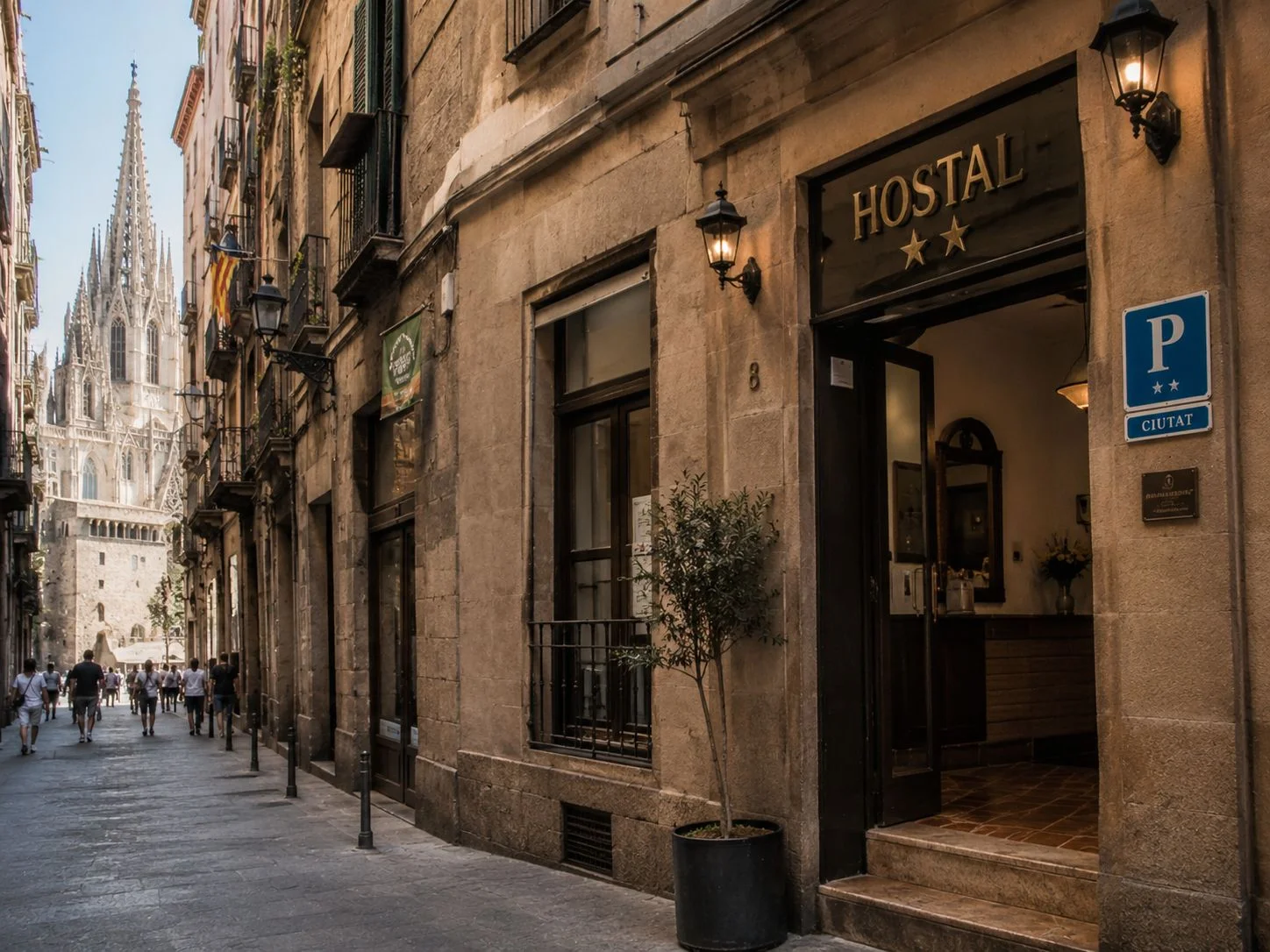
A well-kept, good-value guesthouse on a quiet lane near Plaça Reial, about 5 minutes from the cathedral. Rooms are simple and bright, and some apartments have a small kitchen for longer stays. You’ll be surrounded by tapas bars and old-town streets. A smart choice for travellers who want location over luxury.
🏨 H10 Madison
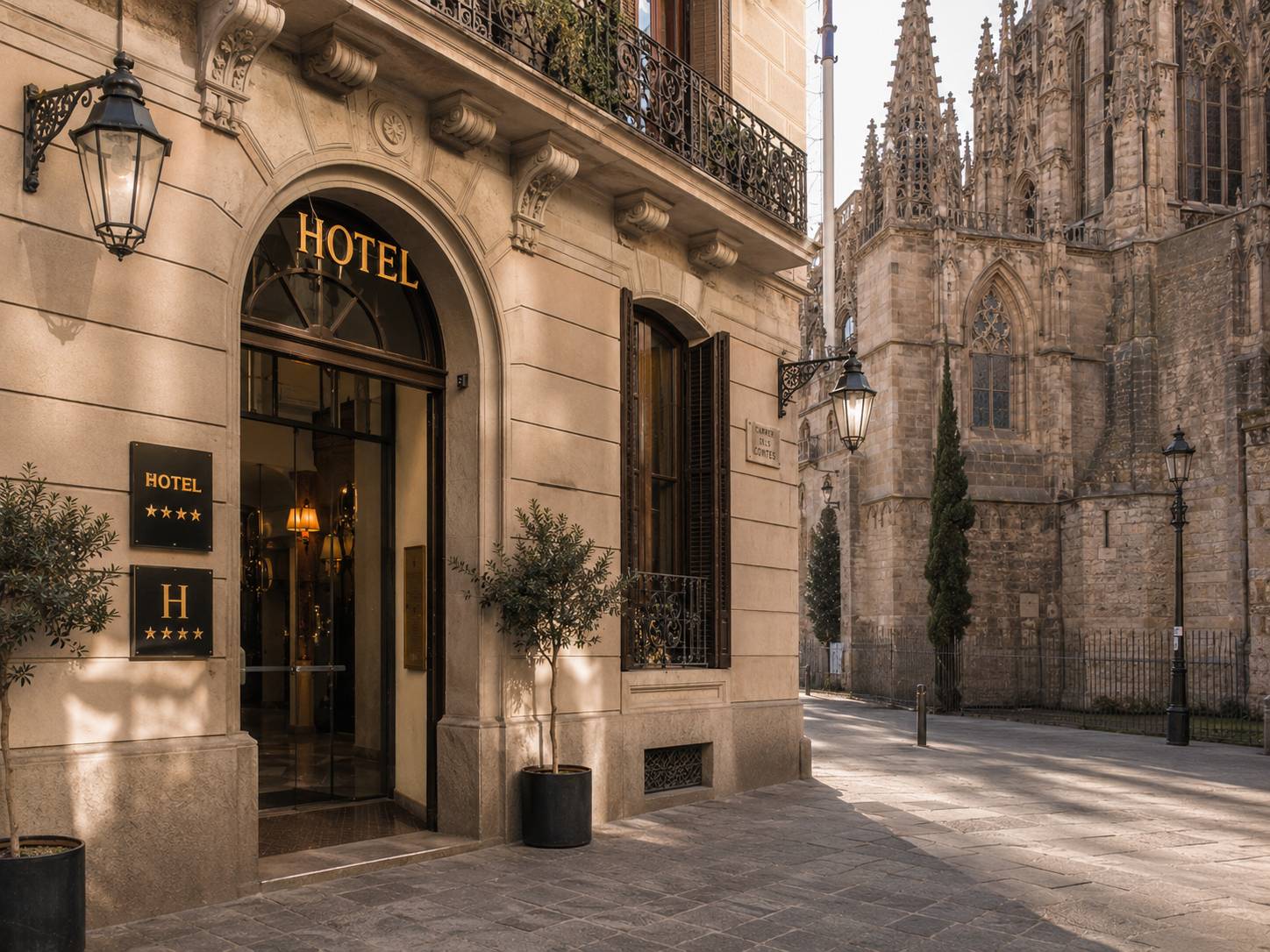
A four-star superior hotel just a few minutes’ walk from the cathedral, near Via Laietana. Rooms are modern and comfortable, and the rooftop terrace with a plunge pool looks straight at the cathedral towers. Breakfast is generous, and the metro is close. A great all-round base for couples and first-time visitors.
💎 Mercer Hotel Barcelona
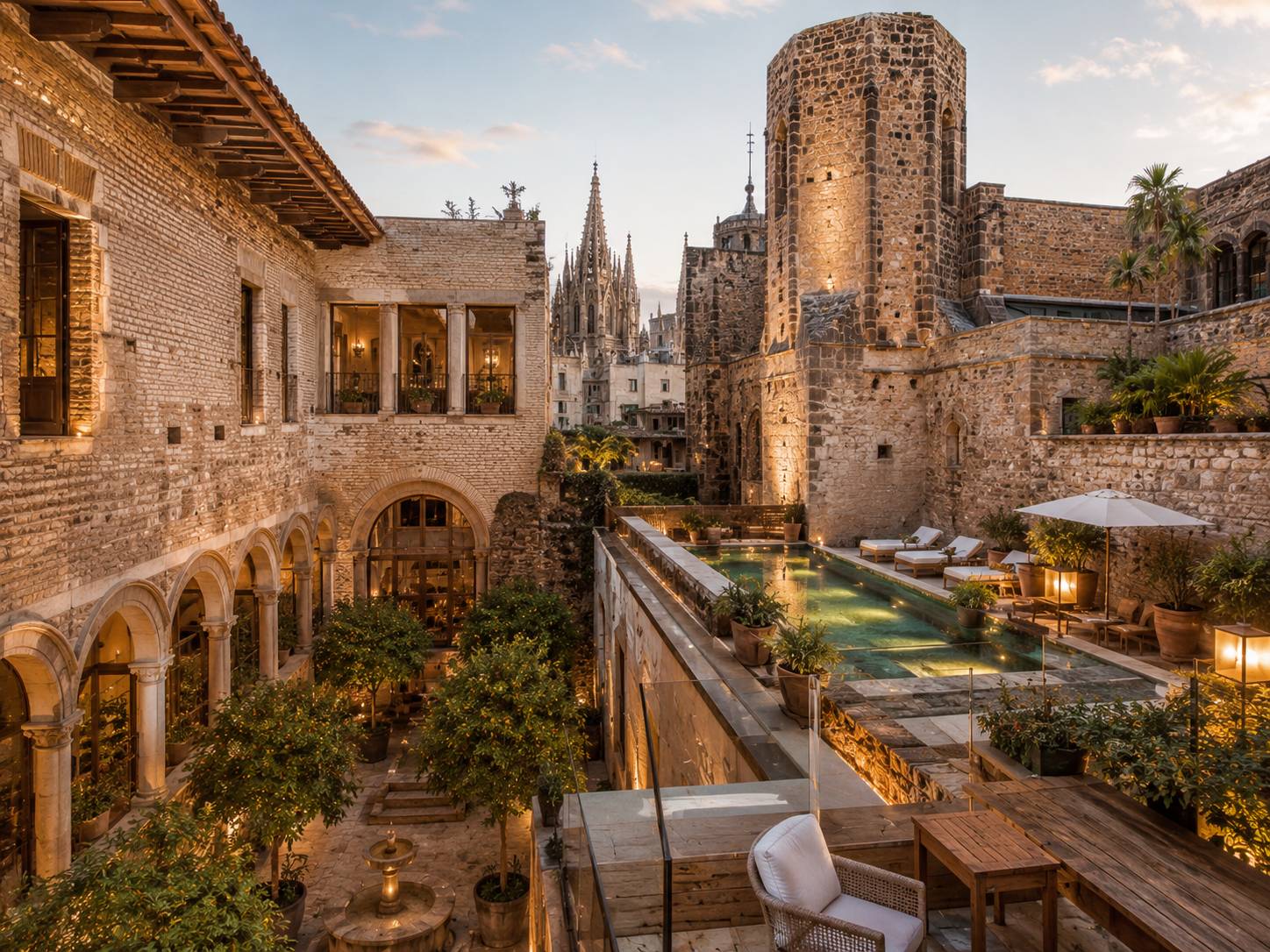
A five-star hideaway built into the remains of the Roman city wall and a medieval palace, about 5 minutes from the cathedral. Exposed stone, wooden beams and quiet, elegant rooms create a very special atmosphere. The rooftop has a small pool with views over the Gothic towers. Ideal for a romantic or special-occasion stay.
Barcelona Cathedral FAQ
Is Barcelona Cathedral free to visit?
Yes, during worship hours, usually in the early morning and evening, you can enter for free to pray or attend mass. To see the choir, the museum and the rooftop, you need a cultural visit ticket.
Is Barcelona Cathedral the same as the Sagrada Familia?
No. Barcelona Cathedral is the Gothic cathedral of the Holy Cross and Saint Eulalia in the old town. The Sagrada Familia is Gaudí’s basilica in the Eixample district, about 3 km away.
How long do you need at Barcelona Cathedral?
Plan about an hour for the nave, the crypt, the choir and the cloister. Add 20 to 30 minutes if you want to go up to the rooftop terraces.
Why are there geese at Barcelona Cathedral?
There are thirteen geese in the cloister, one for each year of the life of Saint Eulalia, who was martyred at 13. Geese were also traditionally kept as guards, because their loud honking warned of intruders.
What should you wear to visit Barcelona Cathedral?
Cover your shoulders and knees. Staff can refuse entry to visitors in beachwear, sleeveless tops or very short shorts, so bring a light scarf on hot days.

