Two thousand years ago, Roman settlers laid out a city on this spot. Today, the loudest traffic is the Sunday crowd haggling over olives, leather sandals and giant pink tomatoes.
Alcudia (Alcúdia in Catalan) sits on the north coast of Mallorca, between the bays of Pollença and Alcúdia. It is really two places in one. The medieval town hides behind 14th-century walls, while Port d’Alcúdia, a short ride away, is a family-friendly beach resort with a marina and some of the most beautiful beaches on the island. In this article you’ll find the best things to do in Alcudia, from the old town and Roman Pollentia to the beaches and boat trips, plus day trips around the north.
💰 Alcúdia Petit Hotel - Boutique four-star hotel in Alcúdia’s Old Town, 100 m from the medieval walls and Roman Pollentia.
🏨 Sunwing Alcudia Beach - Four-star beachfront aparthotel in Port d’Alcúdia, with a large heated pool.
💎 Bordoy Alcudia Port Suites (Adults Only) - Five-star adults-only boutique hotel just 30 metres from Platja d’Alcúdia.
Is Alcudia worth visiting?
Yes, if you want history and a proper beach holiday in the same week. The old town is one of the best-preserved walled towns in the Balearic Islands, and you can see most of it in a relaxed morning. The bay, on the other hand, gives you long, shallow beaches that suit young kids and anyone who simply wants to switch off.
Location is another plus. Cap de Formentor, Pollença, S’Albufera Natural Park and the Tramuntana mountains are all within an easy drive. Palma Airport is about an hour away by car, so you can land in the morning and be on the beach by lunchtime. If you’d rather not depend on buses, car hire makes it much easier to explore Mallorca beyond the resort.
Plan at least three or four days if you want to combine the beach with a couple of excursions. A week is ideal in summer, when the boat trips, the water park and the evening markets are all in full swing.
Things to do in Alcudia old town
Alcudia old town is compact, car-free in its centre and easy to explore on foot. The narrow streets are lined with honey-coloured stone houses, wooden shutters and small squares where cafés spill out onto the cobbles. It feels lived-in rather than staged, and the lively atmosphere on market day contrasts nicely with the quiet evenings, when the old city empties and the lanterns come on.
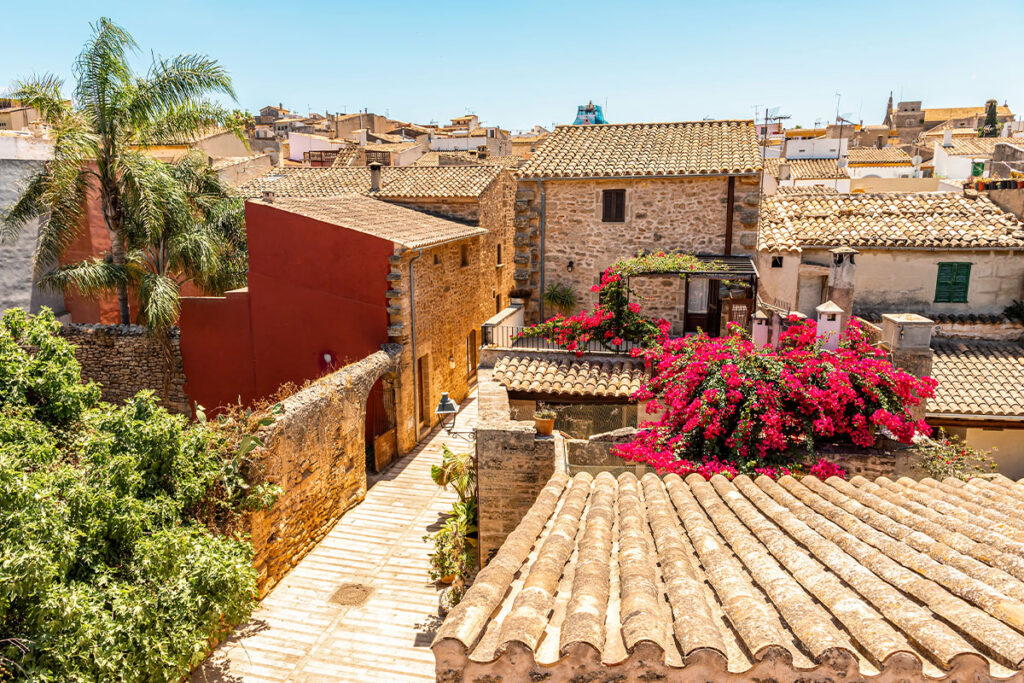
The historic centre is small enough to cover at a relaxed pace. Start at Plaça de la Constitució, the main square, and just wander the charming streets. You’ll pass the town hall with its clock tower, old houses with Gothic windows and plenty of shops selling ceramics, espadrilles and local olive oil. It’s a lovely place to get lost for an hour or two.
Walk along the city walls
The city walls are the reason the old town looks the way it does. They were built in the 14th century to protect the town from pirates, and a second ring of Renaissance bastions was added in the 16th century. Large sections of the medieval walls survive, and you can climb up and walk along the top for views over the rooftops and towards the mountain range behind the bay.
Two gates in the city walls are worth looking out for. Porta de Mallorca (also called Porta de Sant Sebastià) faces the island’s interior, while Porta del Moll (Harbour Gate) once led down to the sea. Both are beautifully preserved and make great photo spots, especially in the soft light of late afternoon.
Church of Sant Jaume
The Church of Sant Jaume stands right by the city walls on the southern edge of the medieval town. The original church dates back to the 14th century, but it collapsed in 1870 and the building you see today was completed in 1893. The interior is calm and cool, a welcome break on a hot day, and the side chapel of Sant Crist draws the most visitors.
Step outside afterwards and find a bench in the square in front of the church. It’s a good spot to sit for a while and watch the town go about its day.
Alcudia market
Alcudia market is held every Tuesday and Sunday morning and is one of the busiest in northern Mallorca. Stalls fill the streets around Porta del Moll and spread through Alcudia old town, so you can’t miss it. You’ll find fresh local produce, cheeses, cured meats, olives, honey and crafts, along with plenty of clothes and souvenirs.
Arrive early, ideally before 10am, because the streets get crowded by late morning and parking near the walls fills up fast. Keep an eye out for the giant pink tomatoes at the vegetable stalls, and bring cash for the smaller traders.
Ensaïmada, bunyols and other local flavours
Food is a big part of local culture here. Try an ensaïmada, Mallorca’s spiral pastry dusted with icing sugar, with your morning coffee. On market days and during local festivals, look for bunyols, small doughnut-like fritters sold hot from street stalls.
For lunch, the cafés around the main square serve tapas, pa amb oli (bread rubbed with tomato and olive oil, topped with cheese or ham) and traditional Mallorcan dishes such as tumbet, a layered vegetable bake. The pace is relaxed, so don’t expect to be rushed out of your seat.
Explore the Roman city of Pollentia
Just outside the walls lie the remains of Pollentia, the most important Roman city on the island. It was founded in 123 BC by the Roman general Quintus Caecilius Metellus after the conquest of the Balearic Islands. For centuries, it was a busy hub of the Roman Empire in the western Mediterranean. A fire in the 3rd century AD damaged the city, and over time the population moved north to where the medieval town stands today.
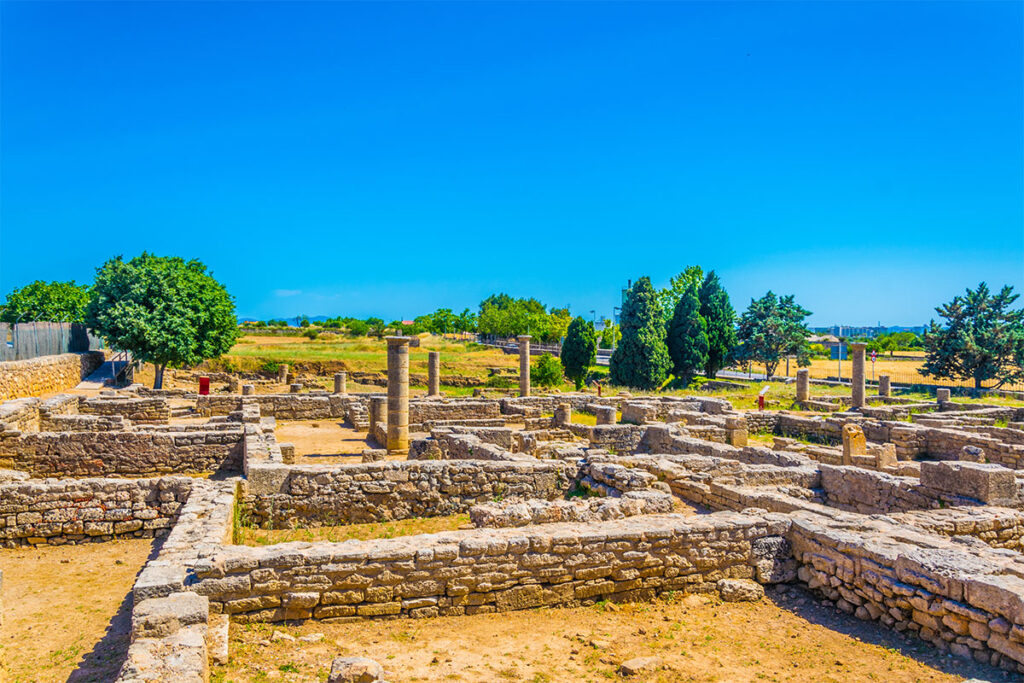
A path leads you through three main areas. Sa Portella was a residential district where you can still see the outlines of houses and streets. The forum was the heart of public life, with temples and shops (tabernae). The small Roman theatre, cut into the rock just south of the old city, is the highlight for many visitors. For history lovers, this is one of the top things to do in Alcudia. These Roman ruins are open to the sky, so bring water and a hat in summer.
Monographic Museum of Pollentia
To understand what you’ve just seen, visit the small museum on Carrer de Sant Jaume, inside Alcudia old town. The Monographic Museum of Pollentia is housed in a former hospital and displays finds from the excavations. Look out for marble sculptures from the forum, a bronze female head, mosaic fragments, coins and everyday objects that bring the Roman city to life.
The museum and the archaeological site have separate entrances, so allow around two hours if you want to see both. The museum is usually closed on Sundays and Mondays, so check the opening times before you go.
Alcudia beach and other beaches nearby
Alcudia beach (Platja d’Alcúdia) runs for several kilometres from Port d’Alcúdia to Playa de Muro, and together with it forms one of the longest stretches of sand in Mallorca. The sand is fine, the water is shallow for a long way out and the sea is usually calm. That makes it ideal for families with young children.
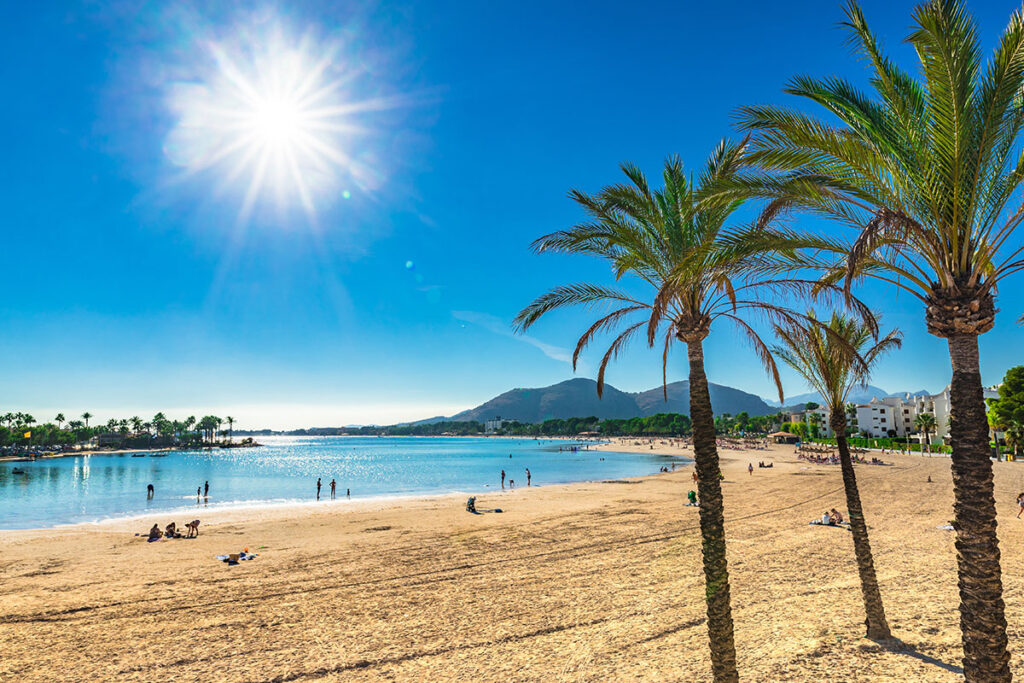
Is Alcudia beach free? Yes. Like all beaches in Spain, it’s public, so you can lay your towel down anywhere. You can hire sunbeds and parasols, and there are lifeguards, showers and beach bars along the promenade in summer. You can also try watersports such as paddleboarding, kayaking and parasailing.
If you’d like something wilder, there are other beaches close by. Playa de Muro, a little further south, is backed by pine-covered dunes and feels quieter. On the Alcudia peninsula, the small coves of Sant Joan and Es Morer Vermell have rocky edges and clear water. The most beautiful spot in the Alcudia area is arguably Coll Baix, a pebble cove with crystal-clear water, reached by a steep half-hour walk or by boat.
Golfers have their own reason to come: the golf course at Alcanada sits right on the bay, and many of its holes look out to a lighthouse on a tiny islet.
Take a boat trip from Port d’Alcúdia
Port d’Alcúdia (Puerto de Alcudia in Spanish) is the beach resort and marina at the heart of the bay. Its seafront promenade is lined with restaurants, ice-cream parlours and bars, and the harbour is the starting point for most boat trips in the north of the island.
A glass-bottom boat trip is a classic choice with children. Boats sail along the cliffs of the Alcudia peninsula, and you can watch fish through the hull before stopping at Formentor beach for a swim. Other options include catamaran cruises with lunch on board, snorkelling trips to sea caves and dolphin-watching tours early in the morning, when the sea is calmest.
Book in advance in July and August, when the most popular trips sell out. Choose a morning departure if anyone in your group gets seasick, because the wind usually picks up in the afternoon.
S’Albufera Natural Park and birdwatching
S’Albufera Natural Park is the largest wetland in the Balearic Islands, covering about 1,700 hectares just south of Port d’Alcúdia. It’s a nature reserve of reed beds, canals and lagoons, and a haven for birdwatchers. Herons, egrets, ospreys and marsh harriers are regular sightings, and spring and autumn bring huge numbers of migrating birds.
Entry is free. You collect a permit at the Sa Roca visitor centre, then follow flat trails on foot or by bike to a series of hides. The paths are easy and shaded in places, so it’s a pleasant half-day trip even with young kids. Bring binoculars and insect repellent, especially at dusk in summer.
Sa Bassa Blanca Museum
For something completely different, head to the Sa Bassa Blanca Museum, home of the Yannick and Ben Jakober Foundation. It sits on the Alcudia peninsula, in a building designed by the Egyptian architect Hassan Fathy and inspired by traditional North African buildings.
The collection is unusual and memorable. It includes more than 150 portraits of children painted between the 16th and 19th centuries, alongside modern art, a sculpture park and a rose garden. It feels off the beaten track, and few visitors who make the trip regret it. Check opening days before you go, as the museum doesn’t open every day.
Hike to the Ermita de la Victòria and the Talaia d’Alcúdia
The Alcudia peninsula is a wild, hilly finger of land between the two bays. A winding road leads to the Ermita de la Victòria, a fortified 17th-century hermitage with a restaurant and views across Pollença Bay to the Formentor peninsula.
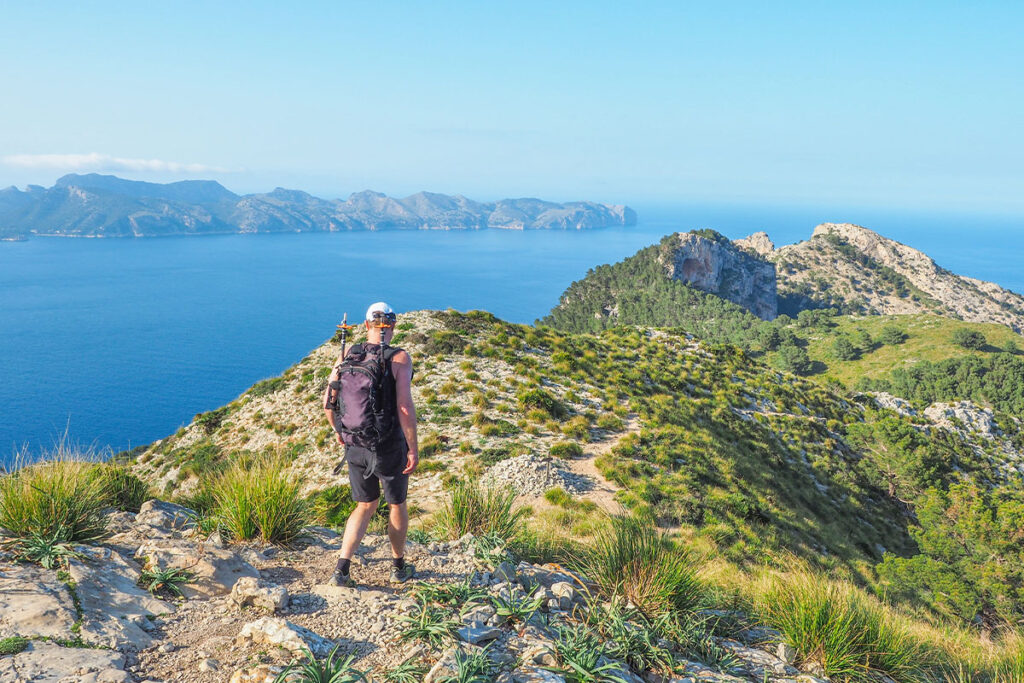
From the hermitage, a well-marked trail climbs to the Talaia d’Alcúdia, an old watchtower at around 445 metres. The walk takes about an hour up and is steep in places, but the panorama of both bays, Cap de Formentor and the Tramuntana mountains is worth every step. Start early in summer, as there’s little shade on the upper section.
Family fun in Alcudia
Alcudia is one of the easiest places in Mallorca for a holiday with children. Beyond the shallow beach, there are plenty of family-friendly activities to keep children busy. Hidropark, in Port d’Alcúdia, is the only water park in the north of the island, with slides, a wave pool and splash areas for toddlers, so there’s something for the whole family. If you want more options, see our article on water parks in Mallorca.
Other ideas for family fun include bike rides along the lagoons behind the beach, horse riding in the countryside and boat trips to the sea caves of the bay. For a family-friendly place to stay, have a look at our pick of family hotels in Mallorca or the Iberostar Alcudia Park.
Day trips from Alcudia
The north of Mallorca is full of great day trips, and you can easily fit two into one outing. The most spectacular is Cap de Formentor, where a dramatic road climbs past the Mirador Es Colomer to the lighthouse at the very tip of the peninsula. Go early or late in the day, as access by car can be restricted in peak season. On the way, stop at Formentor beach, a strip of sand fringed by pine trees.
The pretty town of Pollença is only 20 minutes away and is famous for its 365 steps up to the Calvari chapel. Further afield, you can visit the mountain villages of Valldemossa and Sóller, ride the vintage train through the Serra de Tramuntana or go down to Port de Sóller by tram.
On the east coast, the Caves of Drach near Porto Cristo are a highlight, and the visit ends with a short classical concert on an underground lake. A day in Palma de Mallorca is also easy to plan, with the cathedral, the old town and plenty of shopping.
Alcudia nightlife - is Alcudia a party town?
Not really, and that’s part of its charm. Port d’Alcúdia has a lively strip of bars, pubs and a few clubs near the seafront, and the area around the marina is busy until late in summer. Still, it’s nothing like Magaluf or Playa de Palma, and most evenings revolve around dinner, cocktails and a walk along the promenade.
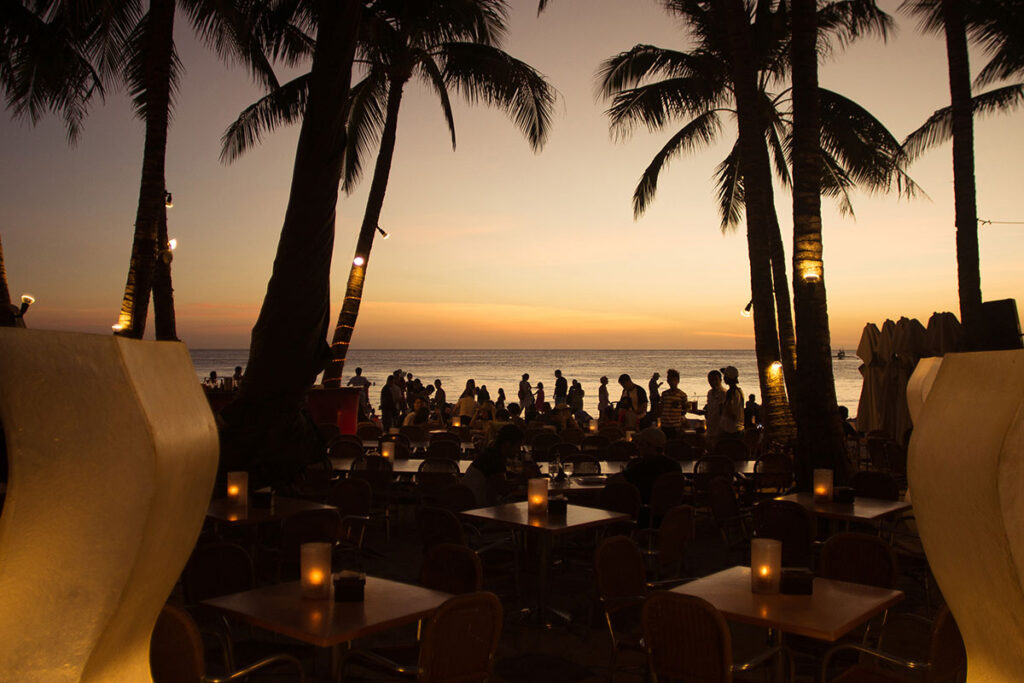
The old town is quieter after dark. It’s the place for a long dinner on a terrace inside the walls, with live music in the squares on some summer evenings. Couples who want even more peace should take a look at our list of adults-only hotels in Alcudia.
When to visit and how to get around
The best time to visit Alcudia is in May, June or September, when the sea is warm, the beaches are quieter and prices are lower than in peak season. July and August bring temperatures above 30°C and busy beaches. In winter, many hotels and restaurants in the resort close, but the old town and the hiking trails are pleasant all year round.
Can you walk from Alcudia beach to Alcudia old town? Yes. From the marina in Port d’Alcúdia, it’s about 2 km, or a 25-30 minute walk along the main road. Local buses run between the two in summer, and many hotels hire out bikes. If you’re staying further down the bay, the bus is the easiest option.
Accommodation in the area goes fast in summer, so book your hotel well in advance if you’re travelling during the school holidays.
See available accommodation in Alcudia
Hotels in Alcudia
Where you stay depends on what kind of holiday you want. The old town is perfect for a quiet, romantic break among historic buildings, while Port d’Alcúdia puts you a few steps from the beach. Wherever you sleep, most things to do in Alcudia are within a short walk or bus ride. Here are three hotels for different budgets.
💰 Alcúdia Petit Hotel
This small boutique hotel is tucked into a quiet lane of Alcudia old town, just 100 metres from the medieval walls. It has only 12 rooms, some with exposed stone walls, skylights and a private terrace or balcony. Breakfast is served in a pretty inner courtyard, and the restaurant offers Mediterranean dishes. It’s ideal for couples who want to wake up inside the walls and walk to the market in two minutes.
🏨 Sunwing Alcudia Beach
A four-star beachfront hotel in Port d’Alcúdia, about a minute’s walk from the sand. The apartment-style units have kitchenettes, so it’s easy to prepare snacks and simple meals for children. There are several outdoor pools, including a children’s pool, plus a restaurant and bar on site. It’s a great base for families who want the beach on their doorstep and the old town a short bus ride away.
💎 Bordoy Alcudia Port Suites (Adults Only)
This adults-only boutique hotel sits a couple of minutes’ walk from Alcudia beach in Port d’Alcúdia. Spacious suites are decorated in a clean Scandinavian style, and some have a rooftop terrace with a hot tub and sea views. Guests have free access to the spa, with a sauna, steam room and jacuzzi, as well as an outdoor pool with a bar. It’s the right choice for a calm, grown-up stay with a touch of luxury.

