More than 200,000 date palms grow inside one Spanish city, and one of them has seven arms. The rest of the town is just as full of surprises.
Elche is the city most visitors fly into without ever seeing. Its name is on the airport sign, yet most holidaymakers head straight to the beaches of the Costa Blanca. That’s a shame, because Elche is home to Europe’s largest palm grove, a baroque basilica with a medieval play staged inside it every August and the spot where the famous Lady of Elche was found. If you’re staying on the coast or flying into Alicante, Elche is the easiest way to swap the beach for a day of culture. In this article you’ll find the best things to do in Elche, a simple one-day plan, tips on getting there and the hotels worth booking.
The city sits in the south of the Valencian Community, in Alicante province. Locals call it Elx, its Valencian name, and you’ll see both versions on road signs. Elche is green, relaxed and easy to explore on foot. Most of the main attractions are a short walk from each other.
💰 Hotel Elche Centro, Affiliated by Meliá - A three-star hotel in the very centre of Elche.
🏨 Port Jardín Milenio - A four-star hotel with a pool and sauna right beside the palm grove.
💎 Hotel Huerto del Cura - A four-star resort with low-rise bungalows scattered among palms, bougainvillea and cacti.
Where is Elche located and is it worth visiting?
Elche is located about 23 km south-west of Alicante and only 10 km from Alicante-Elche Miguel Hernández Airport. The Vinalopó river cuts the city in two, with the old town on its eastern bank. Elche has around 240,000 inhabitants, which makes it the third-largest city in the region after Valencia and Alicante. That’s fewer people than Alicante, but Elche covers a much larger area.
Is Elche, Spain worth visiting? Absolutely, especially if you like history, gardens and places without crowds. Elche is the only city in Spain with three UNESCO listings in different categories: the Palmeral (a World Heritage Site since 2000), the Misteri d’Elx (proclaimed a Masterpiece of the Oral and Intangible Heritage of Humanity in 2001) and the Pusol School Museum, added to UNESCO’s register of good safeguarding practices in 2009. Elche is also known for shoemaking, and many big Spanish brands have factories and outlet shops here.
Top things to do in Elche
The list below starts with the palm groves and then moves into the historic centre. You can see all of it in one long day, but two days let you add the beaches, museums and a trip to Tabarca island.
Wander through the Palmeral of Elche
The Palmeral of Elche is the reason most travellers come. It’s the largest palm grove in Europe, with more than 200,000 date palms (Phoenix dactylifera) growing in walled orchards called huertos. The historic orchards alone cover around 144 hectares. The grove isn’t one park but a patchwork of gardens spread across the city. You’ll find palms along the streets, in school playgrounds and even at petrol stations.
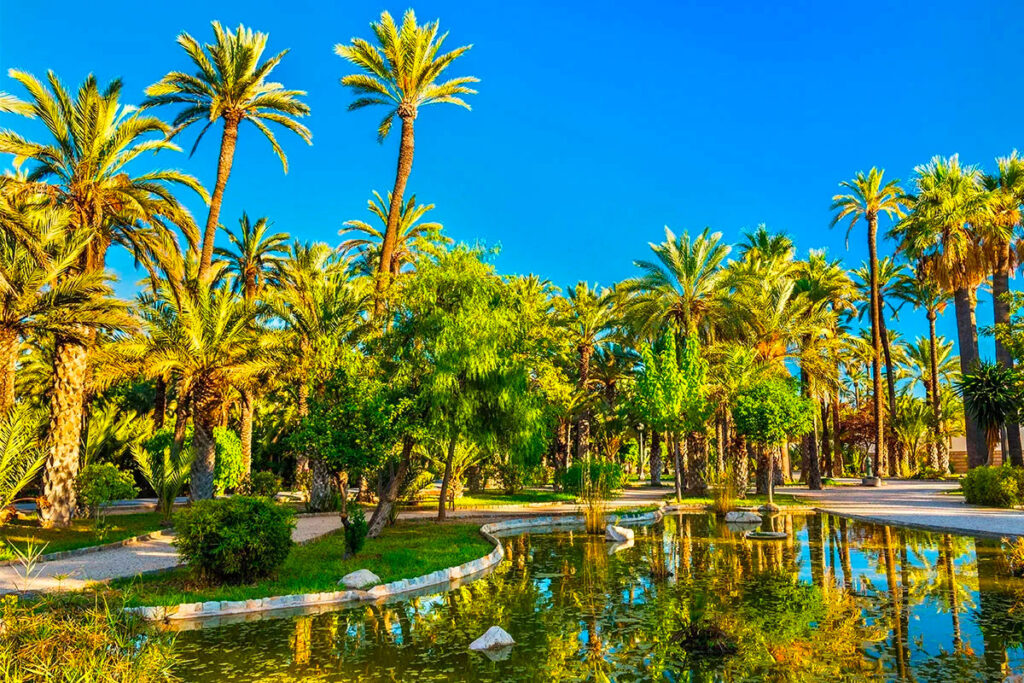
The grove has Islamic roots. Muslim farmers laid out the orchards in rectangles and watered them through an extensive irrigation network, with channels that still work today. The Palmeral became a UNESCO World Heritage Site in 2000 because it shows how Arab farming techniques reached Europe. The best way to see El Palmeral is to follow the signposted Palm Grove Route on foot. It links the Municipal Park, the Huerto del Cura and several working orchards.
Visit the Huerto del Cura garden and the Imperial Palm Tree
The Huerto del Cura garden is the highlight of the Elche palm grove. This small garden was declared a Jardín Artístico Nacional (National Artistic Garden) in 1943. Around 1,000 palm trees grow here among Mediterranean and tropical plants, cactus beds, ponds and lemon trees. The paths are shady, so it’s a pleasant visit even on a hot afternoon.
The star of the garden is the Imperial Palm Tree. Seven arms branch out from one trunk about 1.5 metres above the ground, which makes it a botanical rarity. The palm is named after Empress Elisabeth of Austria, better known as Sisi, who visited the garden in 1894. Her bust stands next to the tree. Book your Huerto del Cura ticket online before you go, especially at weekends and in spring.
Relax in the Municipal Park
The Municipal Park (Parc Municipal) is the most central part of the palm grove and is free to enter. Locals come here to jog, walk their dogs and chat on benches in the shade. You’ll find a pond, a small café, play areas for children and the old irrigation channels running between the palms.
The tourist information office is at the park entrance, where you can pick up a map of the Palm Grove Route and ask about guided walks. From the park it’s only a few minutes on foot to the Altamira Palace and the Basilica of Santa María.
Learn about palm farming at the Palm Grove Museum
The Palm Grove Museum (Museo del Palmeral) is close to the Huerto del Cura, inside a traditional orchard. It explains how the grove works and why it matters so much to Elche. You’ll see old tools, learn how palm climbers harvest dates and watch how palm fronds are tied up so they bleach white. The museum is small, but it helps you appreciate the gardens you walk through afterwards.
Step inside the Basilica of Santa María
The Basilica of Santa María is the heart of the old town. It was built in the 17th and 18th centuries on the site of a mosque, mainly in the baroque style, with some Renaissance styles on its portals. Look up at the large dome covered in blue tiles. Inside, the church feels huge and bright.
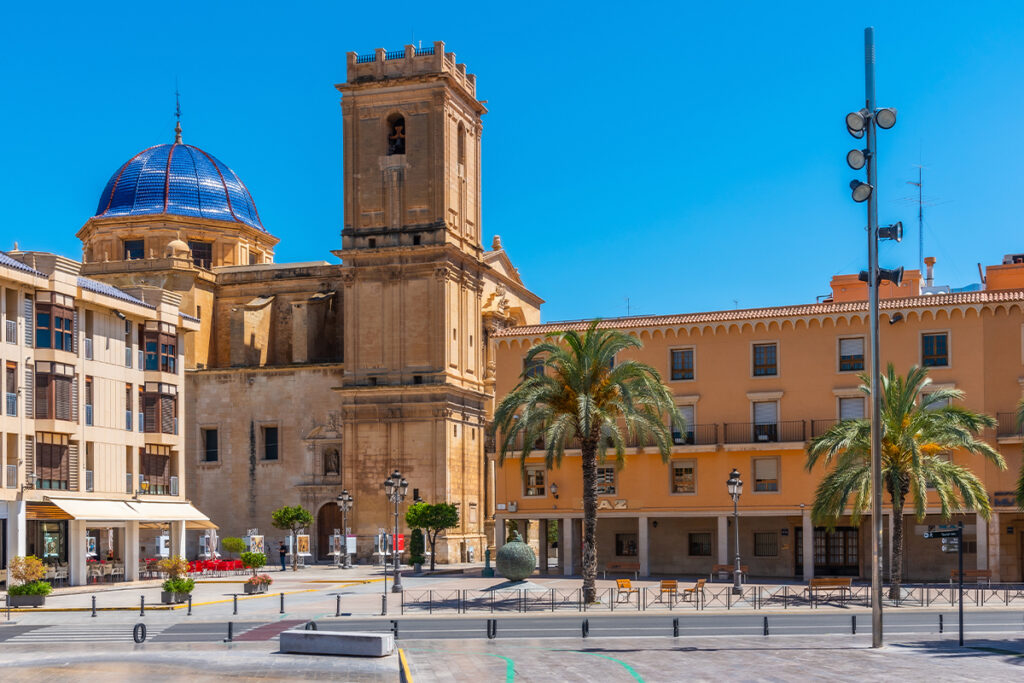
The basilica is dedicated to the Virgin of the Assumption, the Virgin Mary taken up to heaven, who is Elche’s patron saint. It’s also closely linked to the Misteri d’Elx, staged here every August, and locals are deeply proud of it. Visit in the late afternoon, when the light falls on the main portal.
Explore the Altamira Palace and the Archaeological and History Museum
The Palacio de Altamira, also called the Alcázar de la Señoría, is a fortress on the edge of the Municipal Park. It started as a Muslim castle and was remodelled into a palace at the end of the Middle Ages, when it became the residence of the lords of Elche. Over the centuries it served as a factory and a prison before it became a museum.
Today it houses the Archaeological and History Museum of Elche (MAHE). The exhibition follows the city from the Bronze Age through Iberian, Roman and Islamic times to the present day. Interactive exhibits make it easy to follow, even with children. The highlight is the room about the Lady of Elche, with a replica of the bust and the story of its discovery.
Meet the Lady of Elche at Plaza de la Glorieta
The Lady of Elche (Dama de Elche) is one of the most famous pieces of Iberian art. This stone bust of a woman wearing a large headdress with wheel-shaped side pieces was found in 1897 at the La Alcudia site, just outside the city. It was soon sold to the Louvre Museum in Paris and only returned to Spain in 1941. Today the original is in the National Archaeological Museum in Madrid.
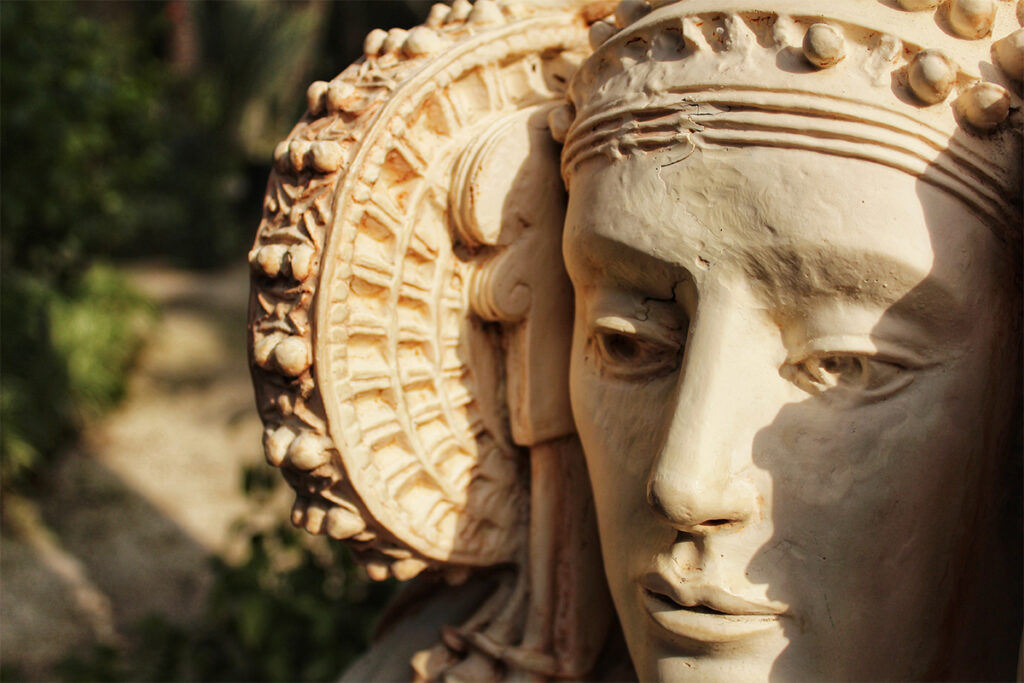
In Elche you’ll meet her in several places. Plaza de la Glorieta, the leafy main square of the centre, has a large replica of the Dama de Elche. It’s a pleasant spot for a coffee and a good starting point for a walk through the shopping streets around Carrer Corredora.
See the city hall, Plaza de Baix and the Calendura clock
Plaza de Baix is the city’s civic heart. The city hall stands here, built around the Torre del Consell, which dates from 1441. It’s often described as the oldest town hall building in the Valencian Community. Look at the gallery of arches and the balcony with the city’s coat of arms.
Right next door is the Torre de la Vetlla, part of the old city walls. On top, you’ll spot two painted wooden figures, Calendura and Calendureta. They strike the bells of a clock installed in 1572: the bigger figure marks the hours and the smaller one the quarters. Stay in the square on the hour to see them in action.
Find the Calahorra Tower and the Arab baths
The Calahorra Tower is a 12th-century Islamic watchtower that once guarded the road to Alicante. An earthquake in 1829 reduced its height, and the neo-Arabic windows were added later. It’s one of the best-preserved parts of the medieval city walls.
A few steps away, under the Convent of La Mercè, are the Arab baths. These 12th-century baths have vaulted cold, warm and hot rooms, much like a Roman bathhouse. Christians later turned the building into a convent, so several eras overlap in one small space.
Stroll through Elche old town
Elche’s old town is compact and full of small squares. Start at Plaza de Santa Isabel, close to the basilica, and wander through the narrow lanes around it. Walk along the Vinalopó river and cross one of its bridges for great views of the palm trees on both banks.
In the evening, the squares fill with families and the terraces of tapas bars get busy. Elche is a working city rather than a resort, so prices are fair and the atmosphere feels local. Art lovers can also drop into MACE, the city’s small museum of contemporary art, while families will enjoy the dinosaur models at the Paleontological Museum.
Discover the La Alcudia archaeological site
La Alcudia lies about 2 km south of the centre. This archaeological site was the Iberian and Roman town of Ilici, the ancestor of modern Elche. You can walk among the remains of houses, Roman baths and streets, and visit the interpretation centre. This is the place where the Lady of Elche was found in 1897. Go by car or taxi, as walking along the road isn’t much fun.
Misteri d’Elx and other festivals in Elche
The Misteri d’Elx (Mystery Play of Elche) is a sacred musical drama about the death, assumption and crowning of the Virgin Mary. It dates back to the Middle Ages and is sung in two acts in old Valencian by local amateur performers. The play is staged on 14 and 15 August inside the Basilica of Santa María. The main performances are free, but they get very busy, so arrive early. The dress rehearsals on 11-13 August need tickets.
The most spectacular moments happen in the air, when angels descend from the dome while singers on a ramp below fill the basilica with music. In even-numbered years there are extra performances around 1 November. You can learn more at the Museu de la Festa, a small museum dedicated to the play in a former hermitage in the old town.
On the night of 13 August, Nit de l’Albà lights up the sky over Elche with fireworks launched from rooftops. Palm Sunday is another highlight, when locals walk through the streets carrying intricately woven white palm leaves. Elche’s long tradition of palm weaving turns these fronds into small works of art.
Beaches and nature around Elche
Few people know that Elche has its own coastline. The beaches of Arenales del Sol, El Carabassí, El Altet and La Marina stretch for kilometres along the Mediterranean. They’re wide, sandy and backed by dunes and pine woods. Next to Arenales del Sol, the Clot de Galvany nature reserve has lagoons and walking trails.
Birdwatchers should head to El Hondo Natural Park, a wetland inland from the coast where you can spot flamingos and herons. The salt flats of the Salinas de Santa Pola, where the Vinalopó river reaches the sea, are just as good for flamingo spotting.
Day trips from Elche: Santa Pola and Tabarca island
The fishing town of Santa Pola lies about 20 minutes’ drive from Elche. It has a lively harbour, a castle and good seafood restaurants. From the port, boats sail to Tabarca, a small island and Spain’s first marine reserve. The crossing is short, usually well under an hour.
Tabarca is perfect for a lazy half-day. Walk around the walled village, swim in clear water and tuck into a plate of caldero, the local rice and fish stew. If you’re staying longer on the coast, you can also reach Torrevieja and its pink salt lake, or head north to Benidorm. The easiest way to explore is with a hire car.
Elche as a day trip from Alicante
Elche makes an easy day trip from Alicante. The C1 local train runs from Alicante Terminal to Elx Parc station in about 30 minutes, and buses link the two cities throughout the day. You can check times and book train and bus tickets online.
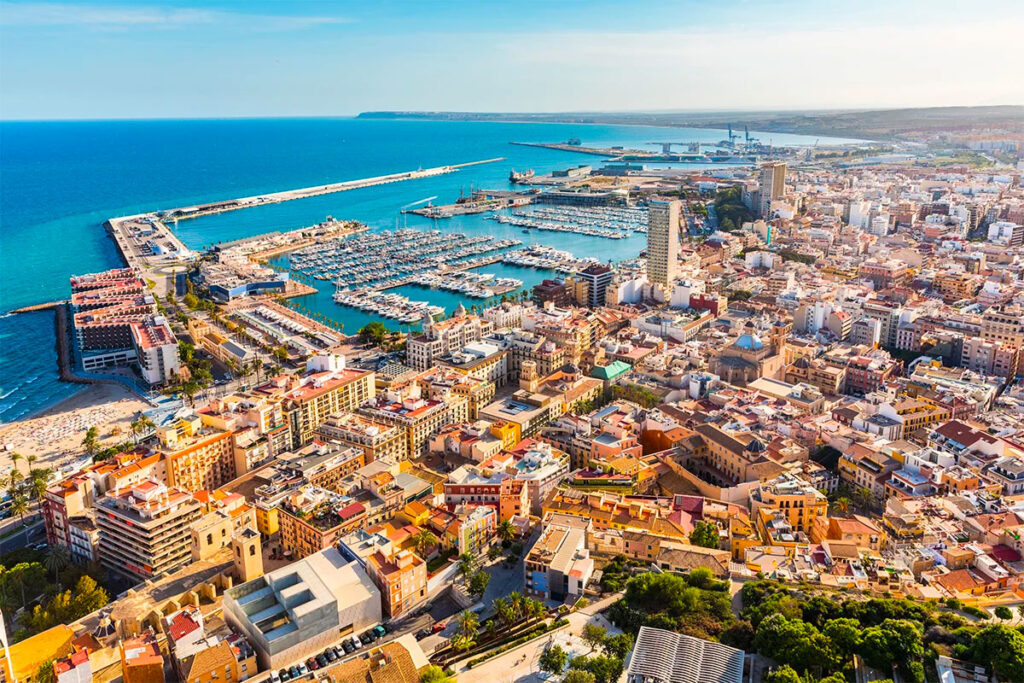
How much time do you need? One full day covers the highlights. Start with the Huerto del Cura when it opens and walk through the Municipal Park. Visit the Altamira Palace before lunch, then have rice at a local restaurant. Spend the afternoon at the Basilica of Santa María, Plaza de Baix, the Calahorra Tower and the Arab baths. If you have a second day, add La Alcudia, the beaches or a boat trip to Tabarca.
What to eat in Elche?
The signature dish of Elche is arroz con costra, rice baked in a clay pot with sausages, chicken and chickpeas, finished with a crust of egg. It’s filling, so order it for lunch, not dinner. Some restaurants serve it only on certain days, so check in advance.
Don’t leave without tasting dates from the palm grove. You’ll find fresh dates, date bread and even date ice cream in shops around the centre. Pair them with a glass of wine from the nearby Vinalopó valley.
Getting to Elche and getting around
Alicante-Elche Airport is about 15 minutes from Elche by car or taxi, and buses run to the city. If you’re coming from Madrid, the AVE high-speed train stops at Elx AV station, about 6 km from the centre. From Alicante and Murcia, the C1 local train is the simplest option.
Inside Elche you won’t need a car. The old town, the palm groves and most museums are within a 20-minute walk of each other. For the beaches, La Alcudia and El Hondo, a car or a local bus is more practical.
When to visit Elche?
Spring and autumn are the best seasons for visiting Elche. Temperatures sit around 20-25°C, the gardens are green and you can walk all day comfortably. Summer is hot, often above 30°C, but August brings the Misteri and Nit de l’Albà. Winter is mild and sunny, so Elche works well for a city break all year round.
If you plan to come for the Misteri in August, book your hotel well in advance, as rooms in the centre sell out fast.
See available places to stay in Elche
Hotels in Elche
Staying in the centre puts the palm groves and the basilica within walking distance. These three hotels cover different budgets and are all within easy reach of the gardens.
💰 Hotel Elche Centro, Affiliated by Meliá
A three-star hotel in the very centre of Elche, a short walk from the Basilica of Santa María and the main shopping streets. Rooms are simple and comfortable, with air conditioning and free Wi-Fi. The 24-hour reception is handy if you arrive on a late flight. It’s a good-value base if you want to explore the city on foot.
🏨 Port Jardín Milenio
A four-star hotel set right beside the palm grove, within the UNESCO-listed area. Many of the modern rooms have balconies overlooking the palm trees. There’s an outdoor pool, a sauna and a restaurant. It suits travellers who want a quiet garden setting but still within walking distance of the centre.
💎 Hotel Huerto del Cura
A four-star garden resort opposite the famous Huerto del Cura, inside the Palmeral of Elche. Its rooms are spread across low-rise bungalows among palms, bougainvillea and cacti. You can cool off in a pool surrounded by exotic greenery and dine at the Mediterranean restaurant on site. It’s the most atmospheric place to stay in Elche.

