Most people picture this island as one long beach. Its north-west coast is a wall of limestone, terraced by hand over a thousand years.
The Serra de Tramuntana is the mountain range that runs along the whole north-west coast of Mallorca, from Sant Elm and Andratx in the south-west to Cap de Formentor in the north-east. It stretches for about 90 km, and you’ll often see it written as Sierra de Tramuntana, the Castilian Spanish spelling. In 2011 the range became a UNESCO World Heritage Site, listed as a cultural landscape. That tells you something important: this isn’t untouched wilderness, but a place shaped by centuries of farming on impossibly steep slopes.
In this article you’ll find the villages worth your time, the best drives and hikes, how to get around without a car and where to stay. If you’re short on time, start with Valldemossa, Deià and Sóller. Those three stops show the Tramuntana mountains at their most photogenic, and you can link them in a single day.
💰 Hostal Ca’n Tiu - A friendly, good-value guest house in the mountain village of Alaró.
🏨 Ca’s Xorc - A Country Hideaway - Adults Only - An adults-only rural hotel with an infinity pool between Sóller and Deià.
💎 La Residencia, A Belmond Hotel, Mallorca - An iconic luxury hotel in two 16th-century manor houses in Deià.
What is the Serra de Tramuntana and where is it located?
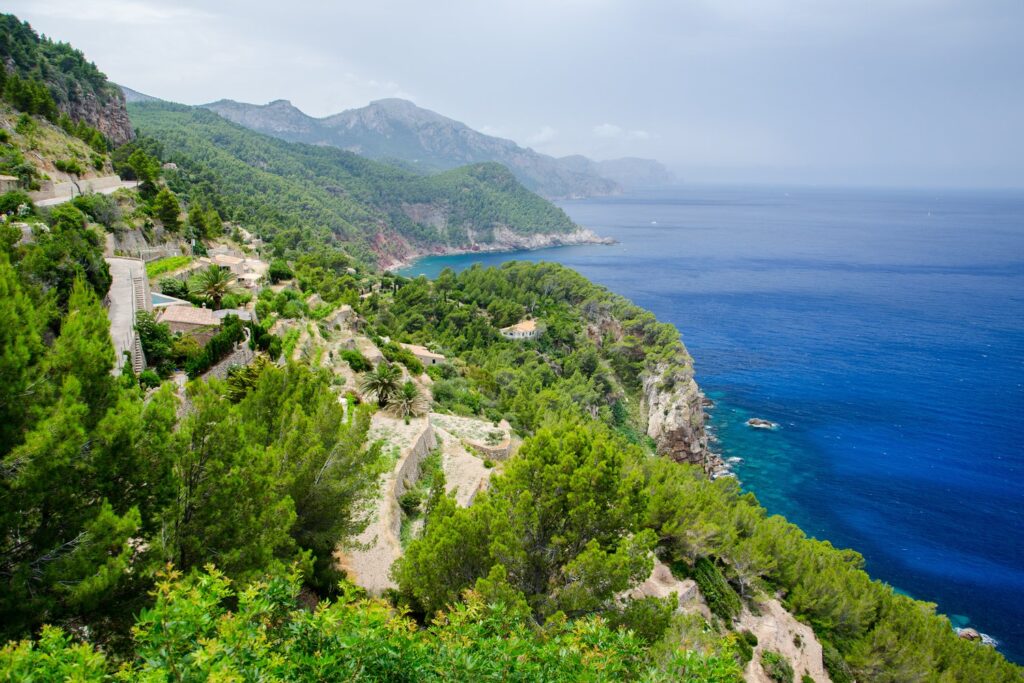
The Serra de Tramuntana is located on the north-western side of Mallorca, facing the open Mediterranean Sea. Its name comes from the tramontana, the cold northerly wind that blows in from the sea, and the mountains shelter the rest of the island from it. The range covers 20 municipalities, from Andratx to Pollença, and its protected natural area takes in 63,084 hectares, including a strip of coastline and sea.
When people search for Mallorca mountains, this is the range they mean. It’s a sheer-sided mountain range rather than a gentle one. On the north-western coast, cliffs drop straight into the water, with only a handful of hidden coves and small harbours where you can reach the sea. Inland, the landscape is covered in pine forests, holm oaks and olive trees, and the valleys are full of orange and lemon groves. It’s also the wettest part of the island, which is why the valleys stay green when the south is parched in August.
The Consell de Mallorca, the island’s council, looks after the main paths, the mountain refuges and much of the public land in the mountains. Its hiking pages are the best place to check route maps, refuge bookings and any temporary path closures before you go.
Why the Serra de Tramuntana is a UNESCO cultural landscape
UNESCO inscribed the Cultural Landscape of the Serra de Tramuntana on 27 June 2011. What earned it the title isn’t the scenery alone, but the way people have farmed this terrain for around a thousand years. With scarce resources and very little flat land, generations of farmers built agricultural terraces held up by dry stone walls. On those narrow steps they grew olives, vines and citrus fruit on slopes that would otherwise have washed away.
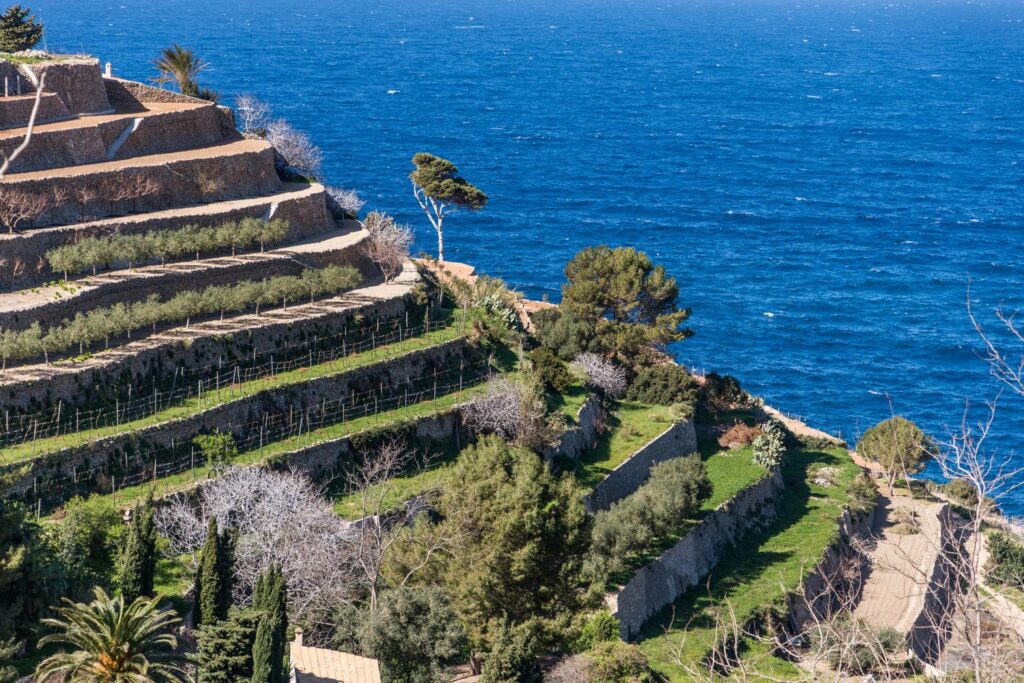
The other half of the story is water. Islamic-era settlers and the farmers who came after them created an articulated network of channels, cisterns, wells and water mills. These inter-connected water works carried water from mountain springs down to the fields, and many of the dry stone constructions still work today. You’ll walk past them on almost every trail, along with charcoal burners’ platforms, snow pits where ice was stored for the summer and the stone houses of old farms.
Many of those farms, called possessions, have a long history. Their feudal origins go back to the Christian conquest of 1229, when King James I divided the land among the nobles who had followed him. The farming units they created still shape the landscape. Some of them are now open to visitors, such as Son Marroig near Deià, the former home of Archduke Ludwig Salvator, the Austrian aristocrat who fell in love with this coast in the 19th century. For anyone with a cultural interest on the island, these estates are well worth a stop.
Puig Major and the highest peaks in the Tramuntana mountains
The highest peak in the range, and in the whole of the Balearic Islands, is Puig Major at 1,436 m (some older sources give 1,445 m). You can’t climb to the top, because the summit is a military zone crowned with radar domes. You’ll still get a good look at its grey bulk from the road between Sóller and Lluc.

The highest summit open to walkers is Puig de Massanella (1,364 m), usually climbed as a full-day hike from the Lluc area. Easier goals include Puig de l’Ofre, just over 1,090 m, with views over the Cuber and Gorg Blau reservoirs, and Puig des Teix (1,062 m) above Valldemossa, a climb of about four and a half hours. On a clear day each of these peaks gives you panoramic views over the island, the bay of Palma and the sea.
The most charming villages in the Serra de Tramuntana
The villages are the reason most people visit. Each one is built from the same honey-coloured stone, with green shutters, steep lanes and a church on the highest point. These are just some of the charming villages worth the detour, from the best known to the quietest.
Valldemossa
Valldemossa sits about 20 km from Palma and is the easiest mountain village to reach by bus. Its Carthusian monastery, the Real Cartuja, is where Frédéric Chopin and George Sand spent the winter of 1838-1839, and you can visit the cells they rented. Before you leave, try a coca de patata, a soft potato bun dusted with sugar that’s the local speciality. Arrive before 10am or after 4pm, because tour coaches fill the lanes in between.
Deià
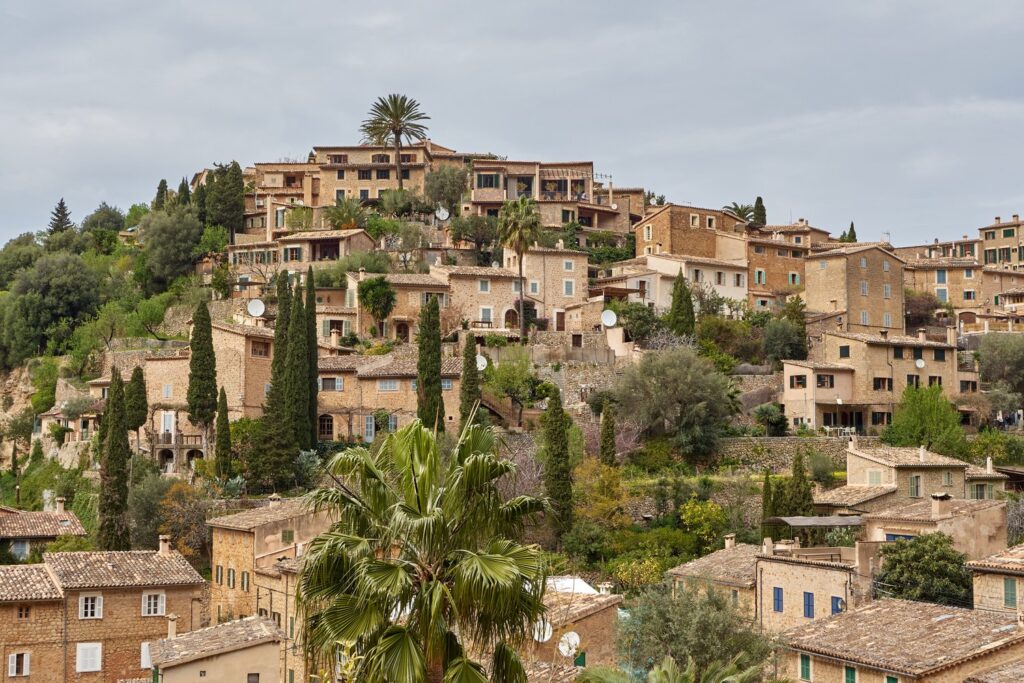
Deià is smaller and quieter, a cluster of stone houses on a hill below the Teix massif. The poet and novelist Robert Graves lived here on and off from 1929 until his death in 1985, and his house, Ca n’Alluny, is now a museum. A steep path leads down to Cala Deià, a rocky cove with two seafood restaurants and clear water for snorkelling. Just outside the village, the Son Marroig estate looks out over Sa Foradada, a rocky headland with a hole right through it.
Sóller and Port de Sóller
Sóller is a small market town lying in a deep valley of orange and lemon groves, often called the Valley of Gold. Its main square, Plaça de sa Constitució, is lined with cafés and watched over by the modernista facade of the church of Sant Bartomeu. From the square, a vintage tram rattles down to Port de Sóller, a horseshoe-shaped harbour with a palm-lined promenade, a sandy beach and boats to Sa Calobra.
Port de Sóller is one of the best bases in the mountains, and it works well for families too. The bay is calm, the beach shelves gently, and you can reach the villages by tram, bus or boat. Book your room early if you want to stay in July or August, because the port is small and fills up fast.
See available places to stay in Port de Sóller
Fornalutx and Biniaraix
Fornalutx, about 4 km above Sóller, is often described as one of the prettiest villages in Spain. There’s not much to do except wander the stepped lanes, admire the flower pots and sit in the little square, which is exactly the point. From the hamlet of Biniaraix nearby, an old stone path climbs through the Barranc de Biniaraix gorge. It’s one of the most beautiful short walks on the island and ends with views over the whole valley.
Banyalbufar, Estellencs and Sant Elm
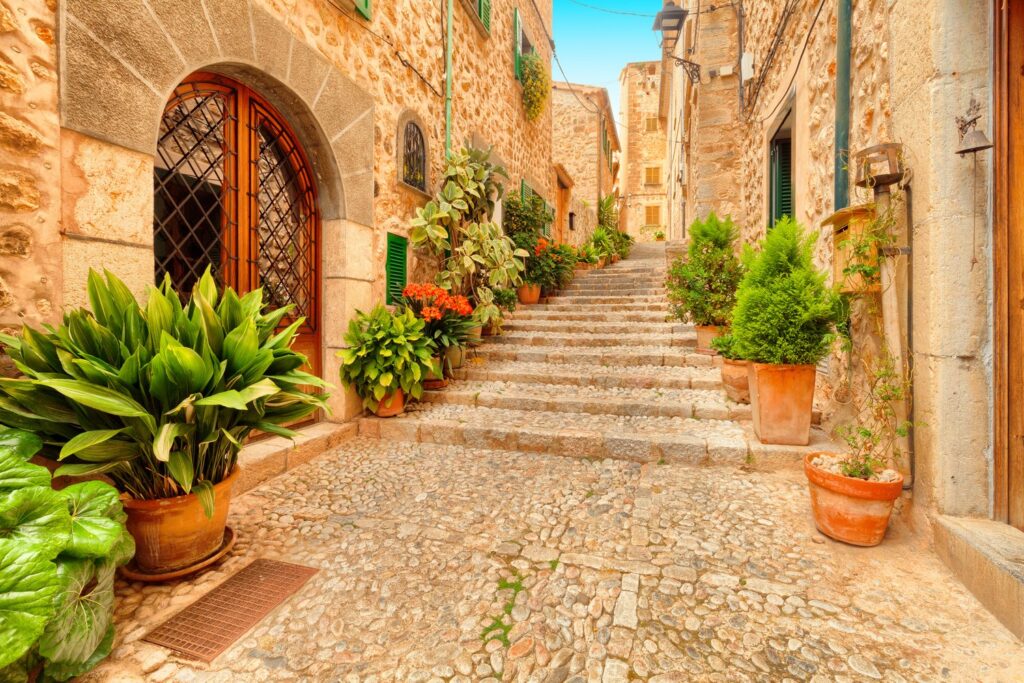
On the western stretch of the coast, Banyalbufar and Estellencs cling to terraces that drop almost to the sea. Banyalbufar’s terraces were once planted with Malvasia grapes, and local winemakers have revived the variety, so look for a bottle of Malvasia de Banyalbufar in village shops. Between the two villages, the Mirador de Ses Ànimes is an old watchtower with one of the classic views of the coast. Further south, Sant Elm is a small seaside village facing the island of Sa Dragonera, a nature park you can visit by boat.
Lluc Monastery and Pollença
In the heart of the mountains, Lluc Monastery is Mallorca‘s most important pilgrimage site. It’s home to a dark-faced statue of the Virgin, known as La Moreneta, and to a boys’ choir that has sung here for nearly 500 years. Lluc is also the main starting point for walks up Massanella and a good place to stop for lunch on a drive across the range.
At the north-eastern end of the range, Pollença has an old town with a Roman bridge, a lively Sunday market and the Calvari, a stairway of 365 steps lined with cypress trees. From the chapel at the top, you can look across the bay towards Alcúdia and the Formentor peninsula.
The Sóller train and tram - a classic day out
The Sóller train has been running between Palma and Sóller since 1912. Its wooden carriages climb through olive groves, pass through 13 tunnels and stop at a viewpoint above the Sóller valley before rolling into town after about an hour. In Sóller, you change to the tram, which takes you down to the port in around 20 minutes.
The train is aimed at visitors rather than commuters, so it can be busy in summer. A popular plan is to take the train one way and come back by bus or boat. You can also book a tour that combines the train, the tram and a boat trip along the cliffs. That way you’ll see the Serra de Tramuntana mountains from the rails, the road and the sea in a single day.
Sa Calobra and the Torrent de Pareis
Sa Calobra is a tiny cove at the mouth of the Torrent de Pareis, a gorge that cuts through the landscape for more than 3 km between walls up to 200 m high. A short path through two tunnels in the rock takes you from the car park to a pebbly beach at the mouth of the gorge. In the early morning, before the boats arrive, it’s one of the most dramatic spots in Mallorca.
The road down, the Ma-2141, is famous in its own right. It drops about 800 m in roughly 12 km of hairpin bends, including the Nus de sa Corbata, the “tie knot”, where the road loops under itself. If you’d rather not drive it, take a boat from Port de Sóller instead. The trip along the cliffs is half the fun, and you’ll see caves and waterfalls that you can’t spot from the road.
Walking the gorge itself is a serious undertaking. The Torrent de Pareis hike involves scrambling over boulders, takes around five to six hours and should never be attempted after rain or with young children. If you want to do it, go with a local guide who knows the route and checks the conditions on the day.
Driving the Ma-10 and Cap de Formentor
The Ma-10 is the main road through the mountains, running about 110 km from Andratx to Pollença along almost the entire mountain range. Its winding roads, tunnels and cliff-edge viewpoints with panoramic views make it one of the great drives in Spain. Take your time, though, because buses, cyclists and coaches all share the same narrow lanes. The section between Sóller and Lluc, past the Cuber and Gorg Blau reservoirs, is the most spectacular.

A car gives you the most freedom here, so car hire at Palma airport is worth considering if you want to see more than one or two villages. Plan a circular route with stops at the Mirador de Ses Ànimes near Banyalbufar, the Mirador de Ricardo Roca near Estellencs and the Sa Foradada viewpoint near Deià. Park only in marked spaces, because fines for parking on the verge are common in summer.
Beyond Pollença, the road continues to Cap de Formentor, the northernmost tip of the island. In 2026, from 15 May to 18 October, private cars were banned from the stretch between Formentor beach and the lighthouse between 10am and 10pm, and TIB bus 334 ran from Port de Pollença and Alcúdia instead. Expect similar rules every summer and check the dates before you set off.
Hiking in the Serra de Tramuntana
Hiking is the best way to discover these mountains, and the range has hundreds of kilometres of marked hiking routes. The main long-distance path is the GR221, the Ruta de Pedra en Sec or Dry Stone Route. The trail follows old mule tracks and cobbled paths for around 140 km, from Port d’Andratx to Pollença, and links a chain of mountain refuges run by the Consell de Mallorca, such as Can Boi in Deià, Muleta near Port de Sóller and Son Amer near Lluc. Most hikers walk the whole dry stone route in about a week, but you can easily pick one stage suitable for a day hike.
Shorter walking routes are just as rewarding. The Camí de s’Arxiduc above Valldemossa follows a ridge path built for Archduke Ludwig Salvator, with sea views all the way. The Camí des Correu, the old postal path between Banyalbufar and Esporles, is easy and mostly shaded. If you only have half a day, the circular route from Sóller to Fornalutx through the Barranc de Biniaraix is hard to beat.
Before you set off on any of the hiking routes, keep a few rules in mind. Spring and autumn are the best seasons, because in summer the rocky terrain is hot and exposed. Take at least two litres of water per person, as springs are rare. Phone signal is patchy, so download an offline map before you leave. Many paths cross private land and a fragile environment, so stay on the marked trail and close gates behind you.
If you’d rather not plan the logistics yourself, a guided hike from Palma with transport included takes the stress out of the day. Local guides also know which paths are open, which is useful after storms.
Nature and wildlife in the mountains
Mallorca is the only island in the Balearic Islands where black vultures breed, and the Serra de Tramuntana is their home. The black vulture is Europe’s largest bird of prey, and you may see one circling above the cliffs near Sa Calobra or Pollença. The mountains also shelter the Mallorcan midwife toad, a unique species found nowhere else in the world, which survives in a few mountain streams. Wild goats roam the higher ground, and booted eagles and ospreys hunt along the coast.
For a gentle taste of nature, the Cuber and Gorg Blau reservoirs make good picnic stops. The gardens of Alfàbia, near the southern entrance to the Sóller tunnel, are a cool and shady place to spend an hour on a hot day.
What to eat and drink in the Serra de Tramuntana
Food culture here is simple and seasonal. In Sóller, order freshly squeezed orange juice and orange ice cream made with fruit from the valley. Mallorca‘s olive oil, much of it grown on these terraces, has its own protected designation, Oli de Mallorca, and makes a great souvenir. Look out for sobrassada sausage, local cheeses, lamb, wild mushrooms in autumn and pa amb oli, bread rubbed with tomato and drizzled with oil, which turns up on almost every menu. In the mountain villages, look for arròs brut, a hearty rice dish with meat and vegetables.

How to get to the Serra de Tramuntana from Palma
From Palma, you have four options. The easiest is to drive: Valldemossa is about 25 minutes away and Sóller about 30 minutes through the tunnel. TIB buses also connect Palma with Valldemossa, Deià, Sóller and Port de Sóller, which is cheap, though buses fill up in summer. For the Sóller valley, the historic train is the most scenic public transport option.
The fourth option is a guided tour. A full-day tour from Palma usually combines the mountain road, a village stop, the Sóller train and lunch, so you don’t need to worry about parking or bus times. It’s a good choice if you don’t fancy driving the hairpins yourself.
When to visit and how many days you need
The best time to visit is from March to early June and from mid-September to November. Almond trees turn the landscape white and pink in February, wild flowers cover the terraces in spring, and autumn brings mild days that are perfect for walking. July and August are hot and busy, especially in Valldemossa and at Sa Calobra. Winter can bring rain, cold winds and even snow on the highest peaks.
Give yourself at least one full day in the region for a circular route by car: Palma, Valldemossa, Deià, Sóller and back through the tunnel. Two or three days let you add Sa Calobra, Lluc and a proper hike. With kids, keep it simple. The Sóller train and tram, an ice cream in the square and an afternoon on the beach at Port de Sóller make an easy family day.
Hotels in the Serra de Tramuntana
Staying in the mountains feels completely different from staying on the coast. Mornings are quiet, evenings are cooler, and you’ll have the villages to yourself once the day-trippers leave. These three hotels cover different budgets and different corners of the Serra de Tramuntana.
💰 Hostal Ca’n Tiu
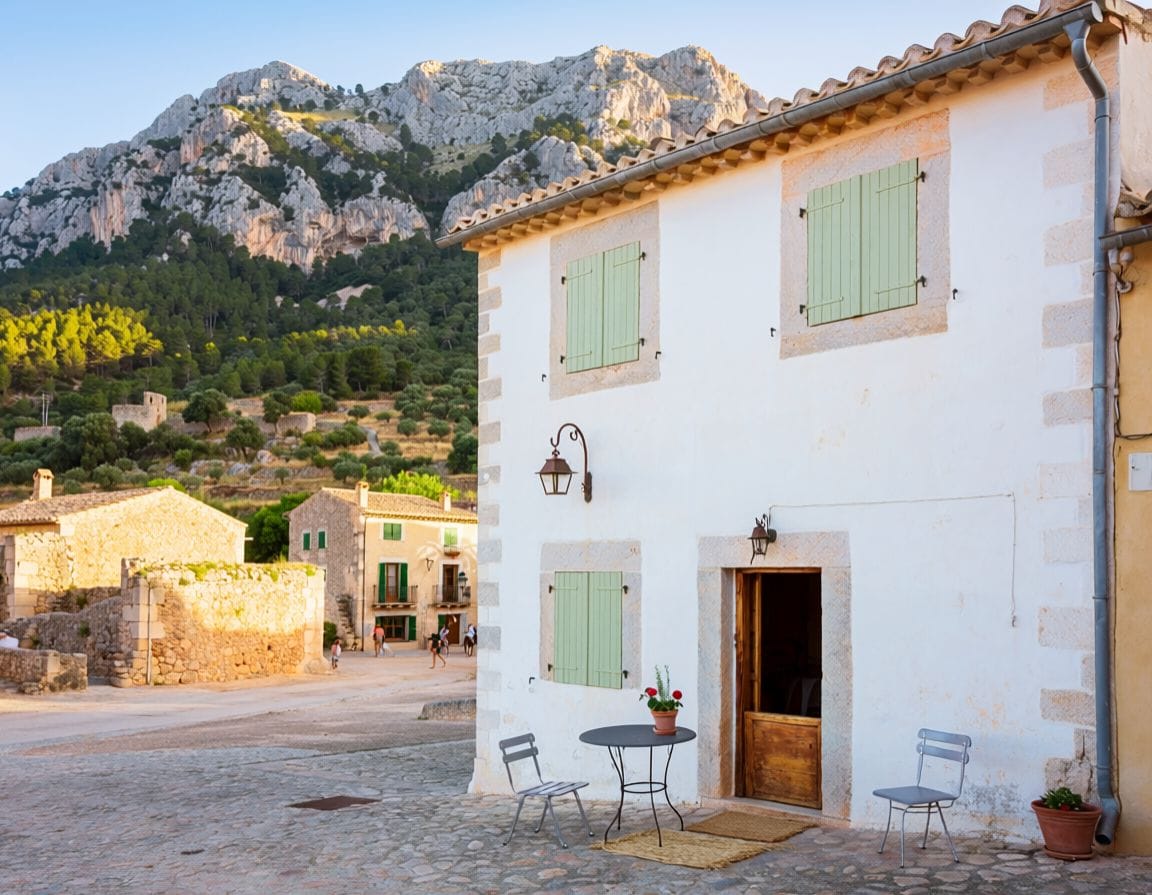
A simple, friendly guest house in the centre of Alaró, a village in the middle of the range, close to the main square. Rooms are bright and modern, with air conditioning and mountain views from some windows, and there are cafés and restaurants a few minutes’ walk away. It’s a good base for hikers who want to climb to the ruins of Castell d’Alaró. It also suits anyone who’d rather spend their budget on long lunches than on a hotel.
🏨 Ca’s Xorc - A Country Hideaway - Adults Only
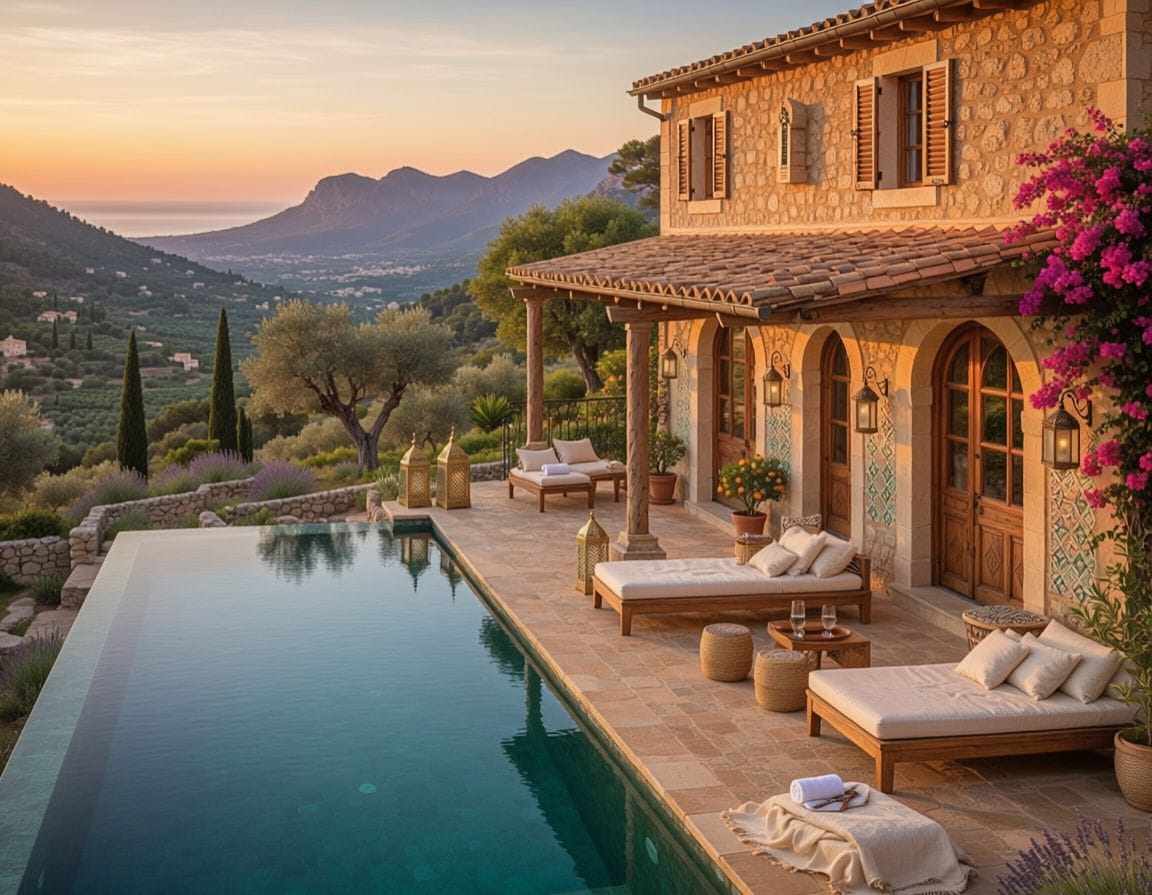
A rural hotel in a former olive mill on the hillside between Sóller and Deià, with views down the Sóller valley to the Mediterranean Sea. Its individually decorated rooms mix Mallorcan style with Moroccan touches, and there are terraced gardens, an infinity pool and a hot tub. The restaurant serves Mallorcan and Mediterranean dishes, outside on the terrace in good weather. Guests must be 16 or older, so it’s ideal for couples looking for peace and quiet.
💎 La Residencia, A Belmond Hotel, Mallorca
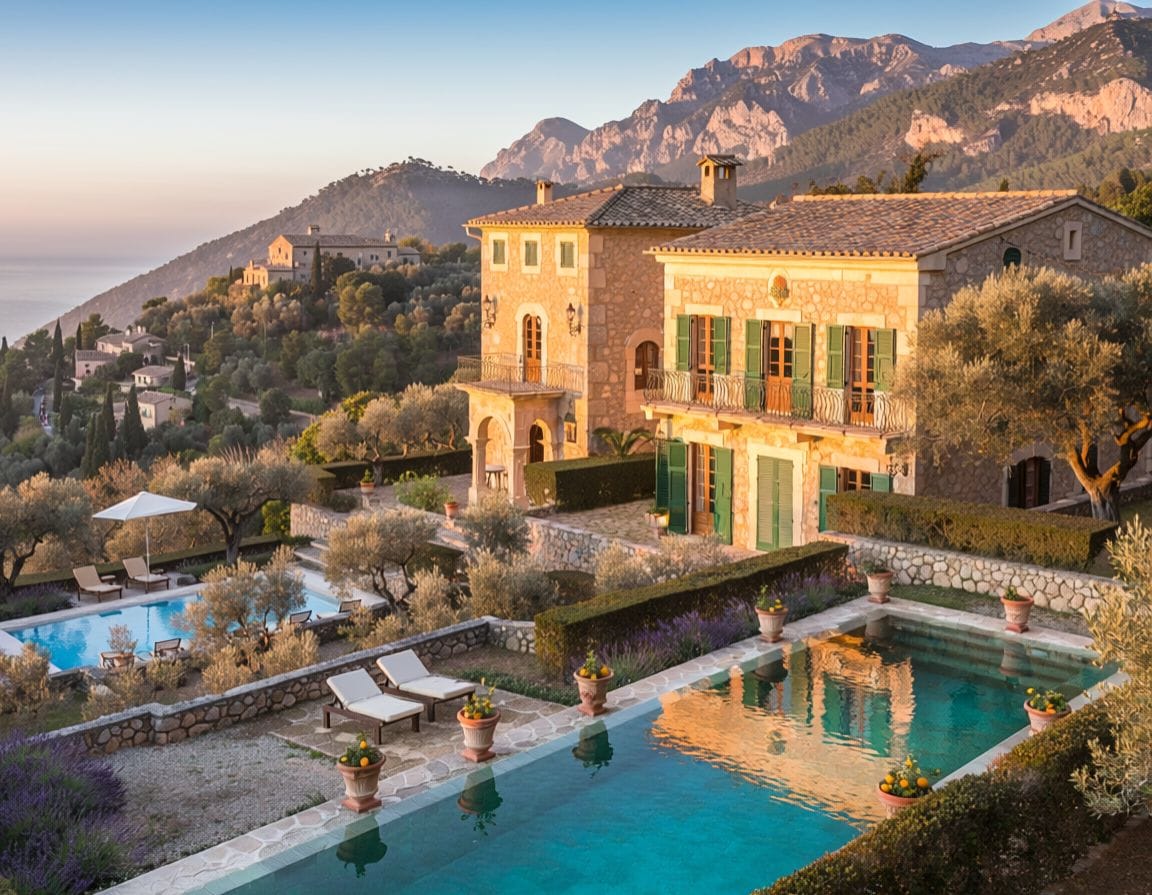
One of the most famous hotels on the island, set in two 16th-century manor houses on the edge of Deià. Its grounds are full of olive and cypress trees, with two outdoor pools, a spa, tennis courts and a permanent art collection with a sculpture garden. Dinner at El Olivo, the restaurant in a former olive press, is a highlight of any stay. Choose it for a special occasion, a honeymoon or a slow few days in the mountains.
Serra de Tramuntana FAQ
What are the mountains in Mallorca called?
The main mountains in Mallorca are the Serra de Tramuntana, which run along the north-west coast for about 90 km. There’s also a lower range in the east, the Serres de Llevant, but nothing else in the Balearic Islands comes close in height. When people talk about mountains in Mallorca, though, they almost always mean the Tramuntana.
Is it Serra or Sierra de Tramuntana?
Both are correct. Serra de Tramuntana is the Catalan name, used officially on the island and by UNESCO, while Sierra de Tramuntana is the Castilian Spanish version. English-language guides often simply say the Tramuntana mountains.
Can you visit the Serra de Tramuntana without a car?
Yes. TIB buses link Palma with Valldemossa, Deià, Sóller and Port de Sóller, and the historic train runs from Palma to Sóller. Sa Calobra is easiest to reach by boat from Port de Sóller. Without a car, a guided day tour is the simplest way to see several villages in one day.
What is the prettiest village in the Serra de Tramuntana?
Fornalutx is the village most often called the prettiest, thanks to its stepped lanes and stone houses. Deià and Valldemossa run it close, and many visitors find Deià’s setting between the mountains and the sea the most memorable.
How long does it take to hike the GR221?
The full Dry Stone Route covers around 140 km and takes most walkers about a week, sleeping in mountain refuges along the way. You can also walk single stages as day hikes, for example from Deià to Port de Sóller, which takes around three hours.
Is the Serra de Tramuntana good for families?
Yes, if you choose the right activities. The Sóller train and tram, short walks such as the Barranc de Biniaraix and a boat trip to Sa Calobra are all suitable for children. Leave the Torrent de Pareis gorge and long summit hikes until the kids are older.

